 Bellingham Roofing
 Decking That Actually Holds Up in Puget
Puget sits close enough to the water that homes here deal with a different set of conditions than decks built further inland. Salt-laden air moves in off the water, driving rain comes in sideways more often than straight down, and the shoulder seasons bring long stretches of damp, low-light weather that keeps everything outdoors wet for days at a time. A deck built without that in mind will show it within a few years — soft spots, surface checking, fastener corrosion, and a slow creep of moss and algae across every horizontal surface that doesn't dry out fast enough.
Composite decking, installed correctly, is one of the more sensible answers to that combination of problems. It doesn't mean "maintenance-free" in the way some marketing suggests, but it does mean a different set of maintenance tasks — and a much longer runway before those tasks turn into structural problems. This page is specifically about composite decking for Puget-area homes, not a general decking overview. The framing, drainage, and fastening choices that make sense here are shaped directly by what this stretch of Whatcom County throws at a deck year-round.
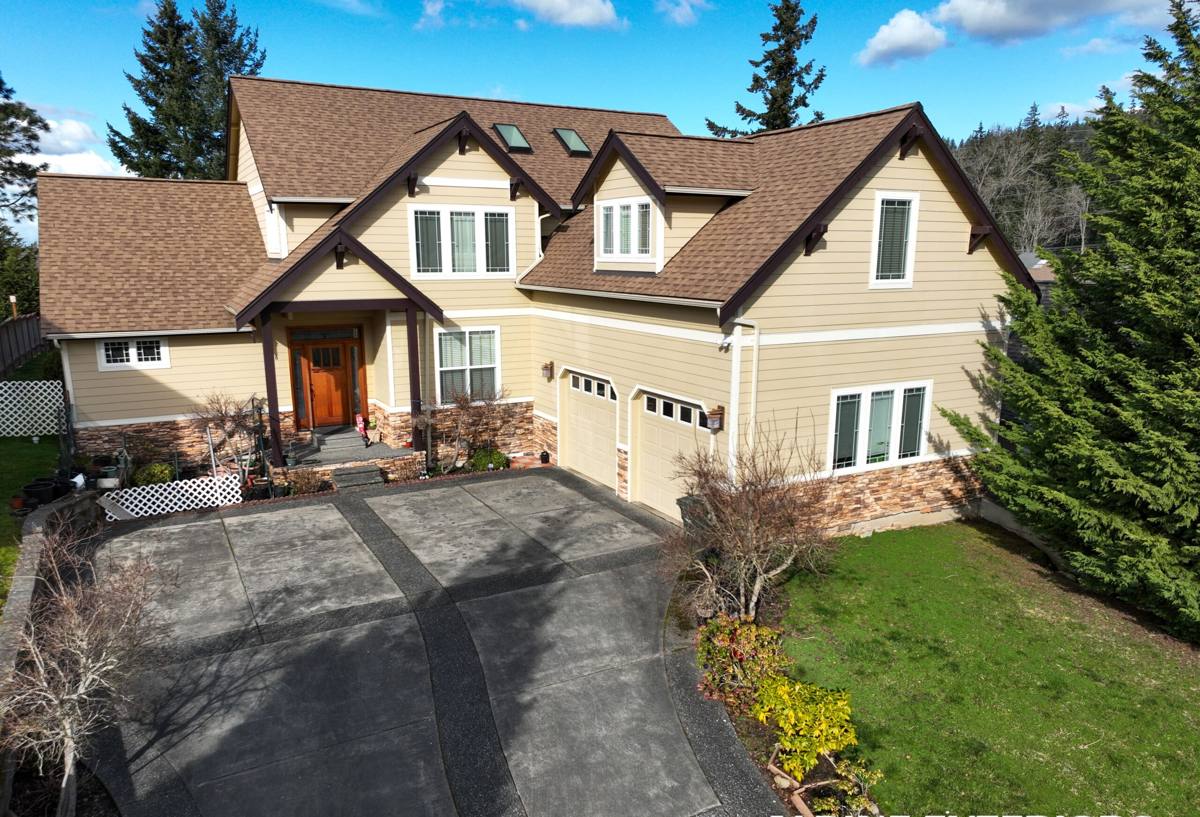
What Bellingham and Whatcom County Weather Does to a Deck
Salt Air and Metal Fatigue
Homes closer to the water pick up airborne salt that settles on every exposed surface, including the deck itself and anything metal underneath it. Standard fasteners and hidden clip systems that aren't rated for coastal exposure will corrode faster than the decking boards themselves, which is a common reason older composite decks fail at the connections long before the boards look worn.
Driving Rain and Poor Drainage
Rain in this part of Whatcom County doesn't always fall straight down. Wind-driven rain gets pushed under rail caps, into end-grain cuts, and along ledger connections where a lot of hidden rot starts. A deck surface can look dry on top while the framing underneath stays damp for days after a storm system passes through.
Moss, Algae, and Long Damp Stretches
Bellingham's long moss season isn't limited to roofs. Any deck surface that stays shaded, doesn't drain well, or traps organic debris in board grooves will grow moss and algae just as readily as a north-facing roof slope. On wood decking that means a slick, degrading surface. On composite decking it's mostly cosmetic if the boards are installed with proper airflow underneath — but installed wrong, moss and algae buildup can hold moisture against the board surface long enough to affect the finish over time.
Why Composite Makes Sense for This Climate
Composite decking is a mix of wood fiber and plastic, capped in most modern products with a protective outer shell. That cap layer is the part that matters most for Puget conditions — it resists moisture absorption, doesn't need refinishing, and holds up better against the freeze-thaw and wet-dry cycling that's routine here between fall and spring.
None of that removes the need for correct installation. Composite boards still expand and contract with temperature and moisture, still need proper gapping, and still rely on the framing underneath being built to shed water. A composite deck installed like a wood deck — tight-butted boards, no ventilation gap, fasteners not rated for the exposure — will develop the same problems a wood deck would, just more slowly.
Composite vs. Wood vs. PVC — Honest Trade-Offs for This Area
| Material | How it handles rain and salt air | Ongoing upkeep | Typical lifespan here |
|---|---|---|---|
| Pressure-treated wood | Absorbs moisture readily; needs sealing to resist salt air and rain intrusion | Annual cleaning, periodic sealing/staining | 10-15 years before major repair or replacement |
| Composite (capped) | Resists moisture absorption; surface doesn't need sealing | Periodic washing to clear moss/pollen/debris from grooves | 25-30+ years with correct install and airflow |
| PVC/cellular | Fully moisture-resistant surface, no organic fiber to hold water | Similar washing needs; can be more prone to surface scratching | Comparable to composite, higher material cost |
We install composite for most Puget-area homeowners because it strikes the right balance for this climate: strong moisture resistance without the premium cost of full PVC systems, and none of the annual sealing cycle that wood demands. Where a homeowner wants a specific look or budget that points toward wood or PVC instead, we'll say so honestly rather than push composite as a one-size-fits-all answer.
What a Correct Composite Deck Install Involves Here
Framing and Ledger Details
The framing underneath a composite deck matters as much as the boards on top, maybe more in a climate like this. We flash ledger boards properly against the house, use joist tape on framing members to keep fasteners from sitting in standing water, and set joist spacing to match the specific composite product's span rating rather than defaulting to old wood-deck spacing.
Ventilation Underneath the Boards
Airflow beneath a deck surface is what keeps moss and mildew from building up on the underside of boards and in the gaps between them. On lower decks or ground-level patios common in parts of Puget, we make sure skirting and perimeter detailing still allow air to move through rather than sealing the space up tight.
Fasteners and Hidden Clip Systems
Given the salt exposure in this area, we use fastener and hidden-fastener systems rated for coastal or marine-grade exposure, not the standard-grade hardware that's fine further inland. This is a small cost difference upfront that avoids a much bigger problem — corroded clips failing under the boards years down the line where they can't be inspected without pulling decking up.
Board Gapping and Expansion
Composite boards need consistent, correctly sized gaps for both drainage and thermal movement. Gaps that are too tight trap debris and moisture between boards; gaps that are too wide catch heels and small objects. We set gapping to the manufacturer's spec adjusted for the temperature at install time, since composite expands and contracts more than people expect.
Pre-Install Checklist We Actually Use
- Confirm ledger flashing and house-side water management before any framing goes up
- Verify joist spacing matches the specific composite product's span table
- Specify marine-grade or coastal-rated fasteners and clips
- Plan skirting and perimeter details that preserve underside airflow
- Set board gapping based on install-day temperature, not a flat default
- Walk the drainage path — where does water actually go once it leaves the deck surface
Repair, Replace, or Leave It — How We Sort That Out
Not every deck in Puget needs full replacement. If the framing is sound and dry, and only the surface boards have failed — usually old wood decking that's cupping, splintering, or rotting at fastener points — we can often reframe minimally and install new composite decking over solid bones. If the framing itself has soaked up years of driving rain at the ledger or joist ends, that's a different conversation, because composite boards on top of failing framing just hides the real problem.
We check this before quoting anything. That means pulling a few boards, checking joists and ledger connections for soft spots, and being straightforward if what looks like a simple resurfacing job is actually a framing repair first.
Living With a Composite Deck in This Climate
The upkeep on a composite deck near Puget is lighter than wood, but it isn't zero. A seasonal wash — plain water and a stiff brush, or a low-pressure rinse — clears pollen, moss spores, and organic debris out of the board grooves before it has a chance to establish. Homeowners who skip this for a few years in a row can end up with a green tinge in shaded areas that's more work to remove than it would have been to prevent.
Railings, fascia, and any trim pieces around the deck deserve the same attention as the decking itself. It's common for a homeowner to maintain the deck boards well while ignoring painted or unprotected trim nearby, which then becomes the weak point in the whole system.
Why a Crew That Already Works in This Area Matters
A lot of composite deck problems we get called to fix started with a crew that installed the product correctly by the manufacturer's general instructions, but didn't account for this specific stretch of coastline. Framing built to a generic spec instead of a salt-air spec, drainage details that work fine on a dry-side property but not here, fastener grades that are fine for an inland deck but not one that catches direct wind off the water — these are the differences between a deck that looks right for the first two years and one that's still solid at year twenty.
Working regularly in Bellingham and around Whatcom County means we're not guessing at how this climate treats a deck over time — we're seeing it on service calls and repair jobs, not just install day.
If you're weighing options for a deck in Puget — new build, replacement, or resurfacing over sound framing — we're glad to walk the site and give you a straightforward estimate. No pressure, no upsell script, just what your deck actually needs. The form below gets you a free estimate started.