 Bellingham Roofing
 If you're weighing a roof replacement in Bellingham, the metal-versus-shingle question comes up on almost every estimate we write. Both are legitimate, well-proven roofing materials. The right answer has less to do with which one is "better" in the abstract and more to do with your home's exposure, your roof's pitch and complexity, your budget horizon, and how much maintenance you're realistically willing to do. This page walks through the real trade-offs so you can make that call with clear eyes.
Why This Decision Matters More in Whatcom County
Roofing materials that perform fine in a dry inland climate get tested differently here. Bellingham sits close enough to the Salish Sea that salt-laden air reaches many neighborhoods, especially those west of I-5 and along the waterfront and Chuckanut corridor. Add in Western Washington's long wet season, driving rain off Bellingham Bay during winter storms, and a moss season that can run eight or nine months out of the year in shaded, tree-covered lots, and you've got a climate that punishes weak flashing details, poor ventilation, and materials that hold moisture.
Neither metal nor asphalt shingles are immune to these conditions. Both can perform very well here for decades. Both can also fail early if installed poorly or matched to the wrong roof. The material matters less than the installation quality and the fit to your specific site.
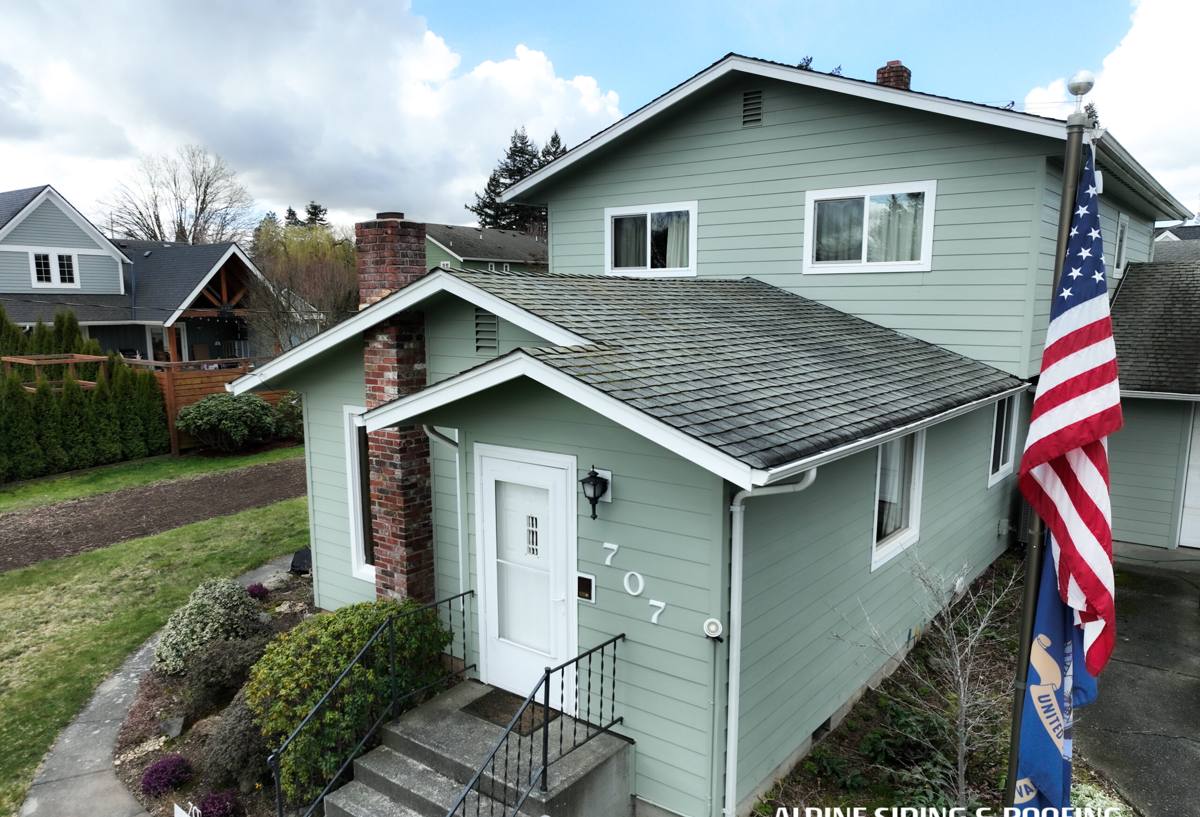
How Metal and Shingle Roofs Actually Compare
Here's a straightforward side-by-side of the factors that matter most for a Whatcom County home.
| Factor | Metal Roofing | Asphalt Shingles |
|---|---|---|
| Typical lifespan | 40-60+ years with proper coating and fasteners | 20-30 years for architectural shingles, less on steep sun/rain exposure |
| Upfront cost | Higher material and labor cost per square | Lower upfront cost, most budget-friendly option |
| Moss and algae resistance | Sheds moss readily; little organic material for spores to grip | Moss and moss-stain algae can take hold, especially on north-facing or shaded slopes |
| Rain and wind performance | Excellent when panels and flashing are properly lapped and sealed | Very good when nailed correctly at the right exposure for our wind zone |
| Salt air exposure | Coating and fastener quality matter a lot near the water | Generally unaffected by salt air itself |
| Noise in heavy rain | Noticeable without solid decking and underlayment | Quieter by nature |
| Repairability | Panel replacement possible but can be harder to color-match over time | Individual shingles are easy to patch and blend |
| Roof weight | Lighter than shingles, less structural load | Heavier, occasionally a factor on older framing |
Metal Roofing: What Holds Up Well Here, and What to Watch
Where metal earns its cost
A quality metal roof — standing seam or a well-fastened exposed-fastener panel system — sheds our winter rain fast and doesn't give moss much to grab onto. Steep and moderately pitched roofs in Bellingham's wetter, tree-shaded neighborhoods often do very well under metal because water and debris move off quickly rather than sitting against granules the way they can on shingles.
Metal also holds up well against wind-driven rain if the panel laps, ridge caps, and valley flashing are detailed correctly. That last point is worth repeating: metal roofing performance is almost entirely dependent on installation quality. A well-installed metal roof on an average steel or aluminum system will comfortably outlast two or three shingle roofing cycles. A poorly installed one can leak at the first hard nor'easter off the bay.
What to watch with metal near the water
Salt air is the wildcard for coastal and near-waterfront Bellingham properties. Not all metal roofing products handle salt exposure the same way — coating quality, fastener metal, and panel gauge all factor in. This is a conversation to have directly with your contractor about your specific address and exposure rather than assuming any metal roof will perform identically a half-mile from the water versus five miles inland.
Metal roofs are also louder in heavy rain unless installed over solid decking with a proper underlayment and, ideally, an acoustic layer — something worth budgeting for if you have living space directly under the roof deck.
Asphalt Shingles: Still a Solid, Practical Choice
Where shingles make sense
Modern architectural (dimensional) asphalt shingles are a mature, well-understood product with decades of real-world performance data behind them, including in wet Pacific Northwest climates. They're more budget-friendly upfront, easier to repair in sections, and widely available, which keeps material and labor costs predictable. For roofs with simpler geometry and good sun exposure — fewer valleys, less shading from mature trees — shingles can perform reliably for their full rated lifespan.
What shingles need in our climate to last
The two things that shorten shingle life fastest here are trapped moisture and moss. Proper attic and roof deck ventilation prevents the underside condensation that rots decking and shortens shingle life from below. On the topside, shaded and north-facing slopes need real airflow and, in many cases, a genuinely moss-resistant shingle or zinc/copper strip treatment near the ridge to slow regrowth. Skip either of these and you'll be dealing with premature granule loss, soft spots, and moss creep well before the shingle's rated lifespan is up.
Moss, Salt Air, and Driving Rain: Matching the Roof to the Site
Rather than treating "metal vs. shingles" as a universal question, it helps to look at your specific lot:
- Heavily shaded lot with mature conifers: Metal's smooth surface and steep-shed performance generally reduces moss buildup better than shingles, though neither is maintenance-free.
- Waterfront or near-waterfront property: Ask specifically about coating and fastener specs for salt exposure, regardless of which material you choose.
- Open, sunnier lot with good airflow: Either material can perform well; the decision comes down more to budget and how long you plan to own the home.
- Steep, complex roofline with multiple valleys: Flashing detail quality matters more than material choice — a poorly flashed valley leaks under either roofing type.
- Living space directly under the roof deck: Factor in acoustic underlayment if going with metal.
Cost Factors Beyond the Sticker Price
The upfront quote is only part of the real cost comparison. Consider these when you're pricing options:
| Cost Factor | Metal | Shingles |
|---|---|---|
| Install labor | Higher — specialized crews and tooling | Lower — widely available skilled labor |
| Expected replacement cycles over 50 years | Typically one install | Typically two, sometimes three |
| Annual moss/debris maintenance | Lower, but not zero | Higher, especially on shaded slopes |
| Insurance considerations | Some carriers offer discounts for impact/fire-resistant metal roofing | Varies by insurer and shingle class |
| Resale perception | Increasingly valued by buyers, especially longevity-focused ones | Familiar and expected in most neighborhoods |
If you're planning to stay in the home for decades, metal's higher upfront cost often evens out or comes out ahead once you account for avoiding a second full re-roof. If you're renovating for near-term resale or working with a tighter budget, shingles remain a sound, honest choice.
Ventilation and Underlayment: The Part Both Roofs Depend On
Whichever material you choose, the underlayment and ventilation system underneath it does as much work as the visible surface. In a climate with this much annual rainfall, a quality synthetic or self-adhered underlayment at eaves, valleys, and penetrations is not optional — it's the backup plan for the inevitable wind-driven rain event. Balanced intake and exhaust ventilation keeps the roof deck dry from the inside, which protects both metal fastener integrity and shingle granule life. We treat this layer as being just as important as the material decision itself, and any estimate you get should spell out exactly what's going underneath.
A Practical Checklist Before You Decide
- How long do you plan to own the home — one roofing cycle or two-plus?
- How shaded is your roof, and how bad has moss been historically?
- Is your property within a mile or two of saltwater exposure?
- What's your roof pitch and how many valleys or penetrations does it have?
- Do you have living space directly beneath the roof deck where rain noise would matter?
- What's your realistic maintenance appetite — annual moss treatment and gutter clearing, or as-little-as-possible?
- Does your upfront budget allow for metal, or does the project timeline favor shingles now with a future upgrade later?
Our Honest Take
We install and stand behind both metal and asphalt shingle roofing, and we don't push customers toward the higher-margin option. What we do insist on is matching the material to the actual site conditions and getting the flashing, underlayment, and ventilation right — because in Bellingham's climate, those details determine whether a roof lasts its full rated life or starts causing problems in year eight. A roof that's wrong for its site will disappoint you regardless of brand or material.
If you'd like a straight answer for your specific home, we're happy to walk the roof, look at your exposure and shading, and put together a free, no-pressure estimate comparing both options with real numbers for your property.