 Bellingham Roofing
 Why Ferndale Decks Wear Out Faster Than People Expect
Ferndale sits close enough to the water and the Nooksack River lowlands that homes here deal with a specific combination of weather most decking products were never designed around: salt-tinged marine air, long stretches of driving rain, and a moss season that can run from October well into spring. Any one of those on its own is manageable. Together, they're why we see so many wood decks in this part of Whatcom County showing soft spots, graying finish, and slick green film within just a few years of being built.
Salt air speeds up corrosion on fasteners and hardware, even at a few miles inland. Driving rain doesn't just wet the surface of a deck — wind-driven moisture gets pushed sideways into end grain, fastener holes, and the gaps between boards, which is where wood decking actually rots from. And moss doesn't just sit on top of a deck looking bad; its root structure holds moisture against the board surface, which keeps wood damp for days longer than open air alone would.
Composite decking doesn't eliminate the climate — nothing does — but it changes how a deck responds to it. That's the real case for composite in Ferndale: not that it looks nice, but that it's engineered for exactly this kind of weather.
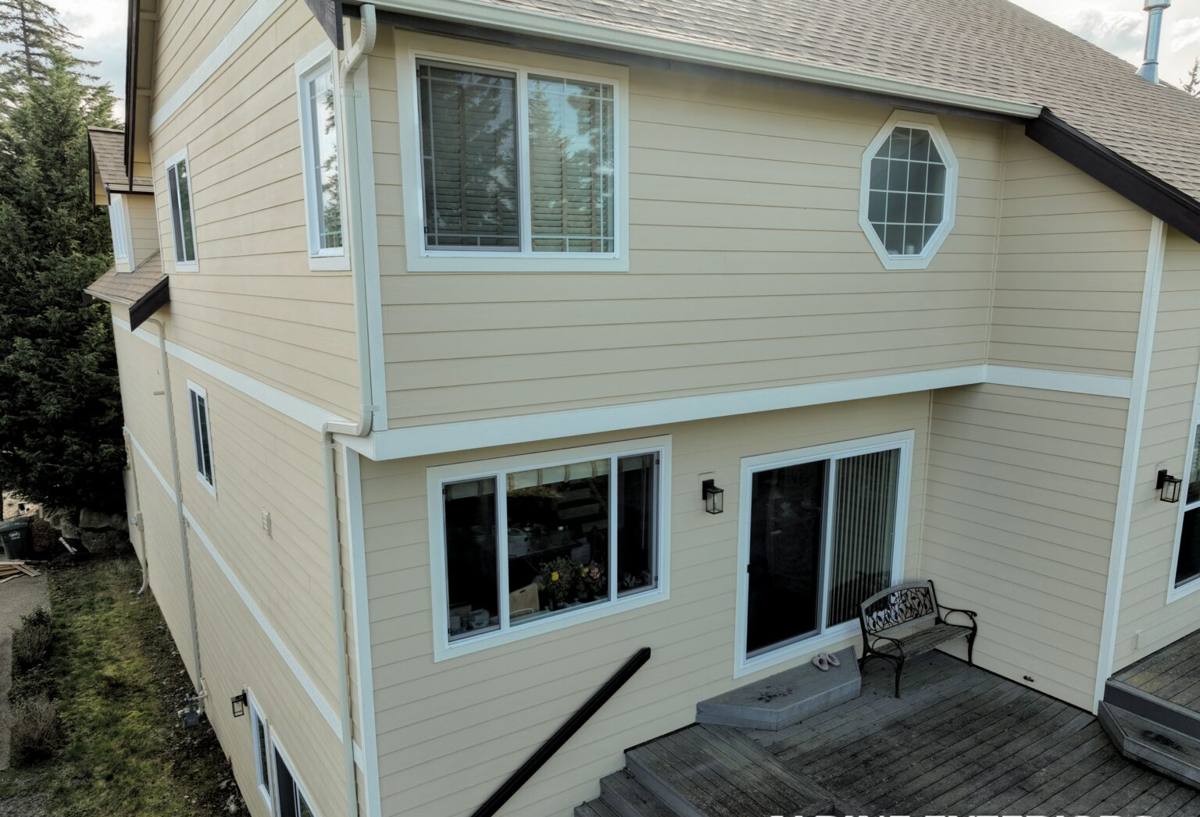
What Composite Decking Solves for This Climate Specifically
Moisture Resistance Where It Matters
Composite boards are made from a blend of wood fiber and plastic polymer, which means they don't absorb water the way solid wood does. They won't swell, cup, or crack from repeated wetting and drying cycles the way a wood deck board will after its second or third wet Whatcom County winter. That matters most at board ends and around fasteners — the exact spots where wind-driven rain gets pushed into a deck surface.
No Annual Refinishing
Wood decking in this climate needs to be cleaned, brightened, and resealed on a fairly tight schedule, or the finish fails and moisture gets underneath it — which is worse than having no finish at all. Composite doesn't need staining or sealing. The color is built into the board, not applied to the surface, so there's no coating to fail.
Better Behavior Around Moss and Algae
Moss and algae still land on composite decking — nothing stops organic growth from settling on any outdoor surface in this region — but composite doesn't give it the same foothold. Solid wood has open grain that moss can root into; composite's denser, capped surface is easier to clean off before it becomes a slip hazard, and it doesn't stain the way bare wood does once you scrub it away.
Composite vs. Other Decking Materials, Honestly
We install what makes sense for the home and the budget, but here's how the common options actually compare for a wet, coastal-influenced climate like Ferndale's:
| Material | Upfront Cost | Maintenance in This Climate | Typical Lifespan Here |
|---|---|---|---|
| Pressure-treated wood | Lowest | Annual cleaning and refinishing to keep moisture out | 10-15 years before major repair or replacement |
| Cedar | Moderate | Regular sealing; prone to graying and softening without it | 12-18 years with consistent upkeep |
| Composite | Moderate-High | Periodic washing; no staining or sealing | 25-30+ years, backed by manufacturer warranty |
| PVC/capped polymer | Highest | Lowest of all options; fully synthetic | 30+ years, but less traditional appearance |
Composite lands in the middle for most Ferndale homeowners: it costs more up front than wood, but it doesn't carry the recurring maintenance bill that wood does, and it holds up to this specific climate better than either wood option without moving all the way to a fully synthetic look.
What a Correctly Installed Composite Deck Actually Involves
The Substructure Matters As Much As the Boards
A lot of composite deck problems we get called out to inspect aren't failures of the decking material at all — they're failures in the framing underneath it. Composite boards are heavier than wood and behave differently under load and thermal movement, so joist spacing, blocking, and fastener type all need to match the manufacturer's engineering specs, not generic deck-building habits carried over from a wood installation.
Flashing and Ledger Attachment
Where a deck attaches to the house, proper ledger flashing is what keeps driving rain from working its way behind the board and into the wall assembly. This is one of the most common shortcuts we see in older or DIY deck work in this region, and it's also one of the most expensive to fix later, since the damage happens out of sight.
Drainage and Airflow Underneath
A deck that traps standing water or stagnant air underneath it stays wet longer after every rain, which encourages rot in the framing and moss growth on the underside of the boards. Correct grading beneath the deck, proper joist tape, and enough clearance for airflow are what keep the substructure dry through a wet Whatcom County winter.
Fastening for a Wet, Salt-Influenced Climate
We use corrosion-resistant, hidden fastening systems rated for coastal exposure rather than standard exterior screws. It's a small material cost difference that has a large effect on how the deck looks and performs a decade in — visible fastener corrosion staining is one of the most common complaints we hear about older deck work in this area.
Our Process for a Ferndale Composite Deck
Every property is a little different, but the process we follow stays consistent:
- Site assessment — we look at drainage, sun and wind exposure, existing framing condition, and how the deck ties into the house.
- Design and product selection — board profile, color, and railing options matched to the home and budget, with real talk about trade-offs rather than upselling.
- Permitting — most deck projects in Whatcom County and the City of Ferndale require a permit depending on size and height; we handle that paperwork rather than leaving it for the homeowner to sort out.
- Framing and structural work — built or reinforced to composite manufacturer specs, with attention to flashing, drainage, and fastener corrosion resistance.
- Decking installation — hidden fastening, proper board spacing for expansion, and clean end-cuts sealed per manufacturer requirements.
- Final walkthrough — we go over care basics with the homeowner before we consider the job done.
Living With a Composite Deck Here: Realistic Maintenance
Composite decking is low-maintenance, not no-maintenance. In a climate with this much rain and moss pressure, a few basic habits go a long way toward getting the full lifespan out of the material:
- Sweep off leaves, needles, and organic debris regularly — trapped moisture under debris is what feeds moss and mildew growth on any deck surface.
- Wash the deck once or twice a year with a soft-bristle brush and a cleaner made for composite material — pressure washers can damage the surface texture if used incorrectly.
- Keep gutters and downspouts near the deck clear so runoff isn't dumping extra water directly onto or under the deck surface.
- Check railing posts and stair connections once a year for movement, since these fasten into framing that can shift slightly with seasonal moisture changes.
- Address any moss or algae film promptly — it's easier to remove when it's a light coating than after a full wet season of growth.
Choosing a Composite Product That Fits the Home
Not every composite board is built the same way, and the differences matter more in a wet climate than a dry one. Fully capped boards — where the polymer shell wraps the entire board, not just the top surface — resist moisture intrusion at cut ends and fastener holes better than boards with only a partial cap. Warranty structure is also worth reading closely: some manufacturer warranties cover material defects but exclude staining, fading, or mold growth, which are the exact issues a wet, low-light climate is most likely to produce. We walk homeowners through these differences during design rather than assuming one brand fits every project.
Why a Crew That Already Works in Ferndale Makes a Difference
Deck-building fundamentals don't change from region to region, but the details that determine whether a deck holds up do. A crew that already works in Ferndale and the surrounding Whatcom County area knows how far salt-influenced air actually reaches inland here, how local permitting offices handle deck submittals, and which framing and flashing details actually get tested by a full Pacific Northwest wet season rather than just a summer inspection. That local track record is the difference between a deck that looks right on installation day and one that still looks right five wet winters later.
If you're weighing composite decking for a Ferndale home, we're glad to take a look at the site, talk through material options honestly, and put together a straightforward estimate — no pressure, no upsell. Use the form below to get started.