 Bellingham Roofing
 Why Puget-Area Homes Need Siding Built for This Climate
Homes in the Puget area near Bellingham sit in a tougher weather pattern than most homeowners realize until their siding starts failing. You've got salt-laden air moving in off the water, wind-driven rain that gets pushed sideways into wall assemblies rather than falling straight down, and a moss and algae season that in Whatcom County can run most of the year on shaded or north-facing walls. Any one of those conditions is manageable. All three together, applied to a house year after year, is what separates siding that lasts three decades from siding that needs attention after five or six years.
This page is about one thing specifically: what it takes to install fiber cement siding correctly on a Puget-area home, and why that's different from a generic siding job description you'd find anywhere else in the country.
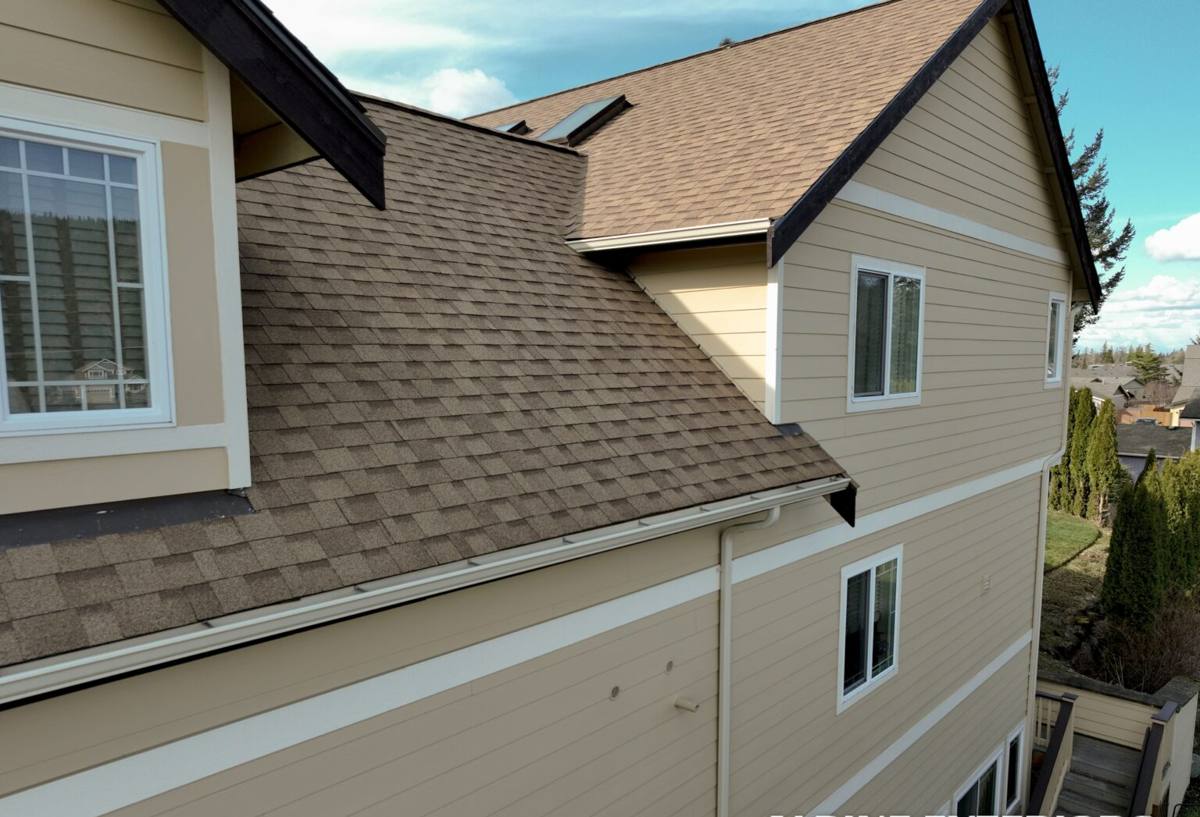
What Salt Air and Driving Rain Actually Do to Siding
Salt air is corrosive to exposed metal — fasteners, flashing, trim caps — and it accelerates the breakdown of finishes that aren't formulated to resist it. On lower-quality or improperly finished siding products, you'll see chalking, fading, and surface degradation happen faster near the water than it would twenty miles inland.
Driving rain is a different problem. It's not about how much rain falls — it's about direction and pressure. When wind pushes rain horizontally against a wall, water gets forced into every gap, seam, and fastener penetration that a calm-weather installation might get away with ignoring. That's why drainage details behind the siding matter as much as the siding material itself in this climate. A product that resists water intrusion but is installed without a proper drainage plane will still let moisture get trapped against the sheathing.
Moss and algae growth is the visible symptom most homeowners notice first, but it's really a moisture indicator. Where you see persistent green or black staining, especially on north- and west-facing walls or under tree canopy, that's a wall assembly holding onto moisture longer than it should. Left alone, that moisture cycle is what leads to substrate rot behind whatever siding is up there.
Why We Only Install James Hardie Fiber Cement
We install James Hardie fiber cement exclusively — not vinyl, not LP SmartSide, not Cemplank, Allura, primed spruce, or cedar. That's a deliberate standard, not a brand preference for its own sake.
Fiber cement is dimensionally stable in a way wood-based and engineered-wood siding products aren't. It doesn't swell, cup, or delaminate the way OSB-based products can when they take on repeated moisture exposure, and it doesn't expand and contract with temperature swings the way vinyl does. James Hardie's HZ product line is specifically engineered for climate zones like ours, factoring in moisture exposure rather than just UV and temperature. The ColorPlus factory finish is baked on under controlled conditions, which gives it better resistance to fading and to the kind of surface staining that shows up as moss and mildew streaking on lesser finishes. It's also non-combustible, which matters more each wildfire season even here on the wet side of the state.
None of that means fiber cement is maintenance-free or install-proof. It means the material itself is well suited to this climate — but only if the installation behind it is done right, which is the part most homeowners never see.
What a Correct Installation Involves in a Driving-Rain Climate
Drainage Plane and Rainscreen Gap
In a climate with sustained wind-driven rain, siding should never be fastened flat against the weather-resistive barrier with no space behind it. A rainscreen gap — even a modest one created with furring strips or a drainage wrap — gives any water that does get past the siding a path to drain and dry out instead of sitting against the sheathing. This is one of the most commonly skipped details on lower-bid siding jobs because it adds labor and material cost, and it's also one of the details that matters most in this specific climate.
Flashing and Kick-Out Details
Every horizontal transition — window and door heads, roof-to-wall intersections, deck ledgers — needs flashing that actually directs water outward and down, not just a bead of caulk hoping to hold. Kick-out flashing where a roofline meets a sidewall is a small detail that prevents a large, expensive problem: water running down behind the siding at that exact junction is one of the most common sources of hidden rot we find on older homes in wetter parts of Whatcom County.
Fastening, Clearances, and Caulk Joints
James Hardie specifies fastener type, spacing, and penetration depth for a reason — get it wrong and you create thousands of tiny entry points for moisture, or you crack the board over time. Ground clearance and roof clearance also matter more here than in a drier climate, since splashback and moss-holding debris both accelerate the moisture cycle at the bottom courses of siding. And caulk joints should be treated as a maintenance item from day one, not a "set it and forget it" seal — even the best sealants have a service life, and salt air shortens it.
Our Process for a Puget-Area Siding Project
- On-site inspection: We look at the existing siding, the condition of the sheathing underneath where accessible, moss and staining patterns, and problem areas like roof-to-wall transitions before quoting anything.
- Product and color selection: We walk through the relevant James Hardie HZ line and ColorPlus options suited to the exposure your specific walls get — a west-facing wall catching driving rain off the water gets treated differently in the plan than a sheltered, shaded wall prone to moss.
- Tear-off and substrate check: Old siding comes off and we inspect sheathing before anything new goes up. This is the point where hidden moisture damage, if any exists, gets found and addressed rather than covered over.
- Weather barrier and drainage plane: House wrap or building paper goes on correctly lapped, with a drainage gap installed behind the siding field.
- Flashing details first: Windows, doors, and roof intersections get flashed before siding closes in around them — not caulked after the fact.
- Installation to spec: Fastener pattern, clearances, and joint treatment follow James Hardie's published requirements for our climate zone, which is also what keeps the manufacturer's warranty intact.
- Final walkthrough: We go over the finished work with you, including what routine maintenance to expect given your specific exposure.
Fiber Cement vs. Other Siding Materials in This Climate
| Factor | James Hardie Fiber Cement | Vinyl | Wood / LP SmartSide |
|---|---|---|---|
| Salt air / coastal exposure | Engineered finish resists fading and staining | Can chalk and become brittle over time | Finish and substrate both vulnerable without diligent upkeep |
| Driving rain resistance | Stable when installed with proper drainage plane | Panels can be pushed by wind-driven rain at laps | Wood-based substrate absorbs moisture if seals fail |
| Moss/algae staining | Factory finish resists surface staining better | Can stain and is difficult to fully clean | Prone to staining and, over time, surface breakdown |
| Dimensional stability | Does not swell, cup, or expand/contract significantly | Expands and contracts with temperature | Can swell or delaminate with repeated moisture cycling |
| Fire resistance | Non-combustible | Combustible | Combustible |
Living with Moss Season: Maintenance That Actually Matters
No siding material in Whatcom County is maintenance-free, including fiber cement. The difference is that correctly installed James Hardie siding gives you a surface that's far easier to keep clean and far less forgiving of neglect than the alternatives. A short list of what actually moves the needle:
- Rinse siding (especially shaded and north-facing walls) once or twice a year to keep moss and algae from establishing rather than trying to remove it after it's set in
- Keep gutters clear so overflow isn't running down the wall and feeding moss growth at the top courses
- Trim back vegetation and tree limbs that keep siding shaded and damp longer than the rest of the house
- Inspect caulk joints around windows, doors, and trim annually — this is the first thing to fail, well before the siding material itself
- Walk the ground-level clearance line and clear mulch, soil, or debris that's built up against the bottom courses
- Address any bare or chipped touch-up spots quickly rather than letting exposed edges sit through a wet season
Why a Crew That Already Works Puget Matters
A siding crew that only works inland or in drier parts of the state doesn't have daily, hands-on experience with how driving rain and salt air actually behave against a wall assembly — which details get skipped on a generic job and which ones can't be. Working regularly in and around Bellingham and Whatcom County means knowing which orientations on a given lot tend to hold moisture, which flashing details fail first in this specific weather pattern, and what a house here actually needs versus what a national installation manual assumes as a baseline. It also means being available for warranty follow-up and maintenance conversations after the install, not just during the sale.
Get a Straightforward Look at Your Siding
If your Puget-area home has moss staining that keeps coming back, siding that's starting to show its age, or you're just planning ahead for a replacement, we're happy to take a look and give you a straightforward, no-pressure estimate. Use the form below to get started.