 Bellingham Roofing
 Metal Roofing on Birch Bay's Open Shoreline
Birch Bay sits right on the water along Whatcom County's coastline, and homes there catch weather that homes even a few miles inland don't see the same way. Wide open exposure to the bay means wind-driven rain hits roofs at angles a standard install spec doesn't always account for, salt-laden air works on every exposed metal component year-round, and a moss season that runs long on this side of the state keeps organic growth and trapped moisture in play for most of the year. Metal roofing has become a popular answer to that exposure, and for good reason — it handles wind and moisture better than most roofing materials when it's installed correctly. The qualifier matters. A metal roof that's cut corners at the fastener spec, the flashing details, or the panel seams will show it faster in Birch Bay than it would on a sheltered inland lot, because there's simply more weather working against it here.
This page covers what a metal roof needs to hold up on a Birch Bay home specifically — not a generic rundown of metal roofing in general.
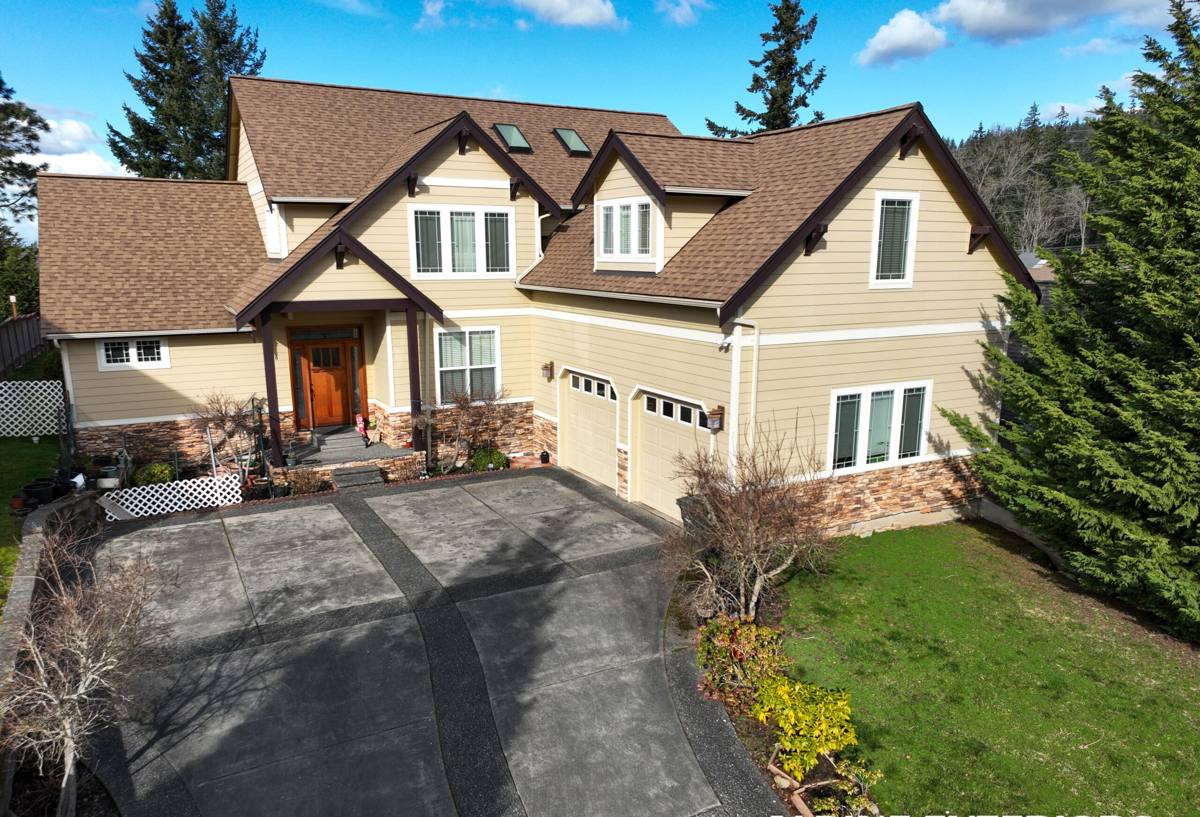
What Birch Bay's Climate Does to a Metal Roof
Salt Air and Fastener Corrosion
Steady salt exposure off the bay is hard on any exposed metal, and a metal roof has more exposed metal than almost any other roofing system — every panel, every fastener, every piece of trim and flashing is out in that air continuously. Fasteners are usually the first weak point. A screw with the wrong coating, or steel hardware paired with the wrong panel metal, corrodes faster in this kind of air than it would fifty miles inland, and a corroded fastener head is where water starts finding its way through a panel long before the panel itself fails.
Coating Wear Under UV and Salt Together
The painted or coated finish on a metal panel is what protects the base metal and holds its color over time. Salt air combined with UV exposure accelerates the breakdown of a lower-grade coating, showing up first as chalking and fading, then eventually as thinning that leaves the base metal more exposed than it was designed to be. Not every coating handles that combination the same way, which is why the coating spec on a Birch Bay roof deserves more attention than it would somewhere drier and further from the water.
Wind-Driven Rain at Seams and Penetrations
Rain off the bay rarely falls straight down — wind pushes it sideways and up under laps, flashing edges, and fastener heads that a calmer climate wouldn't stress the same way. A metal roof sheds water well when its seams and penetrations are detailed for that kind of wind-driven exposure. When they're not, water finds the gaps a standard install would never see tested.
Exposed-Fastener Panels vs. Standing Seam: Why the Profile Matters Here
Metal roofing generally comes in two families — panels fastened directly through their face with exposed screws, and standing seam panels held down by concealed clips with no fasteners penetrating the panel face at all. Both can be legitimate choices depending on the building and the budget, but they age differently in a climate like this one, and that difference is worth understanding before you pick one.
| Panel Type | Behavior in Wind-Driven Rain | Maintenance in Salt Air | Realistic Lifespan Here |
|---|---|---|---|
| Standing seam (concealed fastener) | No exposed fastener penetrations for wind-driven rain to work against; panels can expand and contract without stressing a screw hole | Lower; fewer exposed metal points for salt to attack | 40-60 years with correct install |
| Exposed-fastener screw-down panel | Relies on rubber washers at every fastener to stay sealed; wind-driven rain tests every one of those washers directly | Higher; washers and fastener heads need periodic inspection and eventual replacement | 20-30 years, washer-dependent |
The washers under an exposed-fastener panel's screw heads are usually EPDM rubber, and rubber breaks down under UV and temperature cycling whether or not it's ever near salt air. On a roof that's also catching wind-driven rain off open water, a cracked or compressed washer stops being a small maintenance item and starts being an active leak point. Standing seam avoids that failure mode entirely by keeping fasteners out of the weather side of the panel, which is a large part of why we lean toward it on homes with real exposure to the bay. Exposed-fastener panels aren't a bad product — they're a lower-cost option with a real maintenance commitment attached, and that trade-off is worth being honest about upfront rather than discovering it at year twelve.
Moss, Algae, and Organic Debris on a Metal Roof
Metal doesn't hold moss the way an asphalt shingle or cedar shake roof does — there's no porous surface for spores to root into, and a smooth, sloped metal panel sheds a lot of what lands on it. That said, "resistant" isn't "immune," and Birch Bay's long moss season still matters on a few specific parts of a metal roof:
- Valleys and low-slope sections where debris collects and stays wet longer than the rest of the roof
- Shaded, tree-covered sections that stay damp between rain events
- Areas where fallen needles and leaves build up against a ridge cap, closure strip, or gutter line
- Panel seams and fastener locations where trapped organic material holds moisture directly against the finish
Left alone long enough, that buildup can hold enough moisture against the coating to accelerate wear at exactly the spots where the roof's finish is doing the most protective work. Keeping valleys, closures, and gutter lines clear is a small, occasional task on a metal roof compared to the maintenance a shingle or shake roof needs, but it's not a task that disappears entirely just because the roofing material is metal.
What a Correct Metal Roof Installation Actually Involves
A metal roof's surface is the part everyone sees, but most of what determines whether it holds up on a Birch Bay home happens underneath and at the connections:
- A synthetic or self-adhered underlayment appropriate for the panel type, with extra protection at eaves and valleys where wind-driven rain concentrates
- Fasteners matched to the panel metal to avoid galvanic corrosion between dissimilar metals, and rated for coastal exposure
- Correct clip spacing and fastening pattern for standing seam panels, sized to the wind exposure of this specific site rather than a generic minimum
- Closures and flashing at ridges, eaves, and rakes that actually block wind-driven rain instead of just covering a gap visually
- Properly detailed flashing at every penetration — vents, chimneys, skylights — since these are the highest-risk leak points on any roof, metal included
- Room built into the fastening pattern for the panel's normal thermal expansion and contraction, so panels aren't stressed at fixed points over time
- A coating and finish grade specified for marine and UV exposure, not a generic inland spec
Skip any of these and the roof can still look correct on install day. The consequences — a leak at a poorly flashed penetration, premature corrosion at a mismatched fastener, coating failure from an underspec'd finish — take a season or two of real weather to show up, which is exactly why they're easy to miss until you're the one dealing with them.
Our Process for a Birch Bay Metal Roofing Project
Walkthrough and Assessment
We start by looking at the roof's actual exposure — which slopes face the open bay directly, where wind and driving rain concentrate, where tree cover keeps sections shaded and slow to dry. That assessment shapes the panel profile and fastening spec we recommend, rather than defaulting to one standard package for every roof.
Detailing the Plan Before Install Day
Panel layout, seam and clip spacing, and flashing details at every penetration and transition get worked out before crews start cutting and fastening material. On a roof facing this kind of wind and moisture exposure, planning those details on paper first avoids field improvisation, which is where corners tend to get cut.
Installation to Manufacturer Spec
Every fastener, clip, and flashing detail follows the panel manufacturer's published installation requirements for coastal, high-wind exposure — not a generic national minimum. That's what keeps the manufacturer's warranty intact and what determines whether the roof performs for decades rather than years.
Final Walkthrough
We walk the finished roof with you, cover what little maintenance a metal roof actually needs in this climate — mainly keeping valleys and gutter lines clear — and make sure you know what to look for if you ever want to check it yourself.
Why Hire a Crew That Already Works Birch Bay
A roof facing open water rewards experience with that specific exposure in a way a sheltered inland roof doesn't, because the failure points here are driven by wind direction, salt concentration, and moisture patterns that are specific to this stretch of coastline. A crew that's installed and serviced metal roofs across Birch Bay through multiple wet seasons already knows which slopes take the worst of the wind-driven rain, which fastener and coating specs actually hold up against this level of salt exposure versus what a standard install guide assumes, and where extra flashing detail earns its keep instead of being optional. That judgment doesn't show up on a spec sheet, and it's the difference between a metal roof that still looks and performs the same in thirty years and one that's showing corrosion or coating failure well before that.
Cost Factors for Metal Roofing in This Area
Metal roofing generally costs more upfront than asphalt shingles, and the total for a given Birch Bay home depends on several factors beyond just square footage:
| Factor | Why It Matters |
|---|---|
| Panel profile | Standing seam costs more than exposed-fastener panels but needs far less long-term maintenance |
| Roof pitch and complexity | More valleys, hips, and transitions mean more flashing detail and labor |
| Existing roof condition | Deck repair or full tear-off adds cost if the underlying structure needs attention |
| Coating and finish grade | Marine-rated finishes cost more than standard coatings but hold up longer against salt and UV |
| Penetrations and roof features | Skylights, chimneys, and multiple vents each need individual flashing work |
| Access and site conditions | Steep pitches or difficult site access can add labor time |
We'll walk your specific roof and give you real numbers based on what your home actually needs, rather than a rough estimate off square footage alone — two homes of similar size can land in very different places depending on how many of these factors apply.
Getting It Right the First Time
Metal roofing is not a forgiving system to redo. Panels are ordered and cut to specific runs, and correcting a poorly installed roof usually means removing and replacing sections rather than a simple patch. That's part of why we treat the assessment and planning phase as seriously as the install itself on every Birch Bay project — the cost of getting the fastener spec, the coating grade, and the flashing details right the first time is a lot lower than the cost of redoing a roof that wasn't.
If you're weighing metal roofing for a home in Birch Bay, we're happy to walk the roof, talk through what your specific exposure calls for, and give you a straightforward, no-pressure estimate. There's a form below — reach out and we'll set up a time to take a look.