 Bellingham Roofing
 Storm Damage Roof Repair for Blaine Homes
Blaine sits right where Whatcom County meets open water, and that location shapes everything about how a roof ages here. Homes in Blaine take a steadier beating than roofs just a few miles inland — more wind exposure, more salt-laden air, more months of the year where the roof simply doesn't get a chance to fully dry out. When a storm rolls through and lifts shingles, drives rain under flashing, or knocks debris loose, the damage often isn't as obvious as a hole in the roof. It shows up as a slow leak weeks later, a soft spot in the decking, or moss finding a new foothold in a spot where the roofing granules got scoured away.
This page covers what storm damage repair actually looks like for a Blaine roof specifically — not a generic checklist, but what we've learned works for homes dealing with this exact combination of salt air, wind, and moisture.
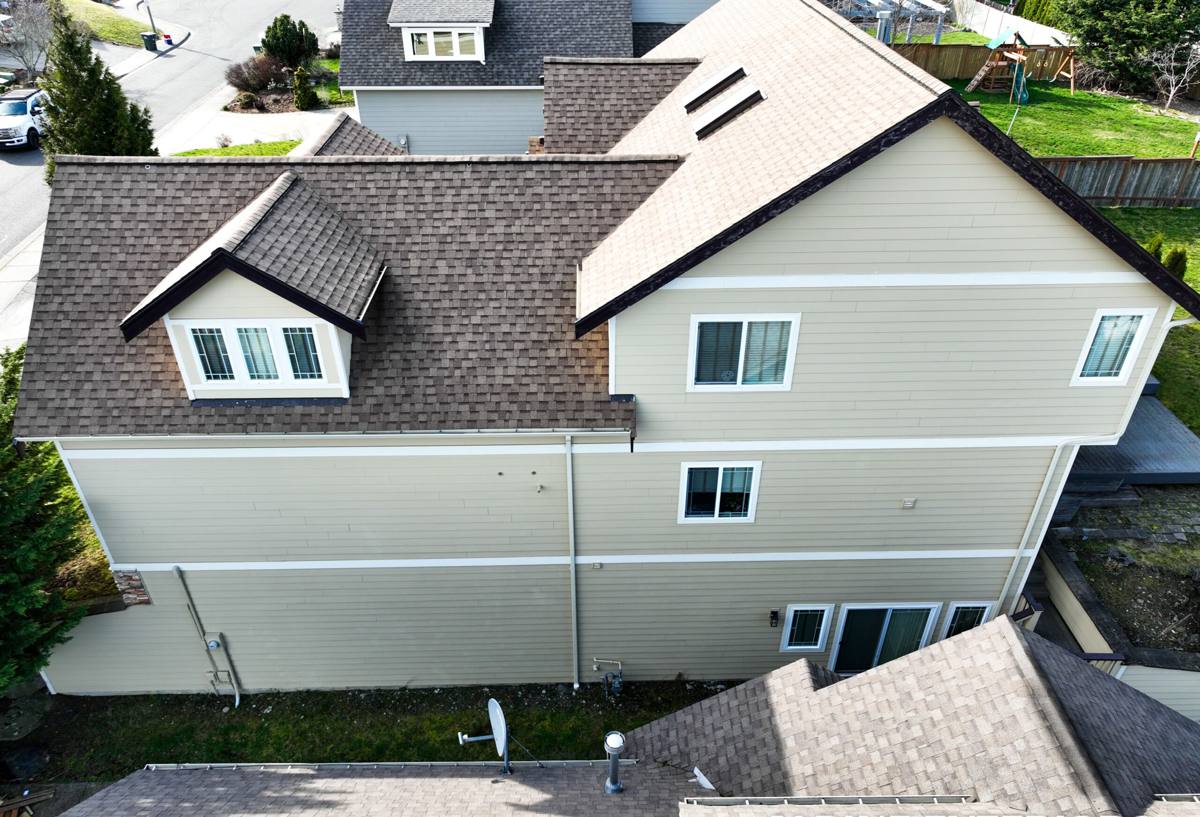
Why Blaine's Climate Is Hard on Roofs
Salt Air
Homes closer to the water deal with airborne salt that settles on roofing materials, gutters, and any exposed metal. Over time, salt exposure accelerates corrosion on fasteners, flashing, and gutter systems, and it can shorten the effective life of lower-grade metal components. It's not dramatic — it's cumulative, and it's the reason we pay closer attention to what metal we use on a storm repair in Blaine than we might a few miles east.
Driving Rain and Wind
Storms coming off the water tend to drive rain sideways rather than straight down. That matters because a roof built to shed water vertically can still take on water when rain is being pushed horizontally into laps, seams, and flashing edges. Wind gusts during these storms are also what typically causes the actual damage — lifted or torn shingles, loosened ridge caps, and stressed flashing around chimneys, vents, and skylights.
Moss Season
Whatcom County's long wet stretch — realistically much of the fall through spring — gives moss and algae plenty of time to establish on north-facing slopes and shaded areas. Moss holds moisture against the roofing surface and works its way under shingle edges, and a storm-damaged spot is exactly the kind of opening moss exploits fastest. A repair that doesn't account for existing moss growth nearby is a repair that's likely to need attention again soon.
What Counts as Storm Damage
Not all storm damage looks like missing shingles. On Blaine roofs we typically see damage fall into a few categories after a wind or rain event:
- Wind-lifted or torn shingles — edges pulled loose, tab cracking, or shingles blown off entirely
- Flashing displacement — around chimneys, skylights, vent pipes, and roof-to-wall transitions, where wind and repeated freeze-thaw cycling loosens seals
- Fastener backing out — nails or screws that have worked loose from wind uplift, leaving a path for water
- Debris impact — branches or windblown debris that puncture or bruise the roofing surface
- Gutter and downspout damage — separated seams or pulled fasteners that redirect water back toward the fascia and roof edge instead of away from the house
- Hidden decking damage — the deck underneath a compromised area softening from water intrusion that isn't visible from the ground
That last one is the reason a proper storm inspection needs to happen on the roof, not from the driveway. Surface damage is often the easy part to spot — what's happening underneath is what determines whether this is a straightforward patch or something more involved.
What a Correct Storm Repair Involves
A storm repair done right isn't just replacing the shingles that are visibly missing. It involves:
A Full Assessment, Not a Spot Check
Wind damage rarely stays contained to one tidy area. We check the full slope the storm hit, adjacent flashing points, and the attic side if accessible, since a water stain on the decking or insulation tells us more about how far the intrusion traveled than the exterior does.
Matching Materials, Not Just Available Ones
A patch repair with mismatched shingle color or a different product line stands out and can also perform differently under UV and moisture exposure than the surrounding roof. Where an exact match isn't available, we'll tell you honestly rather than mixing materials and hoping it blends.
Flashing Done Properly, Every Time
Most leaks that get blamed on "bad shingles" are actually flashing failures. Any storm repair we do includes checking that flashing is properly lapped, sealed, and fastened — not just caulked over as a shortcut. Caulk is a short-term fix, not a repair.
Addressing the Cause, Not Just the Symptom
If moss contributed to the failure, or if a gutter issue was backing water up under the roof edge, fixing the shingle without addressing that underlying condition just resets the clock on the same problem.
Our Storm Damage Repair Process
- Initial inspection — we get on the roof (weather permitting) and document the actual extent of damage, including areas that aren't obvious from the ground
- Straight explanation — you get a clear picture of what's damaged, what's at risk if left alone, and what the repair involves, before any work starts
- Temporary protection if needed — if there's active water intrusion and full repair can't happen immediately, we can tarp or seal the area to stop ongoing damage
- Repair — matched materials, proper flashing technique, and fastening appropriate for wind exposure in your specific location
- Final check — we walk the repair and the surrounding roof area before calling the job done, not just the specific damaged spot
Storm Damage and Insurance Claims
Many storm repairs in Blaine are covered by homeowners insurance, particularly when the damage is tied to a specific wind or storm event rather than gradual wear. We can document the damage with photos and a written assessment that you can submit to your insurer, and we're happy to speak with an adjuster about what we found and what the repair requires. What we won't do is inflate a claim or describe wear-and-tear as storm damage — that's not a service worth offering, and it isn't in your interest either if it puts future coverage at risk.
Repair or Replace: How We Help You Decide
Not every storm-damaged roof needs full replacement, and not every roof is worth patching indefinitely. The right call depends on the roof's age, how widespread the damage is, and what condition the rest of the roofing is in.
| Factor | Leans Toward Repair | Leans Toward Replacement |
|---|---|---|
| Roof age | Under 12-15 years, otherwise in good shape | Nearing or past expected material lifespan |
| Extent of damage | Localized to one area or slope | Multiple areas across the roof, or repeat damage |
| Underlying decking | Solid, no rot found | Soft spots or rot discovered during inspection |
| Moss/algae condition | Minor, manageable with cleaning | Widespread growth affecting multiple slopes |
| Storm history | First significant damage event | Recurring damage from repeated storm seasons |
We'll give you our honest read on where your roof falls on that spectrum rather than defaulting to whichever option costs more.
Why Hiring a Crew That Already Works Blaine Matters
A roofer who works across Whatcom County but doesn't spend much time on the coastal side may not think twice about salt-air corrosion on fasteners, or may not recognize how far driving rain can travel under a flashing lap in a wind-exposed spot. Those aren't things you learn from a manual — they're things you learn from repairing roofs in this specific environment repeatedly. We factor Blaine's conditions into material choices and repair technique as a matter of course, not as an upsell.
Local response time matters too. Storm damage that sits exposed for days, waiting on a contractor who has to drive in from well outside the area, gives water more time to spread into decking and insulation. Being able to get out to a Blaine property quickly after a storm is part of what limits a repair from turning into a much bigger job.
Preventing the Next Storm From Doing the Same Damage
A repair is a good moment to also address the conditions that made your roof vulnerable in the first place. A few things worth checking or scheduling:
- Trim back tree limbs that overhang the roof and could become storm debris
- Have moss and algae growth cleaned before it spreads further, especially on shaded or north-facing slopes
- Check that gutters are clear and properly pitched so wind-driven rain has somewhere to go
- Confirm flashing around chimneys, skylights, and vents is in good condition, not just the shingle field
- Ask about the fastening pattern used on your roof if you're in a particularly wind-exposed spot
- Schedule a post-storm-season inspection even in years without obvious damage
None of this eliminates storm risk — nothing does, given where Blaine sits — but it reduces how much damage a given storm is able to cause.
Get a Straightforward Look at Your Roof
If a recent storm has you wondering whether your roof took damage, or you've noticed a leak, a soft spot, or missing shingles, it's worth getting a second set of eyes on it before the next system rolls through. We offer free, no-pressure estimates for storm damage repair in Blaine — we'll tell you plainly what we find and what your real options are, and there's no obligation to move forward. Use the form below to get started.