 Bellingham Roofing
 Why Sunnyland Siding Takes a Beating
Sunnyland sits close enough to Bellingham Bay that salt-laden air is a constant, low-grade stress on exterior building materials, and it's paired with the long, wet Whatcom County winters that keep siding damp for weeks at a stretch. Add in the tree canopy that shades many yards in this part of Bellingham, and you get a third factor working against your siding: a moss and algae season that can run from fall through spring. None of these forces are dramatic on their own, but stacked together year after year, they're exactly the conditions that find every weak point in a siding system — a gap in caulking, a nail that backed out, a corner where water can't drain away fast enough.
That's the backdrop for almost every siding repair call we take in this neighborhood. The damage rarely comes from one big event. It's cumulative — moisture finding its way behind a panel, moss holding water against a surface, driving rain pushed sideways by wind off the bay. A repair that only addresses what's visible on the surface, without accounting for how water moves through the whole assembly, tends to fail again within a season or two.
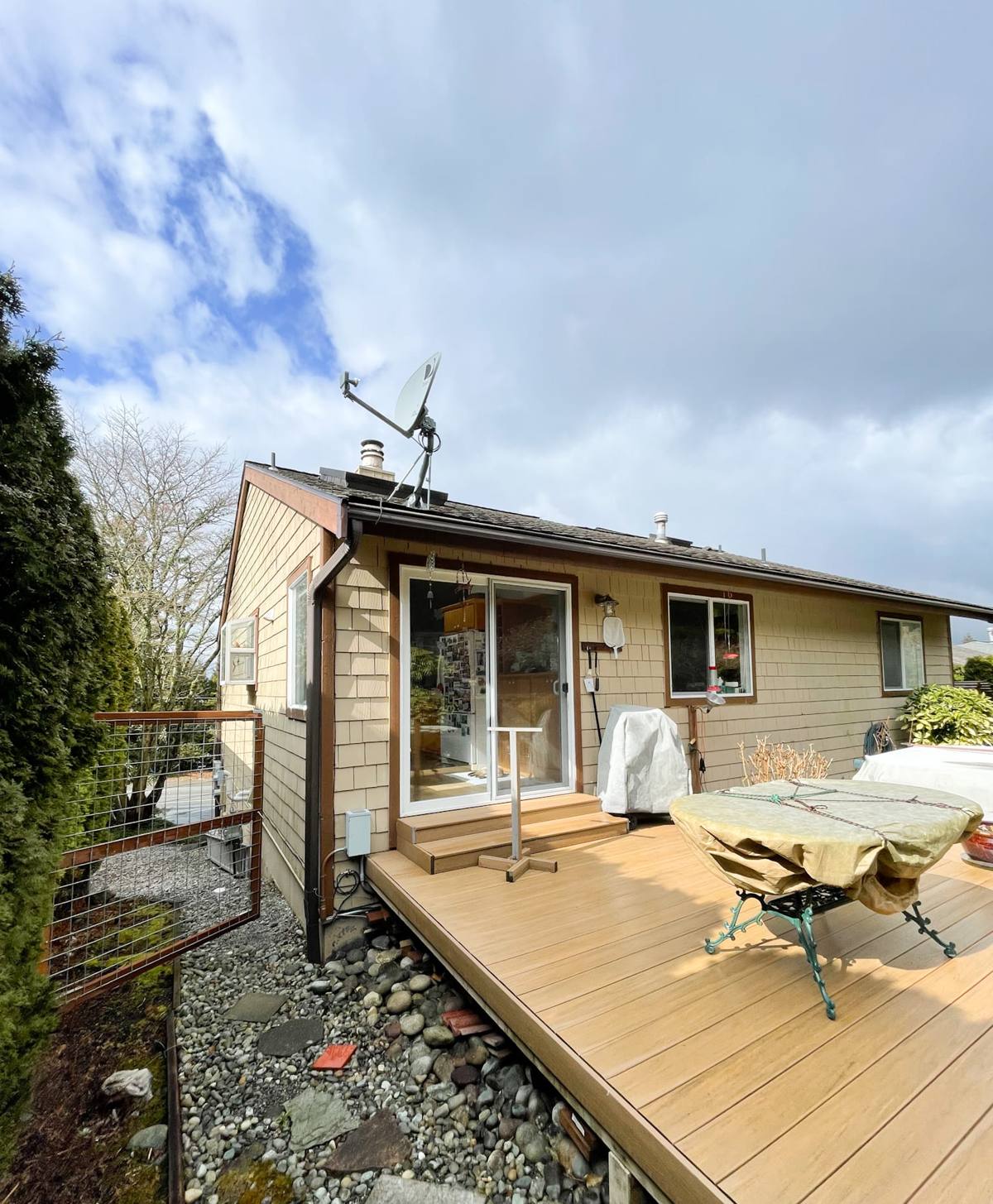
Signs Your Siding Needs Attention
Most siding problems in Sunnyland start small and stay hidden behind trim, under eaves, or low to the ground where they're easy to miss during a quick walk-around. Here's what we tell homeowners to check for a few times a year:
- Soft or spongy spots when you press on the siding, especially near the bottom courses or around window and door trim
- Visible gaps, cracking, or buckling in panels or boards
- Paint that's peeling, bubbling, or failing faster than it should on one section of the house
- Persistent moss or dark streaking that keeps returning even after cleaning
- Warping, swelling, or a "spongy" edge where panels butt together — common on engineered wood products
- Stains or discoloration on interior walls near exterior siding, which can indicate water is already getting through
- Caulking that's cracked, shrunk, or pulled away from joints and trim
- A musty smell near exterior walls, particularly in closets or rooms that share a wall with a shaded, damp side of the house
Any one of these on its own might be minor. Several showing up in the same area of the house usually means moisture has been getting behind the siding for a while, and the visible damage is just the part you can see.
What We Commonly Find on Sunnyland Homes
Sunnyland's housing stock spans several decades, which means we see a genuine mix of siding materials on repair calls — not just one type of problem. The damage pattern usually tracks pretty closely with what the siding is made of.
| Siding Material | Typical Failure Mode | What Drives It Locally |
|---|---|---|
| Cedar lap or shingle | Rot, splitting, cupping | Long wet season keeps wood damp; shaded lots slow drying time |
| LP SmartSide / engineered wood | Edge swelling, soft spots at seams | Water intrusion at cut edges and butt joints if not properly sealed and maintained |
| Vinyl | Cracking, warping, fading, panels blowing loose | Wind off the bay, UV exposure, and brittleness in colder snaps |
| Stucco / older composite panels | Cracking, staining, trapped moisture behind the surface | Rain intrusion through hairline cracks with no drainage path |
| James Hardie fiber cement | Isolated impact damage, caulk or paint wear at joints | Generally holds up well; issues are usually installation-related, not material-related |
The pattern is consistent: materials that absorb or trap moisture struggle in this climate, while non-combustible fiber cement tends to hold its shape and resist the damp far better over time. We'll get into why that matters for repair decisions below.
What a Correct Repair Actually Involves
A lot of siding "repairs" amount to caulking a crack, slapping on a matching paint color, and calling it done. That approach might look fine for a season, but it doesn't address why the damage happened in the first place — and on a home exposed to Sunnyland's combination of salt air, driving rain, and moss, surface patches tend to fail again quickly.
A repair that actually holds up starts with figuring out how water got in, not just where it shows up. That means:
Diagnosis Before Repair
We check moisture levels in and around the damaged area, not just at the surface. Damaged siding is often a symptom — the real problem might be a failed flashing detail, a gap where trim meets siding, or a drainage path that's been blocked by paint buildup or debris.
Water Management, Not Just Patching
Correct repair work restores the drainage plane behind the siding — proper flashing, house wrap integrity, and weep paths — so water that gets behind the surface (which it eventually will, on any siding system) has somewhere to go instead of sitting against wood or sheathing.
Matching, Where It's Actually Possible
If the surrounding siding is in good shape, we'll match material, profile, and paint as closely as we can for a patch repair. But we'll tell you plainly when a patch won't blend or won't last — sometimes replacing a full section or wall is the more honest recommendation, even if it's not what a homeowner wants to hear.
Repair or Replace?
This is the question every homeowner with damaged siding eventually asks, and the honest answer depends on how much of the house is affected and what's driving the damage.
| Factor | Repair Usually Makes Sense | Replacement Usually Makes Sense |
|---|---|---|
| Extent of damage | Isolated to one area or a few boards/panels | Recurring in multiple areas, or damage found behind the siding in several places |
| Cause | A single identifiable issue (bad caulk joint, one impact, a flashing gap) | Systemic — the material itself struggles with sustained moisture in this climate |
| Age of siding | Relatively new, otherwise sound siding | Original siding is decades old or already showing wear elsewhere |
| Material | Fiber cement with isolated damage | Cedar, older engineered wood, or vinyl with widespread rot, swelling, or cracking |
| Cost over time | Lower upfront cost, addresses the immediate problem | Higher upfront cost, but avoids repeat repair calls on failing material |
We won't push a full replacement when a targeted repair will genuinely hold up — that's not how we want to run this business. But we also won't patch a wall we know is going to fail again in two years just to make a smaller sale today. Part of our job is telling you which situation you're actually in.
Our Repair Process
- On-site assessment. We inspect the damaged area and the surrounding siding, checking moisture levels and looking for the underlying cause, not just the visible symptom.
- Straight answer on scope. You'll get a clear explanation of what we found, whether it's a targeted repair or something broader, and why — no upsell for its own sake.
- Written estimate. Scope, materials, and cost laid out before any work starts, so there are no surprises.
- Repair work. We remove and replace only what needs it, restore proper flashing and drainage details, and match materials and finish as closely as the situation allows.
- Final check. We walk the repair with you before we consider the job done, and explain any maintenance steps that will help it last.
Why We Recommend James Hardie for Replacement Sections
When a repair calls for replacing a section of siding rather than patching it, we install James Hardie fiber cement — it's the only siding product we install, on repairs or full projects. That's a deliberate standard, not a default. Fiber cement doesn't absorb water the way wood or engineered wood products can, it isn't prone to the cracking and warping we see in vinyl after enough freeze-thaw cycles and UV exposure, and it's non-combustible, which matters given wildfire smoke seasons are now a regular part of Pacific Northwest summers. Hardie's ColorPlus factory-applied finish also holds color and resists the kind of paint failure that shows up fast in a damp, shaded climate like Sunnyland's.
We won't install LP SmartSide, vinyl, Cemplank, Allura, or bare cedar as a repair or replacement material, even for a small patch job. That's not a knock on every homeowner's choice of those products elsewhere — it's our professional standard, based on what we've seen hold up in this specific climate over time and what we're willing to warranty our workmanship against. If your existing siding is one of those materials and it's failing in more than one spot, we'll say so plainly and talk through what replacing that section — or eventually the whole wall — with Hardie would look like.
Why Local Experience in Sunnyland Matters
Siding repair isn't one-size-fits-all, and a crew that's worked in Sunnyland specifically has a real advantage over one that hasn't. Like a lot of established Bellingham neighborhoods, Sunnyland has a mix of home ages and construction styles, which means the siding details, framing quirks, and moisture patterns vary block to block, even lot to lot depending on tree cover and sun exposure. Knowing which failure patterns show up on which type of home — and where water tends to collect given the terrain and shade in this specific part of Bellingham — means less guesswork and a repair that's designed for the actual conditions your house faces, not a generic checklist.
It also means faster, more accurate estimates. When we've already seen how a particular siding assembly behaves in this climate, we can diagnose a problem correctly the first time instead of treating symptoms and coming back out in a year.
What Affects the Cost of a Siding Repair
Every repair is different, but a few factors consistently drive the price up or down:
- Extent of hidden damage. What we find once panels come off often changes scope — rotted sheathing or damaged house wrap adds work beyond the visible repair.
- Material match. Matching an older, weathered, or discontinued siding color and profile can take more time and material than replacing with a fresh, uniform section.
- Access. Second-story sections, tight side yards, or areas near landscaping and trees can add labor time.
- Underlying water management repairs. Fixing flashing, house wrap, or drainage details properly costs more than a surface patch, but it's what actually prevents the problem from returning.
- Material choice. If a damaged section is being replaced with James Hardie fiber cement rather than the original material, there's a cost difference upfront that typically pays off in reduced repair frequency down the road.
We lay all of this out in the estimate itself, so you know exactly what's driving the number before any work begins.
If your Sunnyland home has siding damage — whether it's an obvious soft spot or just siding that hasn't looked right in a while — we're happy to come take a look. The estimate is free, there's no pressure, and you'll get a straight answer about whether it's a simple repair or something bigger.