 Bellingham Roofing
 Building a Deck That Can Actually Handle Blaine
Blaine sits right on the water, which means any deck built here is doing double duty: it has to hold up under normal Pacific Northwest rain and it has to survive salt-laden air blowing off Semiahmoo Bay and Drayton Harbor. That combination is harder on a structure than either factor alone. Salt air accelerates corrosion in metal fasteners and hardware, while the region's long wet season keeps wood surfaces damp for weeks at a stretch, which is exactly what moss and mildew need to take hold. A deck built to a generic spec sheet — the kind you'd see in a big-box materials guide — often isn't built for that specific combination, and it shows within a few years as rust streaks, soft boards, and slick, moss-covered surfaces.
We build decks in Blaine the way the location demands: corrosion-rated hardware, decking and framing choices that tolerate sustained moisture, and drainage details that keep water moving instead of pooling. None of this is exotic — it's just matching the build to the actual conditions instead of assuming Blaine is no different than an inland project.
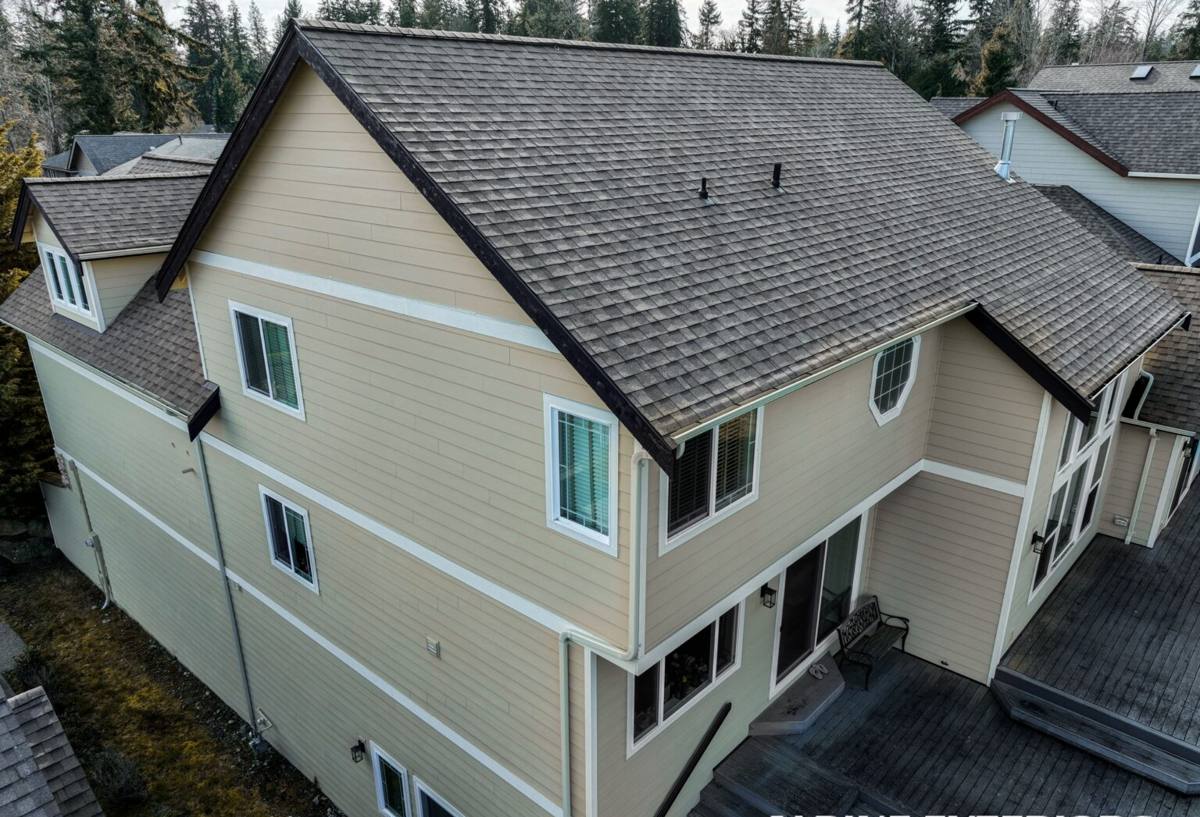
What Blaine's Coastal Climate Does to an Underbuilt Deck
Salt Air and Corrosion
Airborne salt from the bay settles on every exposed surface, including screws, joist hangers, bolts, and any exposed metal railing components. Standard electro-galvanized fasteners can start showing rust within a couple of seasons in a salt-exposed location like Blaine, and once a fastener corrodes it loses holding strength long before it looks obviously bad. That's a structural issue, not just a cosmetic one.
Driving Rain and Moisture Retention
Storms coming off the water often bring rain at an angle, which drives moisture into places a straight-down rain wouldn't reach — under railings, into end-grain cuts, behind ledger boards, and into any gap where boards butt together. Wood that stays wet longer takes longer to dry between storms, and that extended damp period is what drives rot in framing and fastener pockets.
The Long Moss Season
Whatcom County's wet months stretch long, and a deck surface that doesn't shed water well becomes a moss farm. Beyond looking neglected, moss holds moisture against the decking surface and creates a genuinely dangerous slip hazard on stairs and walking surfaces — a bigger liability concern than most homeowners realize until someone actually slips.
Signs a Blaine Deck Needs Attention
- Rust streaks running down from screw heads, hangers, or railing brackets
- Boards that feel spongy or flex more than they used to, especially near the ledger or stair stringers
- Persistent green or black growth that comes back within weeks of cleaning
- Gaps opening up between decking boards, or boards cupping and warping
- Railing posts that wiggle at the base — often a sign the connection hardware has corroded
- A ledger board connection that looks caulked-over rather than properly flashed
Any one of these on its own might just mean routine maintenance. Several together, especially rust plus soft framing, usually means it's time to look at a rebuild rather than another round of patching.
Decking Material Options for a Salt-Air Site
There's no single "correct" material for every Blaine deck — it depends on budget, how much upkeep you want to do, and how close the deck sits to open water. Here's how the common options stack up for this specific climate:
| Material | Salt Air Behavior | Moss/Moisture Resistance | Maintenance |
|---|---|---|---|
| Pressure-treated fir/pine | Fine with stainless or coated fasteners; wood itself doesn't corrode | Needs regular sealing to resist moss and rot | Annual cleaning and re-sealing recommended |
| Cedar | Naturally rot-resistant; still needs corrosion-rated hardware | Better natural resistance, still needs periodic treatment | Moderate — cleaning, occasional oil/stain |
| Composite decking | No corrosion concern with the board itself; check fastener spec | Sheds water well; can still get slick with algae film | Low — occasional washing |
| PVC/capped composite | Excellent — fully synthetic surface | Best moisture resistance of the group | Lowest — soap and water cleaning |
We're honest with clients about trade-offs rather than pushing one product line. Composite and capped-composite boards cost more up front but save real time and money on upkeep for a waterfront-adjacent property like most Blaine lots. Cedar and treated wood cost less initially but need a homeowner willing to actually stay on top of sealing and cleaning — skip that in a climate like this and the wood loses that cost advantage fast.
Fasteners, Framing, and Hardware — Where Salt Air Actually Wins or Loses
The decking surface gets the attention, but the hardware underneath is what actually determines how long a Blaine deck lasts. We spec stainless steel or heavy hot-dip galvanized fasteners and connectors for any deck within salt-exposure range of the water, not the lighter-duty coated fasteners that are fine for an inland build. Joist hangers, ledger bolts, and post bases all get the same treatment — it's a small cost difference at build time and it's the difference between hardware that's still solid in fifteen years and hardware that's rusting through in five.
Framing lumber gets the same scrutiny. We use rated pressure-treated framing appropriate for ground contact or moisture exposure depending on the specific part of the structure, and we detail flashing at the ledger board connection so water can't get behind it and sit against the house rim joist — that ledger connection is the single most common failure point we see on older decks in this area.
Our Deck Building Process
- On-site assessment — we look at sun/rain exposure, proximity to open water, soil and drainage conditions, and how the deck will actually be used before recommending materials.
- Honest material walkthrough — we go over decking, railing, and hardware options with real cost and maintenance trade-offs, not a one-size pitch.
- Permitting — we handle the permit and inspection process with the applicable local jurisdiction so the structure is built and documented correctly from the start.
- Framing and structural work — footings, posts, beams, and joists built to span and load requirements, with corrosion-rated hardware throughout.
- Decking, railing, and stairs — installed with attention to drainage, board spacing, and fastener placement so water moves off the surface instead of collecting.
- Final walkthrough — we go over the finished deck with you, including what maintenance it actually needs and how often.
Permits and Local Considerations
Deck projects in Blaine and the surrounding Whatcom County area typically require a permit once the structure exceeds a certain height or size, and waterfront-adjacent lots can carry additional review depending on setback and shoreline considerations. We handle that process as part of the build so you're not the one chasing down inspections. If your lot is close enough to the water that shoreline regulations might apply, that's worth flagging during the initial estimate rather than after materials are ordered.
Maintenance That Actually Matters Here
- Sweep debris off the deck surface regularly — trapped leaves and needles hold moisture and feed moss growth
- Rinse salt residue off railings and hardware periodically, especially after storms
- Check fastener heads and brackets once a year for early rust — catching it early is cheap, catching it late means hardware replacement
- Reseal wood decking on the schedule appropriate to the product — don't wait until it's visibly gray and dry
- Keep gutters and downspouts near the deck clear so runoff isn't dumping extra water onto or under the structure
- Address slick, mossy spots promptly rather than letting them spread across the whole surface
Why a Crew That Already Works Blaine Makes a Real Difference
A contractor who mostly builds decks inland or in drier parts of Whatcom County can still build a technically sound deck — but they may not default to salt-rated hardware, they may not think through ledger flashing the same way, and they may not have a feel for how fast moss takes over a shaded, water-facing surface here. A crew that regularly works Blaine specifically has already seen what fails in this environment and builds around it from the first fastener, not after a callback five years in. That's not a marketing distinction — it shows up directly in how long the deck lasts and how much maintenance it actually needs.
If you're planning a new deck or need an honest look at an existing one, we're happy to walk the property with you and talk through what actually makes sense for your home. Reach out for a free, no-pressure estimate using the form below.