 Bellingham Roofing
 Storm Damage Looks Different on a Fairhaven Roof
Fairhaven sits close enough to Bellingham Bay that wind off the water behaves differently than wind further inland. Gusts coming across open water tend to hit rooflines at an angle rather than straight on, which is exactly the kind of load that catches under a shingle tab or ridge cap and starts peeling it back. Add in Whatcom County's long wet season, and a roof that took wind damage in November may not show a leak until a heavy January rain finally finds its way through the opening.
We've repaired storm damage across Bellingham for years, and Fairhaven roofs consistently show a specific pattern: wind damage concentrated on the windward slope and around ridge lines, moss-softened wood that failed faster than it would have on a drier roof, and flashing that corroded ahead of schedule because of the salt content in the air near the water. None of that means Fairhaven homes need exotic solutions — it means the repair has to account for conditions that a generic storm-damage checklist doesn't cover.
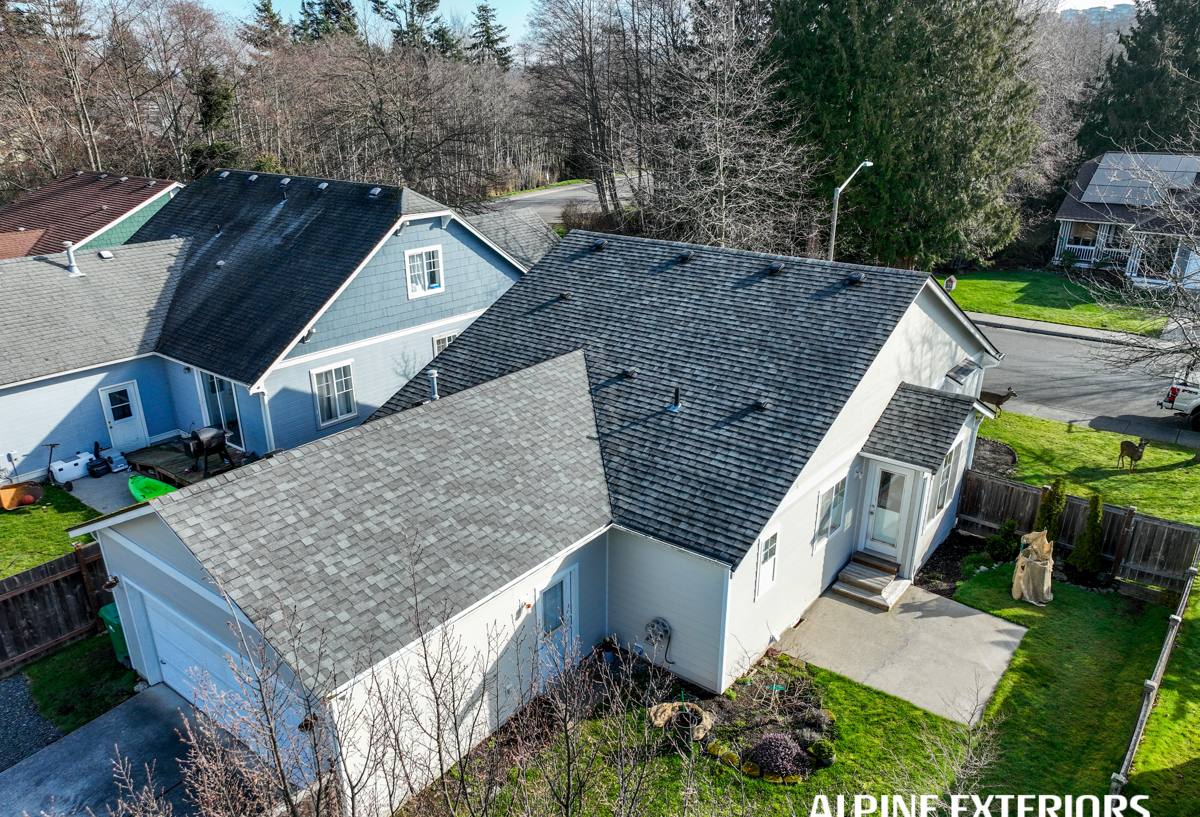
What Actually Counts as Storm Damage
Homeowners often assume storm damage means a hole in the roof. Most of the calls we get after a windstorm or heavy rain event look far less dramatic, and that's part of the problem — the damage is easy to miss until it's already caused a secondary problem.
- Shingles lifted, cracked, or missing along the roof edge or ridge, often only visible from the ground at an angle
- Ridge cap shingles blown loose or gone entirely, exposing the ridge vent or ridge board underneath
- Bent, lifted, or separated flashing around chimneys, skylights, and roof-wall intersections
- Granule loss from wind-driven debris or hail, which shows up as bare, shiny patches on shingles
- Branch or debris impact that punctures the roofing material without an obvious visible hole from the ground
- Gutters pulled away from the fascia, which redirects water back up under the roof edge instead of away from it
- Soft or discolored ceiling spots inside the home that appear days or weeks after the storm itself
Any one of these can be minor on its own. The problem is that Bellingham's rain doesn't wait for a convenient time to test a weak spot, and a small gap that would sit dry for months in a drier climate gets exposed to moisture almost immediately here.
Why the Damage You Can't See Matters More
The visible damage from a storm is rarely the full story. Wind that lifts a shingle enough to let water underneath doesn't need to tear the shingle off completely — it just needs to break the seal. Once that seal is broken, water works its way under the shingle, across the underlayment, and eventually to the roof sheathing. In a marine climate with regular rain and a moss season that keeps surfaces damp for extended stretches, that process moves faster than most homeowners expect.
This is why we don't just look at the spot the homeowner points to. A proper storm damage inspection covers the whole roof plane, the flashing details, the ridge, and the attic space if it's accessible, because storm damage frequently shows up in more than one place at once. A wind event strong enough to lift one section of shingles was strong enough to stress the whole roof, even if only one area failed visibly.
Signs the Damage Has Already Reached the Deck
Sagging felt or underlayment visible from the attic, dark staining on the sheathing, a musty smell in the attic space, or soft spots when walking the roof are all signs that water has already reached the wood structure underneath the roofing material. At that point the repair isn't just about the shingles — it's about the deck itself, and that changes the scope of the job.
What a Correct Storm Repair Actually Involves
Inspection Before Anything Else
We start by documenting the damage — photos, measurements, and a clear description of what failed and why. This matters for two reasons: it tells us exactly what needs to be repaired versus replaced, and it gives the homeowner something concrete to bring to an insurance adjuster if the claim is being filed.
Matching the Repair to the Roof's Age and Condition
Storm damage repair isn't always a like-for-like patch. If the surrounding shingles are already near the end of their service life, or if moss has been breaking down the granule surface for years, patching just the storm-damaged section can leave a repair that doesn't blend in and doesn't last as long as the rest of the roof. We'll tell you honestly when a patch makes sense and when it doesn't — the goal is a repair that holds up, not the smallest possible job.
Flashing and Underlayment, Not Just Shingles
A storm repair that only replaces shingles and ignores the flashing underneath is a repair that's likely to fail again in the next storm. Flashing around chimneys, vents, and wall intersections takes the same wind and rain load as the shingles, and near the water it corrodes faster. We check and, where needed, replace flashing and underlayment as part of the repair, not as an upsell after the fact.
Getting the Ridge Right
Ridge caps are the first thing wind gets under, and a ridge repaired without proper nailing pattern and sealant will lift again in the next windstorm. This is one of the most common repeat-repair issues we see on roofs that were patched quickly after a storm without addressing why the ridge failed in the first place.
Repair or Replace: How We Help You Decide
Not every storm-damaged roof needs full replacement, and not every roof can be safely patched. The right call depends on the roof's age, how much of it was affected, and what condition the rest of the roofing is in.
| Factor | Leans Toward Repair | Leans Toward Replacement |
|---|---|---|
| Roof age | Under 10-12 years | Approaching or past expected lifespan |
| Extent of damage | Isolated to one slope or section | Spread across multiple slopes |
| Moss/algae condition | Minimal, surface-level growth | Long-term moss buildup, granule loss underneath |
| Deck condition | Solid, no soft spots | Soft or stained sheathing found during inspection |
| Shingle availability | Matching shingles still available | Discontinued color/style, visible mismatch likely |
We walk through this with every Fairhaven homeowner before we recommend anything. If a repair is the honest answer, that's what we'll propose — a storm repair job is not the place to sell a replacement the roof doesn't need yet.
Our Process for a Storm Call
1. Immediate Mitigation
If the roof is actively leaking or has an open section exposed to weather, the first priority is stopping further water intrusion — tarping or temporary sealing to protect the interior of the home until the permanent repair can be scheduled.
2. Documented Inspection
We inspect the full roof, not just the obvious damage point, and document everything with photos and notes. This is the same documentation we'll hand over if you're filing an insurance claim.
3. Clear Scope and Estimate
You get a written explanation of what needs to be done, why, and what it will cost — before any work starts. If there are options (patch versus partial replacement, for example), we explain the trade-offs in plain terms.
4. The Repair Itself
Work is done to match the existing roofing as closely as possible, with attention to flashing, ridge, and underlayment as described above — not just the shingles that failed.
5. Follow-Up
After the repair, we confirm the fix is holding and address any related issues (gutters, fascia, ventilation) that contributed to the original damage or could affect it going forward.
Insurance Claims: What Homeowners Should Know
Most storm damage claims in this area come down to whether the damage is clearly storm-related versus gradual wear, and documentation is what separates a smooth claim from a denied one. An adjuster who sees clear photos, a dated inspection report, and a specific description of the storm event tied to the damage has an easier time approving a claim than one working from a homeowner's verbal description alone.
We're not a public adjuster and we don't negotiate your claim for you, but we can provide the documentation and professional assessment that supports your claim, and we're glad to walk an adjuster through what we found if that's useful. Keep in mind that most policies have a claim-filing window tied to the date of the storm, so it's worth getting an inspection soon after damage occurs rather than waiting.
Living With a Marine Climate: What Fairhaven Roofs Need Between Storms
A single storm repair fixes one event. What actually protects a Fairhaven roof over time is dealing with the conditions that make storm damage worse in the first place — moss, salt exposure, and constant moisture.
- Keep gutters and downspouts clear so water doesn't back up under the roof edge during heavy rain
- Address moss growth before it lifts shingles or holds moisture against the roof surface for long stretches
- Check exposed metal flashing and fasteners periodically for early corrosion, especially closer to the water
- Trim back branches that overhang the roof — impact damage and debris buildup both increase with overhanging trees
- Have the roof looked at after any named windstorm, even if nothing looks obviously wrong from the ground
None of this replaces a professional inspection after a real storm event, but it reduces how much damage a given storm can do and makes any future repair simpler and less costly.
Why a Crew That Already Works Fairhaven Makes a Difference
Storm damage repair isn't a one-size-fits-all trade. A crew that regularly works roofs in this specific part of Bellingham has already seen how wind moves off the bay, how fast moss establishes itself in the shade of Fairhaven's tree cover, and which flashing details tend to fail first in this air. That familiarity means less time spent figuring out the roof's specific problems and more time spent actually fixing them correctly the first time.
It also means we're not guessing at material behavior in this climate — we know which repairs hold up through a full Whatcom County winter and which ones tend to need a second visit. That's the difference between a repair that solves the problem and one that just gets you through until the next storm.
Get an Honest Look Before You Decide Anything
If your roof took damage in a recent storm, or you're just not sure whether what you're seeing is worth worrying about, we're happy to take a look. There's no pressure and no obligation — just a straight assessment of what's going on and what, if anything, needs to be done about it. Reach out using the form below for a free estimate.