 Bellingham Roofing
 Why Ferndale Siding Takes a Different Kind of Beating
Ferndale sits close enough to Bellingham Bay and the Strait of Georgia that salt-laden air is a regular part of the weather, not an occasional event. Add in Whatcom County's long stretch of driving rain from fall through spring, plus a moss season that can run most of the year on shaded north- and west-facing walls, and you've got a combination that wears out the wrong siding material faster than homeowners expect. Wood siding checks, cups, and rots where moisture sits. Vinyl gets brittle and can warp under sun exposure after years of freeze-thaw cycling near the water. Engineered wood products absorb moisture at cut edges and swell if that moisture isn't kept out consistently.
Fiber cement siding was developed specifically to resist this kind of environment, and it's the only siding material we install on Ferndale homes. This page covers what the climate demands, what a correct installation actually involves, and why the crew doing the work matters as much as the product itself.
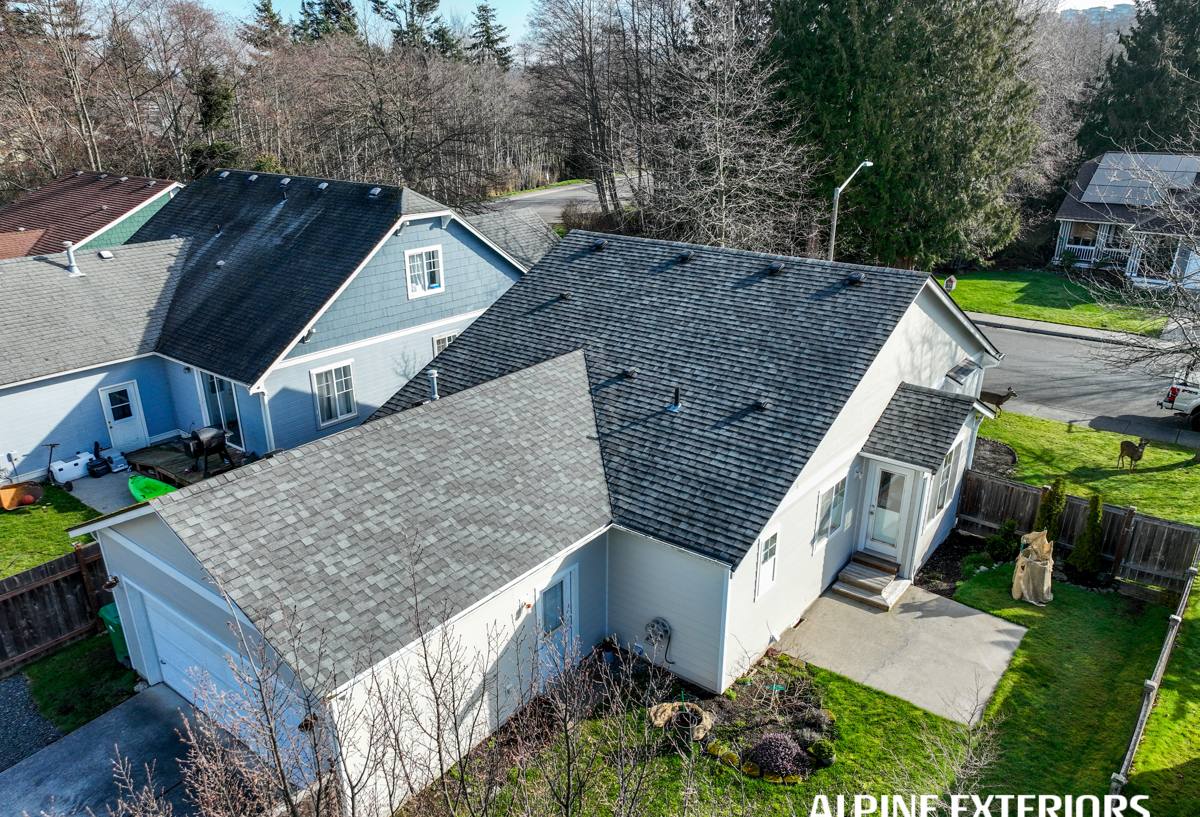
What Salt Air, Rain, and Moss Actually Do to a Home's Exterior
Salt Air
Airborne salt accelerates corrosion on fasteners, flashing, and any exposed metal trim. It also speeds up the breakdown of lower-grade paint finishes, which is why factory-applied, baked-on finishes hold up so much better here than field-applied paint that's exposed to salt spray from day one.
Driving Rain
Whatcom County storms don't just fall straight down — wind-driven rain gets pushed sideways into wall assemblies, seams, and butt joints. Any siding system with weak water management at the seams, around windows, or at the bottom edge will eventually let moisture behind the cladding, where it can sit against sheathing and framing.
Moss and Sustained Dampness
Shaded walls, especially those facing north or tucked under overhangs and mature trees, stay damp for extended stretches. Moss and algae take hold on porous or textured surfaces that hold moisture, and organic material sitting against siding keeps that surface wet even longer, compounding the problem.
Why Fiber Cement Holds Up Where Other Materials Struggle
Fiber cement is made from cellulose fiber, sand, and cement, which makes it dimensionally stable and non-combustible. It doesn't absorb and swell with moisture the way engineered wood products can, it doesn't become brittle in cold, wet conditions the way vinyl can over time, and it doesn't rot. That's the core reason it performs well in a marine climate like Ferndale's.
But the material is only half the equation. Fiber cement's long-term performance depends heavily on correct installation — proper clearances, flashing, fastening, and joint treatment. A poorly installed fiber cement job can still trap moisture and fail early, which is why we treat installation quality as seriously as the product choice itself.
What a Correct Fiber Cement Installation Involves
Water Management First
Before a single piece of siding goes up, the wall needs a proper weather-resistive barrier, correctly lapped and sealed, with flashing integrated at every window, door, and horizontal trim transition. This is the step that determines whether wind-driven rain stays out of the wall assembly — and it's also the step that's easiest to shortcut if a crew is moving fast.
Clearances and Gaps
Fiber cement siding needs proper clearance from grade, roofing, decks, and other horizontal surfaces, along with correctly sized gaps at butt joints and around penetrations. Manufacturer specifications exist for a reason — these gaps and clearances allow the assembly to shed water instead of wicking it upward into the material.
Fastening
Fasteners need to be corrosion-resistant, sized and spaced to manufacturer specification, and driven correctly — not overdriven, which can crack the material or compromise its ability to move slightly with temperature changes. In a salt-air environment, fastener quality matters more than in inland areas, since standard fasteners corrode faster near the coast.
Caulking and Sealing
Joints and penetrations get sealed with a quality, paintable sealant rated for exterior use. Sealant that's applied incorrectly, or skipped where it isn't visible, is one of the most common causes of early moisture intrusion behind fiber cement siding.
Why We Install James Hardie and Nothing Else
We standardized on James Hardie fiber cement products rather than offering multiple brands or alternative materials like vinyl, LP SmartSide, or primed wood siding. A few reasons drove that decision:
- James Hardie engineers climate-specific product lines (HZ5 for regions with more freeze-thaw and moisture exposure), rather than a single one-size-fits-all formulation.
- ColorPlus Technology applies the finish in a factory-controlled process, which holds up better against sun and salt exposure than field-applied paint, and reduces how often the siding needs repainting.
- Fiber cement is non-combustible, which is a meaningful consideration anywhere wildfire risk or ember exposure is a factor.
- James Hardie backs its products with a strong, transferable warranty — a real asset if a home changes hands.
- Consistency lets our crews specialize. Installing one system correctly, every time, produces better results than installing several products at a general level of competence.
We're not going to tell you other siding products are worthless — vinyl, engineered wood, and other fiber cement brands all have a place. But we've made a professional judgment that James Hardie, installed correctly, is the best long-term fit for the homes we work on in this climate, and we'd rather do one thing well than several things adequately.
Our Process for a Ferndale Siding Job
1. On-Site Assessment
We look at the home's exposure — how much direct salt air and wind-driven rain it takes, where moss and moisture are already showing up, and the condition of the existing sheathing and weather barrier once old siding starts coming off.
2. Tear-Off and Prep
Old siding comes off, and we inspect what's underneath. Any sheathing damage from prior moisture intrusion gets addressed before new siding goes up — covering over a compromised wall assembly just sets up the same failure again.
3. Weather Barrier and Flashing
A new weather-resistive barrier goes on correctly lapped, with flashing detailed at every window, door, and trim transition before siding installation starts.
4. Installation to Manufacturer Spec
Siding, trim, and fascia go up following James Hardie's installation guidelines for clearance, fastening, and joint treatment — not a generic approach adapted from other materials.
5. Final Detailing and Walkthrough
Caulking, touch-up, and a final walkthrough close out the job so you know exactly what was done and what maintenance, if any, to expect going forward.
Living With Fiber Cement Siding in a Moss-Prone, Salt-Air Climate
Fiber cement is low-maintenance compared to wood, but "low-maintenance" doesn't mean "no maintenance" — especially in Whatcom County. A simple seasonal routine goes a long way:
- Rinse siding periodically, especially on shaded or north-facing walls where moss and algae tend to establish first.
- Trim back vegetation and tree branches that keep a wall section shaded and damp longer than the rest of the house.
- Check gutters and downspouts before the fall rains — overflowing gutters are a common source of concentrated water hitting siding in the same spot repeatedly.
- Inspect caulking at joints and trim every couple of years and have any cracked or missing sealant redone.
- Watch for any soft spots, staining, or paint failure near ground level, deck ledgers, or roof-to-wall intersections — these are the areas most likely to show an early water problem.
What Affects the Cost of a Fiber Cement Siding Project
Every home is different, but the same handful of factors drive most of the cost variation we see on Ferndale jobs:
| Factor | Why It Matters |
|---|---|
| Home size and wall area | More square footage means more material and labor |
| Trim and architectural detail | Gables, dormers, and multiple trim transitions take more time to flash and finish correctly |
| Tear-off condition | Sheathing repair or rot remediation found during tear-off adds scope |
| Number of stories and access | Taller walls and difficult access require more equipment and time |
| Siding profile and color | Lap width, panel style, and ColorPlus finish selection affect material pricing |
We'll walk through these specifics for your home during an on-site estimate rather than quoting a number sight unseen.
Why It Matters That We Already Work in Ferndale
A crew that already works Whatcom County homes knows what a Ferndale wall assembly is typically dealing with before they pull the first piece of old siding off — how much salt exposure a given orientation gets, where moss tends to establish on homes near the water versus further inland, and what kind of moisture damage is common on homes of a certain age in this area. That local pattern recognition shows up in better prep decisions, fewer surprises mid-project, and a finished install that's actually built for the conditions it has to survive, not just installed to a generic checklist.
If your Ferndale home needs new siding, or you're seeing early signs of moisture or moss trouble on the walls that take the worst of the weather, we're happy to take a look. Request a free, no-pressure estimate using the form below and we'll walk the property with you and talk through what your home actually needs.