 Bellingham Roofing
 Deck Repair Built for Sudden Valley's Conditions
Sudden Valley sits in one of the shadier, more tree-covered pockets of Whatcom County, tucked along Lake Whatcom east of Bellingham. That setting is part of why people live there — but it's also hard on a deck. Overhanging trees mean more debris and slower drying time. Lake-adjacent humidity keeps wood damp longer after every rain. And like the rest of the county, this area gets a steady diet of driving rain off the water and marine air moving in from Bellingham Bay, carrying enough salt to accelerate corrosion on fasteners and hardware even well inland. Put those together and you get a climate that's genuinely tougher on outdoor structures than it looks on a sunny afternoon.
We repair decks for homeowners throughout Sudden Valley and the surrounding Bellingham area, and the calls we get are rarely random. They follow a pattern tied directly to this environment — soft spots near ledger boards, moss buildup on shaded boards, rusted fasteners, and railings that have started to feel less solid than they used to. This page covers what actually causes that damage, what a correct repair looks like, and how we approach the work.
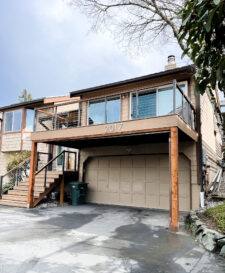
What Whatcom County's Climate Does to a Deck
Every deck problem we see traces back to moisture, and moisture in this region comes at a deck from several directions at once, not just one obvious culprit.
Moss and Prolonged Dampness
Bellingham's long wet season, combined with tree cover common in Sudden Valley, gives moss and algae months at a stretch to establish themselves on decking boards, stair treads, and anywhere shade keeps a surface from drying out between rains. Moss holds water against the wood surface, which speeds up rot and also makes boards dangerously slick — a safety issue as much as a maintenance one.
Driving Rain and Wind-Driven Moisture
Rain in this region rarely falls straight down. Wind pushes it sideways into ledger board connections, under railing posts, and into any gap where flashing has failed or was never installed correctly. That's why so much deck damage starts at the house-to-deck connection rather than out in the open field of the deck.
Salt Air and Fastener Corrosion
Even at a distance from open water, marine air moves inland across Whatcom County and carries trace salt with it. Over years, that accelerates corrosion in nails, screws, and structural hardware — especially anything that isn't rated for coastal or marine exposure. A fastener that's rusting from the inside out can fail long before the wood around it shows obvious damage.
Signs Your Deck Needs Repair — Not a Full Rebuild
Most decks we're called out to don't need to be torn out and replaced. They need targeted repair to the parts that are actually failing. Here's what we look for, and what you can check yourself before calling anyone:
- Soft, spongy, or springy spots when you walk across the deck surface
- Visible gaps, cracking, or splintering concentrated in certain boards, not the whole deck
- Rust streaks below fasteners or visibly corroded screws and brackets
- A railing or post that wiggles or flexes when pushed
- Green or black growth that doesn't wash off with a simple scrub
- Separation or a visible gap where the deck meets the house (the ledger board area)
- Stair treads that feel less solid than the rest of the deck
- Standing water that doesn't drain within an hour or two after rain stops
If what you're seeing is limited to a few boards, a railing section, or the stairs, repair is almost always the right call. Full replacement becomes necessary when the structural framing itself — the joists, beams, or ledger connection — has been compromised, which is something we verify in person rather than guess at from the surface.
What a Correct Deck Repair Actually Involves
A repair that only replaces what's visibly damaged and ignores the cause tends to fail again within a season or two. We treat every repair as two jobs in one: fix the damage, and fix whatever let the moisture in.
Structural Inspection First
Before replacing a single board, we check the framing underneath — joists, beams, posts, and especially the ledger board where the deck attaches to the house. This is the connection that carries the most load and takes the most water exposure, and it's the one spot where a shortcut repair can turn into a safety problem.
Flashing and Water Management
If water is getting behind the ledger board or pooling where the deck meets the house, we correct the flashing rather than just patching the board that rotted because of it. Skipping this step is the single most common reason deck repairs don't hold up in this climate.
Fastener and Hardware Upgrades
Where corrosion is part of the problem, we replace failing hardware with fasteners and connectors rated for exterior, high-moisture use — not just matching what was there originally, especially if what was there originally is what failed.
Board Replacement and Matching
Damaged boards get replaced with material that matches the structural rating of the original decking, sized and spaced correctly for proper drainage and expansion. We don't just fasten in a board that "fits" — spacing and orientation affect how well the new section drains and dries.
Wood vs. Composite: Repair Considerations
Sudden Valley has a mix of both wood and composite decking, and repair strategy differs depending on which you have. Neither is automatically the "right" answer — it depends on your existing deck, your budget, and how much upkeep you want to take on.
| Factor | Wood Decking | Composite Decking |
|---|---|---|
| Moisture behavior | Absorbs water; needs sealing and airflow to dry between rains | Resists water absorption but can trap moisture underneath if drainage is poor |
| Moss/algae resistance | Lower — porous surface holds growth in shaded, damp spots | Higher, but not immune, especially in deep shade |
| Repair approach | Individual boards can often be replaced and blended in | Matching color/texture to older composite boards can be harder as products age |
| Ongoing maintenance | Periodic cleaning, sealing, and inspection | Lower maintenance, but structural framing underneath still needs the same checks |
| Typical repair cost | Generally lower material cost per board | Material cost higher, labor similar |
One point worth being direct about: regardless of which decking material sits on top, the framing underneath is almost always wood, and it's almost always the part that actually fails. A composite deck with a rotted joist underneath is still a structural repair, not a cosmetic one.
Our Deck Repair Process
- On-site assessment. We walk the full deck, check the framing from underneath where accessible, and identify which problems are cosmetic versus structural.
- Honest scope and estimate. You get a clear picture of what needs to be repaired now, what's worth monitoring, and what a full replacement would cost by comparison if that's ever the better long-term move.
- Repair the cause, not just the symptom. Flashing, drainage, and fastener issues get corrected alongside any board or framing replacement.
- Quality check and cleanup. We confirm the deck is solid underfoot, railings are secure, and the site is left clean.
What Affects the Cost of a Deck Repair
Every deck is different, so we don't quote sight unseen — but these are the factors that typically move the price:
| Factor | Why It Matters |
|---|---|
| Extent of structural damage | Framing and ledger board repairs take more time and involve more material than surface-level fixes |
| Accessibility | Decks with limited underside access or built over sloped ground take longer to inspect and repair |
| Material type | Wood and composite have different material costs and require different fastening approaches |
| Number of affected boards or sections | A few boards is a different job than a full resurfacing |
| Railing and stair condition | Code-related railing or stair repairs may require additional hardware or structural bracing |
Most straightforward board and railing repairs land in a modest range; jobs involving ledger board or framing correction cost more because of the added labor and hardware. We'll always walk you through exactly what's driving the number before any work starts.
Why It Matters to Hire a Crew That Already Works in Sudden Valley
Deck repair looks similar on paper everywhere, but the failure patterns aren't the same in every climate. A crew used to working in a dry region will size up moisture damage differently than a crew that repairs decks in Whatcom County every week through a long wet season. Knowing that Sudden Valley's tree cover and lake-adjacent humidity tend to concentrate moss and dampness on the shaded side of a deck, or that fastener corrosion shows up here faster than it would somewhere drier, changes where we look first and what we flag as a priority versus a "keep an eye on it."
We also know that access matters in a community like this — narrow driveways, sloped lots, and decks built into a wooded site all change how a repair gets staged and completed cleanly, without unnecessary disruption to your property.
Maintaining Your Deck Between Repairs
A good repair lasts longer when it's paired with basic seasonal upkeep. A short list that goes a long way in this climate:
- Clear leaves and debris from the deck surface and between boards regularly, especially under tree cover
- Sweep or gently pressure-wash moss and algae buildup before it has a chance to establish, particularly in shaded corners
- Check railings and stair treads for movement once or twice a year
- Look underneath the deck after heavy rain for standing water or damp framing
- Reseal or refinish wood decking on the manufacturer's recommended schedule, not just when it looks faded
If you're noticing soft boards, moss that keeps coming back, or a railing that doesn't feel as solid as it should, we're glad to take a look and give you a straight answer about what it needs. Reach out for a free, no-pressure estimate using the form below.