 Bellingham Roofing
 Lynden's Climate Is Harder on Siding Than It Looks
Lynden sits inland in the Nooksack River lowlands, but "inland" doesn't mean dry. Whatcom County as a whole deals with long stretches of driving rain, heavy valley moisture, and a moss season that can run most of the year on shaded north and west walls. Add in the damp air that moves across the county from Bellingham Bay and the Salish Sea, and you get a climate that keeps exterior surfaces wet far longer than homeowners expect — even on days when it isn't actively raining.
That combination is exactly what wears out the wrong siding material. Wood-based products absorb moisture and swell. Vinyl doesn't rot, but it doesn't stop water either — it just moves it, and any gaps behind it become a place for trapped moisture to sit against your sheathing. Moss and algae find a foothold on almost anything that stays damp, and once established, they hold water against the surface even longer, accelerating whatever wear was already happening underneath.
None of this means Lynden is a bad place to own a home. It means the siding on that home has one job above all others: manage water correctly, for decades, without babysitting.
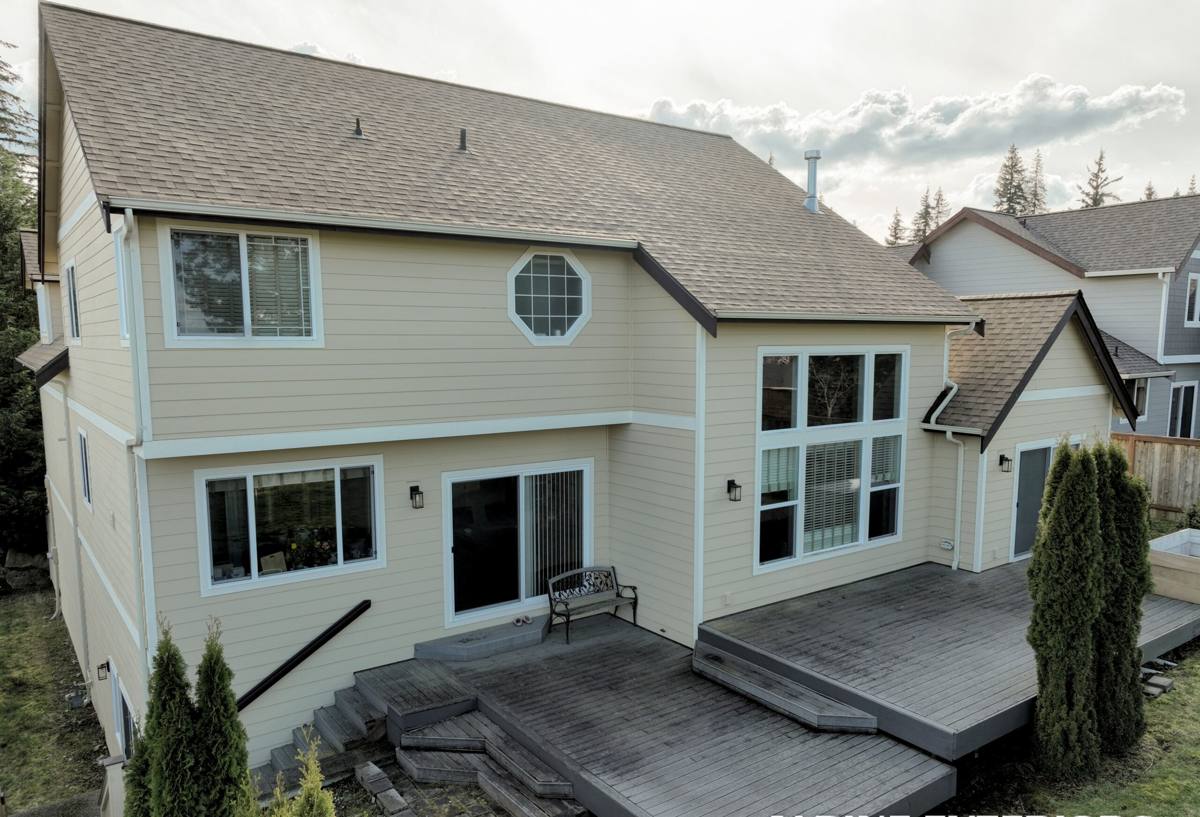
Why We Install Only James Hardie in This Area
We standardized on James Hardie fiber cement siding for every home we side, including here in Lynden, and we're upfront about why. It's not brand loyalty — it's what holds up under the specific punishment Whatcom County weather delivers.
- Non-combustible material — fiber cement doesn't feed a fire the way wood-based siding can.
- Dimensionally stable — it doesn't swell, cup, or warp with repeated wet-dry cycles the way engineered wood products do.
- Factory-applied ColorPlus finish — baked-on color that resists fading and chipping far better than field-applied paint, which matters when a house sits under near-constant cloud cover and moisture.
- Climate-engineered HZ product lines — Hardie's HZ10 formulation is built specifically for wetter, colder regions like the Pacific Northwest, not a one-size-fits-all national product.
- A real transferable warranty — backed by the manufacturer, not just the installer's word.
We don't install LP SmartSide, vinyl, Cemplank, Allura, primed spruce, or cedar. Some of those products are reasonable choices in drier climates or on a tighter budget, and we'll say that honestly if asked. But for what Lynden weather does to a wall over 20-plus years, we've made the call that Hardie is the product we're willing to put our name behind.
Salt Air, Driving Rain, and Moss — Addressed Individually
It helps to separate the three climate stresses, because each one attacks siding differently:
| Climate Factor | What It Does to Siding | How Hardie Handles It |
|---|---|---|
| Salt-influenced marine air | Accelerates corrosion of fasteners and trim, degrades unprotected finishes over time | Fiber cement doesn't corrode; we pair it with corrosion-resistant fasteners and flashing |
| Driving rain | Drives water sideways into laps, joints, and penetrations, not just straight down | Correct lap spacing, sealed joints, and a drainage plane behind the siding |
| Long moss/algae season | Holds moisture against the surface, stains and softens vulnerable materials | Dense fiber cement resists surface breakdown; factory finish resists staining better than field paint |
What a Correct Hardie Installation Actually Involves
James Hardie siding performs the way it's rated to perform only when it's installed to spec. A rushed or generic install undercuts the material's advantages and can void the warranty. On a Lynden home, we pay particular attention to:
Drainage and the Rain Screen Gap
Siding in a climate like this shouldn't sit flush against the wall assembly. We install a proper water-resistive barrier and maintain the gap that lets any moisture that does get behind the siding drain and dry out, rather than sit trapped against the sheathing.
Flashing at Every Penetration
Windows, doors, hose bibs, light fixtures, deck ledgers — every point where something breaks the plane of the wall is a spot where driving rain can find a way in. Flashing at these locations isn't optional trim work; it's the difference between a wall that sheds water and one that slowly absorbs it.
Fastening and Clearances
Hardie specifies fastener type, spacing, and placement for a reason — get it wrong and you create stress points where the board can crack or the finish can fail early. We also hold the manufacturer's minimum clearance from grade, decks, and roof lines, which matters more in a wet climate where standing water and splashback are common.
Caulking and Joint Treatment
Butt joints and trim transitions need the right sealant, applied correctly, not just enough to look finished. Done wrong, these are the first places moss and water intrusion show up.
Choosing the Right Hardie Product Line for Your Home
Not every Hardie product is the right fit for every house. Part of our process is walking through the options with you before anything is ordered.
| Product | Best For | Notes for Lynden Homes |
|---|---|---|
| HardiePlank lap siding | Traditional horizontal siding look | Most common choice; wide range of textures and exposures |
| HardiePanel vertical siding | Board-and-batten or modern styling, accent walls | Good for gables and mixed-material facades |
| HardieTrim | Corners, fascia, window and door surrounds | Matches the durability of the field siding instead of using softer trim material |
| HZ10 formulation | Homes in colder, wetter regions | Engineered for freeze-thaw and moisture cycling typical of Whatcom County |
Cost Factors Homeowners Should Know
We don't publish blanket prices because every home is different, but the real cost drivers are consistent. Understanding them upfront helps you get an accurate estimate instead of a rough guess.
- Current siding removal — tear-off complexity varies by what's underneath and whether the sheathing needs repair.
- Wall complexity — dormers, multiple gables, and cut-up facades take more labor than a simple rectangular wall.
- Product line and texture — panel vs. lap, smooth vs. woodgrain, and trim detail level all affect material cost.
- Moisture or rot repair — if we find damaged sheathing once the old siding comes off, that gets addressed before new siding goes up, not covered over.
- Color — factory ColorPlus finishes versus field-painted primed panels carry different pricing.
Our Process on a Lynden Project
- On-site assessment — we look at your current siding, wall condition, and any trouble spots (moss buildup, staining, soft spots) before quoting anything.
- Product and color selection — we walk through Hardie lines and ColorPlus options suited to your home's exposure and style.
- Detailed estimate — a written scope so you know exactly what's included, with no vague allowances.
- Tear-off and sheathing check — old material comes off, and we address anything we find underneath before moving forward.
- Weather barrier and drainage plane installation — the unglamorous layer that determines whether the siding actually performs.
- Hardie installation to manufacturer spec — correct fastening, flashing, clearances, and joint treatment throughout.
- Final walkthrough — we go over the finished work with you directly.
Why Hiring a Crew That Already Works in Lynden Matters
Fiber cement siding is not a forgiving material to learn on. A crew that regularly works Whatcom County jobs already knows how local wall assemblies are typically built, what moisture problems show up most often once old siding comes off, and how to detail flashing and drainage for the amount of driving rain this area actually gets — not a generic national average. That local repetition shows up in the small decisions: how tight to run a rain screen gap, where extra flashing is worth adding even though it's not the bare minimum, and which trouble spots on a house to check first.
It also means accountability. A local crew has a reputation in the community to protect and is easy to reach if a question comes up after the job is done — not a phone number tied to a company working three states away.
Maintaining Hardie Siding in a Wet Climate
Correctly installed Hardie siding is genuinely low-maintenance compared to wood-based alternatives, but "low-maintenance" isn't "no-maintenance." A little attention keeps it performing for decades:
- Rinse off moss, pollen, and organic buildup once or twice a year, especially on shaded north-facing walls.
- Keep gutters clear so overflow doesn't run down the siding face repeatedly.
- Trim back landscaping and tree limbs that keep a wall section shaded and damp longer than the rest of the house.
- Check caulking at trim joints and penetrations periodically and have any cracked sealant redone.
- Watch for any staining or discoloration that persists after cleaning — it's worth a look before it spreads.
If your Lynden home's siding is showing moss staining, soft spots, cracked boards, or you're just planning ahead for a replacement, we're happy to take a look and give you a straightforward, no-pressure estimate. Use the form below to get started.