 Bellingham Roofing
 Siding Replacement for York Homes: What Makes This Neighborhood Different
York is one of Bellingham's older, established residential neighborhoods, with a mix of early-1900s construction, mid-century homes, and newer infill scattered along its tree-lined streets. That age range matters when it comes to siding. A house built decades ago was likely sided with materials, house wrap, and flashing details that were standard for their era but don't hold up the way modern systems do under today's understanding of moisture management. When we replace siding on a York home, we're not just swapping old boards for new ones — we're often correcting decades of small building-science gaps that were invisible until the siding came off.
Homes in this part of Bellingham also sit under mature tree canopy more often than newer subdivisions do. That shade is part of what makes York a pleasant place to live, but it also means siding here deals with more standing shade, more organic debris in gutters and wall cavities, and slower drying times after every rain event. Any siding replacement plan for this neighborhood has to account for that.
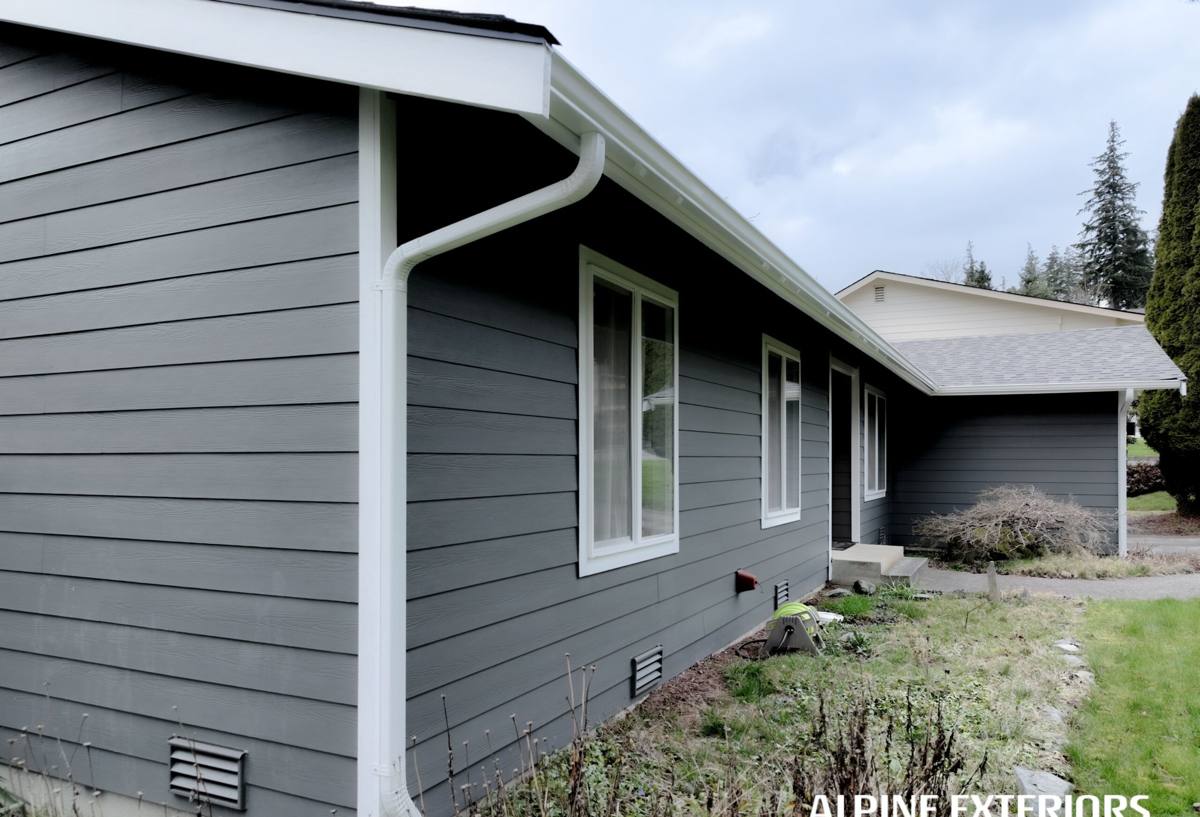
What Bellingham's Climate Does to Siding Over Time
Whatcom County's marine climate is mild, but "mild" doesn't mean gentle on a house. Three specific conditions do most of the damage to siding here, and they show up on York homes just like everywhere else in Bellingham.
Salt Air Off Bellingham Bay
Bellingham sits on saltwater, and prevailing winds carry salt-laden moisture well inland. Salt air accelerates corrosion on fasteners, flashing, and any exposed metal trim, and it speeds up the breakdown of paint films and lower-grade composite materials. Siding that isn't engineered to resist that exposure tends to chalk, fade, and fail faster here than the same product would in a dry inland climate.
Driving Rain
Storms off the Pacific don't just bring volume — they bring wind-driven rain that hits siding at an angle, working into laps, seams, butt joints, and anywhere caulking has started to fail. Over a wet season, that's thousands of small opportunities for water to find a gap. Siding systems and installation details that aren't built for wind-driven rain — not just vertical rain — are the ones that fail first.
A Long Moss and Mildew Season
Cool, damp, shaded conditions for much of the year create ideal growing conditions for moss, algae, and mildew on north-facing and tree-shaded walls. Beyond the cosmetic staining, sustained organic growth holds moisture against the siding surface far longer than the material would otherwise experience, which accelerates rot in wood-based products and breaks down paint and caulking faster than in drier climates.
Signs a York Home's Siding Needs Replacing, Not Just Patching
Not every siding problem calls for a full replacement. But there are signs that tell us patching would just be delaying the inevitable:
- Soft or spongy spots when you press on the siding, especially near the bottom courses or under windows
- Visible cracking, buckling, or warping across multiple sections rather than one isolated board
- Paint that won't hold anymore — it peels or bubbles again within a year or two of repainting
- Persistent moss or dark staining that comes back quickly after cleaning
- Gaps opening up at seams, corners, or trim that keep reappearing after caulking
- Rising energy bills alongside noticeably drafty rooms, suggesting the water-resistive barrier behind the siding has failed
If you're seeing two or more of these at once, especially on a home that's more than 20-25 years past its last full siding job, it's worth having someone look at the sheathing underneath — not just the surface.
Why We Install Only James Hardie Fiber Cement
We made a deliberate decision to install one siding system: James Hardie fiber cement. We don't install vinyl, LP SmartSide, Cemplank, Allura, primed spruce, or cedar, and that's worth explaining rather than just stating.
Vinyl is inexpensive and low-maintenance, but it's a petroleum-based product that expands and contracts significantly with temperature swings, can crack in impacts, and simply melts or warps if it's ever exposed to enough radiant heat. Wood-based composite siding and real wood or primed spruce products can look excellent when new, but they depend heavily on paint film and edge sealing to keep moisture out — and in a climate with this much sustained dampness and moss growth, any breach in that seal starts wood substrate breaking down from the inside, often before it's visible from the outside. Cedar is a beautiful, genuinely traditional Pacific Northwest material, but it requires ongoing maintenance — refinishing, sealing cut ends, watching for rot at grade — that many homeowners don't want to sign up for indefinitely.
James Hardie fiber cement is cement, sand, and cellulose fiber — it doesn't rot, it isn't attractive to insects, and it's non-combustible. Hardie's HZ5 product line is engineered specifically for climates with prolonged moisture exposure, which describes Whatcom County well. The factory-applied ColorPlus finish is baked on under controlled conditions rather than field-painted, which gives it better adhesion and UV resistance than site-applied paint, and it comes with a real transferable warranty backing both the substrate and the finish. That combination is why we standardized on it: it's the system that holds up to what this specific climate does to a house, year after year, without asking the homeowner to maintain it constantly.
What a Correct Siding Replacement Involves
Replacing siding correctly is not simply removing old boards and nailing up new ones. A job done right on a York home includes:
- Full tear-off and inspection — removing the existing siding to expose the sheathing, framing, and any hidden rot, especially around windows, corners, and the bottom few feet of wall where moisture tends to collect
- Sheathing repair — replacing any water-damaged OSB or plywood found underneath, rather than siding over it
- Water-resistive barrier — installing a proper weather-resistant house wrap, correctly lapped and taped, as the actual first line of defense against wind-driven rain
- Flashing at every penetration — windows, doors, vents, hose bibs, light fixtures, and anywhere else something passes through the wall plane, each detailed to shed water downward and outward
- Correct fastening and clearances — Hardie siding installed to the manufacturer's fastening schedule, with proper gaps at butt joints and at least a 6-inch clearance from grade, decks, and roof lines to keep splash-back and standing moisture away from the material
- Trim and caulking details — quality trim work and sealant at transitions, done in a way that won't need re-caulking every couple of years
Skip any one of these steps and you can end up with siding that looks correct for a few years while the underlying problem — the one you paid to have replaced — keeps developing behind it.
How Our Process Works, Start to Finish
Assessment and Estimate
We start with an on-site look at the current siding, the sheathing condition where accessible, and any specific trouble spots you've noticed — moss-heavy walls, soft areas, drafty rooms. From that we put together a clear, itemized estimate, including options across Hardie's product lines and colors.
Preparation
Before tear-off begins, we protect landscaping, walkways, and anything near the work area, and confirm access for material staging.
Tear-Off and Repair
Old siding comes off in sections so we can inspect and address sheathing issues as we go, rather than guessing at what's underneath before the estimate.
Installation
House wrap, flashing, and Hardie siding go on to manufacturer spec, with attention to the details that matter most in this climate — laps, fastening, and clearances.
Final Walkthrough
We walk the finished job with you, cover care and warranty registration, and make sure everything meets what was agreed to in the estimate.
Why a Crew That Already Works in York Matters
General exterior knowledge only goes so far. A crew that's worked repeatedly in York and similar Bellingham neighborhoods has already seen how homes of this vintage were built, what's commonly hiding under the existing siding, and how tree cover and drainage patterns on these lots tend to affect a wall system over time. That translates into fewer surprises mid-project, more accurate estimates up front, and a finished job that accounts for the site conditions instead of a generic installation checklist. It also means faster response if something needs a look after the job is done — we're not driving in from across the county.
What Affects the Cost of a Siding Replacement
Every home is different, but these are the main factors that move the price of a siding replacement up or down:
| Factor | Why It Matters |
|---|---|
| Home size and wall complexity | More square footage and more corners, gables, and dormers mean more material and labor time |
| Condition of existing sheathing | Hidden rot or water damage found during tear-off adds repair work before new siding can go on |
| Hardie product line chosen | Lap siding, shingle-style panels, and board-and-batten looks carry different material and labor costs |
| Color and finish selection | Factory ColorPlus finishes versus field-painted options affect both cost and long-term maintenance |
| Trim and detail work | Window and door trim, corner boards, and fascia detailing add time relative to a plain flat wall |
| Access and site conditions | Tree cover, tight lot lines, and multi-story walls affect staging, scaffolding, and time on site |
We walk through each of these during the estimate so there are no surprises once work begins — and any sheathing repair found during tear-off is discussed with you before we proceed, not billed after the fact.
What to Ask Before Hiring a Siding Contractor
Whether you call us or someone else, these questions will tell you a lot about who you're hiring:
- Do you inspect and repair sheathing as part of the job, or just install over what's there?
- What water-resistive barrier and flashing details do you use, specifically?
- Are you a certified installer for the siding brand you're proposing, and what does that warranty actually cover?
- Can you walk me through your fastening and clearance practices for this climate?
- What's included in your estimate versus what could come up as an added cost?
- Do you carry proper licensing and insurance for exterior work in Washington?
A contractor who answers these clearly and specifically, without hedging, is one who actually knows the work.
Ready to Talk About Your York Home's Siding?
If your siding is showing its age, holding moisture, or just past due for a real look, we're happy to come take a look and walk you through honest options — no pressure, no obligation. Use the form below to request a free estimate for your York-area home.