 Bellingham Roofing
 South Hill's Setting Is Beautiful — and Hard on Siding
South Hill sits up on the slope above downtown Bellingham, with views over Bellingham Bay and the harbor. That elevation and exposure are part of what makes the neighborhood desirable, but they're also exactly what wears out siding faster than in more sheltered parts of Whatcom County. Homes up here take a steadier dose of wind-driven rain off the water, carry a fine film of salt air on windward walls, and sit in the kind of shaded, damp microclimate that keeps moss and algae growing on siding, trim, and roofs for a good chunk of the year.
None of that is a reason to avoid living on South Hill — it just means the exterior envelope has to be chosen and installed with that exposure in mind. Siding that's fine in a dry inland climate can fail here years ahead of schedule. That's the starting point for every conversation we have with South Hill homeowners.
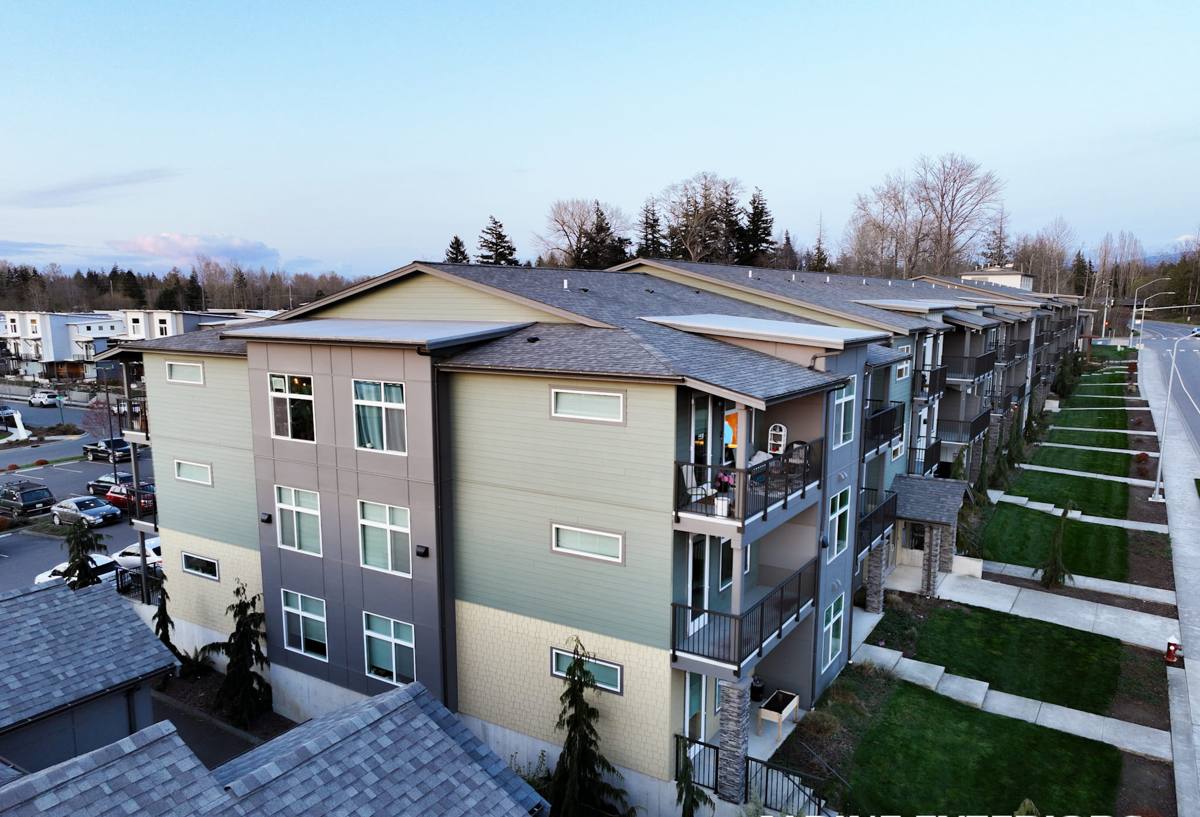
What South Hill Homes Actually Need From Their Siding
Three climate factors drive most of the siding problems we see on hillside and bay-facing homes in this part of Bellingham:
- Salt air: moisture carrying trace salt accelerates corrosion of fasteners and metal flashing, and it degrades finishes that aren't formulated to handle it.
- Driving rain: wind-driven rain doesn't just fall on siding, it gets pushed sideways into laps, joints, and penetrations — so the water management behind the siding matters as much as the siding itself.
- Long moss season: shaded north- and west-facing walls stay damp for months, which feeds moss, algae, and mildew growth on porous or absorbent siding materials.
Any siding product can look fine in a showroom. What separates a good long-term choice from a bad one is how it holds up to these three things, year after year, on an actual South Hill exterior wall.
Why We Install James Hardie — and Only James Hardie
We don't install vinyl, LP SmartSide, cedar, primed spruce, Cemplank, or Allura. That's a deliberate standard, not a sales pitch — we've made the call that James Hardie fiber cement is the product that holds up best against the specific conditions South Hill homes face, and we'd rather turn down a job than install something we don't believe in for this climate.
Non-combustible and dimensionally stable
Fiber cement doesn't expand and contract with moisture the way wood-based products do, and it won't rot or support insect damage. In a climate where siding stays wet for extended stretches, that stability matters more than in a drier region.
Built for this exposure: the HZ5 product line
James Hardie engineers its siding to different climate zones, and the HZ5 line is formulated for wetter, harsher climates like the Pacific Northwest — including moisture and impact resistance suited to the kind of driving rain South Hill sees regularly.
ColorPlus factory finish
Rather than field-painting a porous substrate, ColorPlus finish is baked on at the factory in multiple coats, which holds color and resists fading, chalking, and moisture intrusion far better than a job-site paint job — especially useful on a wall that's going to be rained on sideways for half the year.
What a Correct Installation Involves on a South Hill Home
Hardie siding is only as good as the installation behind it. On exposed, rain-heavy sites, the details that separate a correct job from a problem job include:
- Proper water-resistive barrier and flashing at every window, door, and penetration, lapped correctly so water sheds outward instead of behind the siding.
- Rainscreen gap where conditions call for it, giving any moisture that does get behind the cladding a path to drain and dry instead of sitting against the wall sheathing.
- Correct fastener spacing and type — corrosion-resistant fasteners driven to Hardie's specified depth, not overdriven or underdriven, since either mistake creates a failure point.
- Manufacturer-specified clearances from grade, roof lines, and decks, so splashback and standing moisture don't sit against the bottom edge of the siding.
- Sealed and caulked joints at butt joints and trim using products compatible with ColorPlus finish, not generic caulk that will fail early in a wet climate.
Skip any one of these steps and you can end up with moisture problems behind siding that otherwise looks perfectly installed from the street — which is exactly the failure mode we're guarding against on hillside, rain-exposed homes.
Our Process for South Hill Projects
We treat every South Hill estimate as its own site assessment, not a generic siding quote, because exposure varies a lot from one lot to the next depending on which direction a home faces and how much tree cover or wind break it has.
- On-site evaluation: we look at existing siding condition, moisture staining, moss buildup patterns, and how the home is oriented to prevailing wind and rain.
- Tear-off and sheathing check: removing old siding lets us inspect the wall sheathing underneath for hidden rot or moisture damage before anything new goes up.
- Water management install: weather-resistive barrier, flashing, and rainscreen detailing installed to spec, not shortcut.
- Hardie installation: HZ5 panels, planks, or trim installed to manufacturer fastening and clearance specs.
- Final inspection: checking joints, caulking, and clearances before we call the job done.
Because we work in this neighborhood regularly, we already have a feel for which walls on a given South Hill lot take the worst weather — that's not something you can get from a one-time out-of-town crew looking at a house for the first time.
Comparing the Options South Hill Homeowners Actually Ask About
| Factor | James Hardie Fiber Cement | Vinyl | Cedar / Wood-Based |
|---|---|---|---|
| Moisture behavior in driving rain | Stable, non-absorbent when installed to spec | Can flex and gap under wind-driven rain | Absorbs moisture, prone to swelling |
| Salt air / corrosion resistance | Fiber cement itself doesn't corrode; needs corrosion-resistant fasteners | Plastic resists corrosion but can become brittle over time | Fasteners and finish both vulnerable |
| Moss and algae resistance | Factory finish resists growth better than raw or field-painted surfaces | Resists moss but seams trap grime | Porous surface, prone to moss and mildew |
| Finish longevity | Factory-baked ColorPlus, many years before repaint needed | Color molded in, but fades and chalks over time | Requires repainting/staining on a regular cycle |
| Fire resistance | Non-combustible | Melts/deforms under heat | Combustible |
This isn't a knock on the other products — vinyl and cedar both have legitimate uses and plenty of homes wear them fine. It's why, given South Hill's specific exposure, we've standardized on the one option we're confident holds up the longest with the least maintenance headache.
Maintenance in a Moss-Prone Climate
Even the right siding needs basic upkeep, especially on shaded or bay-facing walls. A simple annual routine goes a long way:
- Rinse siding gently once a year to clear moss spores, pollen, and grime before they take hold — avoid high-pressure washing directly at joints and seams.
- Keep gutters clear so overflow doesn't run down and saturate wall sections.
- Trim back vegetation and tree limbs that keep a wall section shaded and damp longer than necessary.
- Check caulking at trim and joints every couple of years and have any cracked sections resealed.
- Watch for staining near the bottom edge of siding, which can signal splashback or a grading issue worth addressing early.
Warranty and Long-Term Value
James Hardie backs its siding with a strong, transferable warranty — a real factor if you ever sell the home, since it gives buyers confidence the exterior was done right. Combined with a correct installation, that warranty is part of why we treat Hardie as a long-term investment in the house rather than a cosmetic refresh. On a hillside, rain-exposed lot, the cost of doing the water management and fastening correctly the first time is far lower than the cost of tearing into a wall a decade early because moisture got behind an improperly installed product.
Why a Crew That Already Works South Hill Makes a Difference
South Hill has a mix of older and newer homes, varying lot grades, and enough tree cover in places to create genuinely different moisture conditions from one block to the next. A crew that's worked the neighborhood before isn't guessing at how a given wall will behave in a wet winter — they've seen it. That local pattern recognition, paired with installing a single product system to spec rather than juggling several different materials' quirks, is what keeps a siding job from turning into a callback.
If you're planning a siding project on South Hill, we're happy to walk the exterior with you, point out any moisture or moss issues already in play, and put together a clear, no-pressure estimate for a James Hardie installation built for this specific hillside climate. There's no obligation — just a straightforward look at what your home needs.