 Bellingham Roofing
 Siding That Has to Work in Barkley's Climate
Barkley sits close enough to Bellingham Bay and the surrounding wetlands that homes here deal with a specific combination of weather stress: salt-laden air drifting in off the water, long stretches of driving rain through fall and winter, and a moss season that can run most of the year in shaded, north-facing spots. Any siding material installed in Barkley has to hold up to all three at once, not just one of them. That's a tougher standard than most siding is designed to meet, and it's the reason we install James Hardie fiber cement exclusively rather than offering a menu of cheaper alternatives.
Salt air accelerates corrosion on fasteners and trim, and it breaks down paint film faster than it would further inland. Driving rain, especially when it comes sideways off the water during a windstorm, finds every gap in flashing and every seam that wasn't lapped correctly. And moss doesn't just look bad — it holds moisture against the siding surface for weeks at a time, which is exactly the condition that rots wood-based products and delaminates lower-grade composite panels. Whatcom County's mild, wet marine climate means siding rarely gets a chance to fully dry out between rain events, so whatever's on the wall needs to tolerate sustained dampness without breaking down.
Why We Standardized on James Hardie for This Area
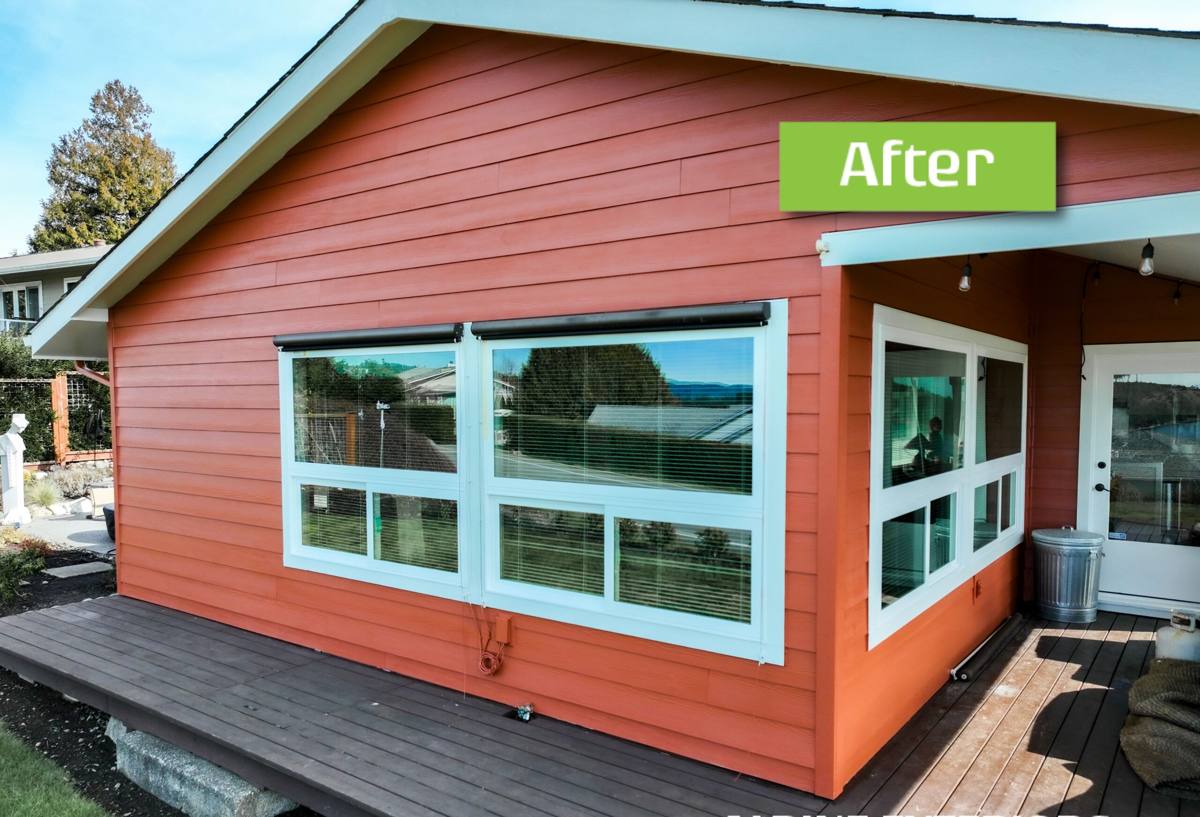
James Hardie fiber cement is cement, sand, and cellulose fiber — there's no wood content to rot, swell, or feed moss the way it feeds on organic material. It's also factory-primed or finished with ColorPlus technology, a baked-on finish that holds color and resists fading far better than field-applied paint, which matters when a house is going to see a lot of grey, overcast days and UV-punishing summer stretches in between. For Barkley specifically, that combination — no organic rot risk plus a factory finish that isn't relying on a paint crew's timing and conditions — is what makes the product worth the switch for homeowners moving off older wood or vinyl siding.
James Hardie also builds region-specific product lines engineered for different climate zones (their HZ5 and HZ10 designations, for example, address freeze/thaw and moisture exposure differently depending on where a home sits). We spec the right line for Whatcom County's marine climate rather than defaulting to a generic panel, which matters more here than in a drier inland market.
What This Means in Practice
- No wood fibers for moss, mold, or pests to take hold in
- Factory-applied finish reduces the repainting cycle homeowners are used to with cedar or primed wood siding
- Non-combustible core, which matters given regional wildfire smoke and ember exposure in dry summer stretches
- Product lines matched to marine/coastal exposure rather than a one-size-fits-all panel
What a Correct Installation Involves
Fiber cement siding is only as good as the installation behind it. Hardie's own warranty and installation instructions are specific about clearances, fastening patterns, and water management — and in a wet climate like Barkley's, skipping any of it shows up as a problem within a few years rather than decades.
Water Management Comes First
Before a single piece of siding goes up, the wall needs a properly lapped weather-resistant barrier, correctly integrated flashing at every window, door, and penetration, and a rainscreen or drainage gap where conditions call for it. In a driving-rain environment, water will get behind the cladding at some point — the question is whether it has a path to drain and dry out, or whether it sits against sheathing. This is the step that's invisible once the job is done, and it's the step that determines whether a house stays dry for the next 30 years.
Clearances and Fastening
Hardie specifies minimum clearances from grade, roof lines, and decks — typically several inches — to keep splashback and standing water off the bottom edge of the siding. Fasteners need to be corrosion-resistant (particularly important given the salt air here) and driven to the manufacturer's specified depth and pattern, not just "close enough." Over-driven or under-driven nails are a common source of cracked boards and premature failure, and it's one of the easiest things for a rushed crew to get wrong.
Joints, Caulking, and Trim
Butt joints need to be properly backed and sealed, trim needs the right gap and sealant, and every penetration (hose bibs, vents, light fixtures) needs to be flashed rather than just caulked over. Caulk is a maintenance item, not a waterproofing strategy — if a job relies on caulk to keep water out of an otherwise open joint, it will eventually fail.
Our Process for Barkley Homes
| Step | What Happens | Why It Matters Here |
|---|---|---|
| On-site assessment | We walk the exterior, check current siding condition, moss/moisture patterns, and existing flashing | Identifies problem areas specific to the lot's exposure and shade |
| Product selection | Match Hardie plank, shingle, or panel style and HZ line to the home's exposure | Salt air and rain exposure vary even block to block near the water |
| Tear-off and inspection | Remove old siding, inspect sheathing for hidden rot or moisture damage | Long-term moisture in this climate often hides damage until removal |
| Water barrier and flashing | Install or correct weather-resistant barrier, window/door flashing, drainage plane | This is the layer that actually keeps a house dry, not the siding itself |
| Hardie installation | Install to manufacturer clearance, fastening, and joint specifications | Ensures the transferable warranty stays valid and performance matches the product's design |
| Final walkthrough | Review finished work, caulking, and trim details with the homeowner | Confirms nothing was left as a "we'll get to it later" item |
Moss, Shade, and Site-Specific Factors in Barkley
Not every Barkley lot has the same exposure. Homes tucked under mature trees or facing north tend to hold moisture and grow moss on siding, roofing, and decking far more than homes with open southern exposure. That doesn't change what material we recommend, but it does change details in the installation — gutter and downspout placement, ventilation behind the cladding, and how aggressively we address existing moss and organic buildup on the wall and trim before new siding goes up. Fiber cement resists the rot moss causes, but moss left in place on adjacent trim, fascia, or roofing can still drop debris and hold moisture against a wall over time, so we look at the whole exterior system rather than siding in isolation.
Cost Factors Homeowners Should Understand
Every Barkley project prices out differently based on a handful of factors, and it's worth understanding them before comparing quotes:
- Tear-off scope — removing old wood or vinyl siding versus siding over an existing layer (which we generally don't recommend on a home with any moisture history)
- Sheathing repair — hidden rot found during tear-off adds cost but has to be addressed before new siding goes up
- Product line and profile — lap siding, shingle-style panels, and trim boards price differently, and the HZ line specified for coastal exposure can affect material cost
- Flashing and water management upgrades — bringing an older home's window and door flashing up to current standards
- Home size and complexity — roofline cuts, dormers, and multiple stories affect labor time
We give homeowners a broad range up front and a firm number after the on-site assessment — there's no way to accurately price a re-side without seeing the current condition of the walls.
A Practical Checklist Before You Hire
- Ask what siding material and specific product line is being proposed, and why
- Ask how water management (weather barrier, flashing, drainage) will be handled, not just the visible siding
- Ask whether the crew has installed Hardie products in this specific climate zone before
- Ask what the manufacturer's warranty covers and what voids it
- Get a written scope that includes tear-off, sheathing inspection, and disposal — not just "install siding"
Why Hiring a Crew That Already Works Barkley Matters
A crew that regularly works this specific area already knows which streets sit in year-round shade, which lots catch the worst of the wind off the water, and where moss and moisture problems tend to show up first. That local pattern recognition shortens the assessment, informs product and detail choices before problems appear, and means fewer surprises once tear-off starts. It's a different starting point than a crew working from a generic checklist with no sense of how this particular pocket of Bellingham behaves through a wet winter.
If you're considering new siding for a home in Barkley, we're happy to walk the exterior with you, look at the current condition of your walls and trim, and put together a straightforward, no-pressure estimate using the form below.