 Bellingham Roofing
 Birch Bay sits right up against the water, and that changes what a house needs from its siding. Homes a few miles inland in Bellingham deal with the same wet Pacific Northwest winters, but Birch Bay properties also take on salt-laden air off the bay, more sustained wind, and driving rain that hits walls at an angle instead of falling straight down. Add a moss season that runs longer here than in drier parts of the state, and you have an exterior that gets tested harder and more often than most.
Siding installation in a environment like this isn't just about picking a product and nailing it up. It's about how the wall assembly is built underneath, how water is directed away from the house, and how the finish holds up to salt, moisture, and shade over years, not just the first summer after install. This page covers what that actually looks like for a Birch Bay home.
What Birch Bay's Climate Actually Does to Siding
Whatcom County's coastal edge brings a few specific stressors that inland siding jobs don't have to fully account for:
- Salt air: Airborne salt accelerates corrosion on exposed metal fasteners, flashing, and trim, and it can degrade lower-grade coatings and finishes faster than a standard exterior-grade product is rated for.
- Wind-driven rain: Open exposure off the water means rain doesn't just fall on a wall, it gets pushed into laps, seams, and penetrations with real force. Any weak point in the water-resistive barrier or flashing gets found eventually.
- Extended moss and algae season: Shaded, damp, and humid conditions that stick around for much of the year give moss and algae a long runway to establish on any surface that holds moisture or organic residue.
- Temperature swings and material movement: Coastal humidity plus seasonal temperature shifts cause more expansion and contraction in some siding materials than homeowners expect, which stresses joints, caulk lines, and fastener points over time.
None of this means siding is a losing battle in Birch Bay. It means the material choice and the installation details matter more here than they would in a drier, more sheltered part of the region.
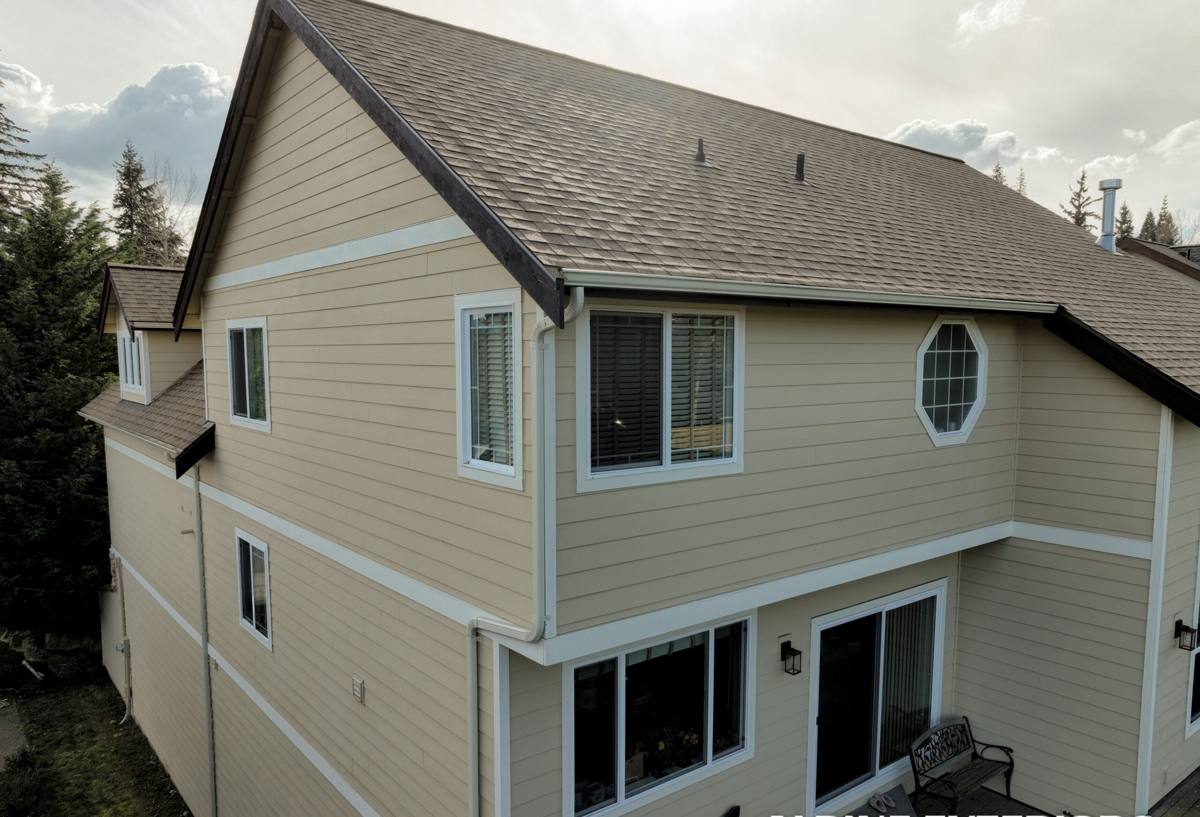
Why Material Choice Matters More on the Coast
Every siding material handles moisture and salt exposure differently, and the differences show up faster in a coastal environment than they would twenty miles inland. This is the core of why we standardized on one product line rather than offering several.
Wood-based and engineered wood products
Primed spruce, cedar, and engineered wood siding all rely on their coating and edge-sealing to keep moisture out of the wood fiber. In a high-humidity, high-exposure setting like Birch Bay, any gap in that protection, whether from a factory defect, a field cut that wasn't sealed, or years of coastal weathering, gives moisture a path into the substrate. Once wood fiber starts absorbing water, swelling, checking, and eventual rot follow. These products can perform well in the right hands and the right climate, but Birch Bay's coastal exposure is not a forgiving place for a moisture-sensitive substrate.
Vinyl siding
Vinyl is affordable and low-maintenance in a lot of climates, but it isn't rigid, and it isn't fire-resistant. In sustained coastal wind it can flex, rattle, or in worse cases pull loose from its fastening at the panel locks. Its color is baked through the material rather than applied as a separate finish coat, which helps with fading but doesn't address the panel's tendency to expand and contract more than a fiber cement product across a wide temperature range.
Fiber cement alternatives
Other fiber cement brands, Cemplank and Allura among them, share the same base material science as James Hardie: sand, cement, and cellulose fiber. The differences that matter to us are in the factory finish system, the specific climate engineering of the product line, and the manufacturer's installation specifications and warranty backing, all of which affect how well a board actually performs once it's on a wall facing Birch Bay's weather for the next thirty years.
Why We Install James Hardie Products Only
We made a deliberate decision to install one siding system: James Hardie fiber cement. A few reasons that decision holds up especially well in a coastal community like Birch Bay:
- Non-combustible material: Fiber cement doesn't feed a fire the way wood-based sidings can, which matters for insurance considerations and peace of mind regardless of location.
- HZ5 and climate-specific engineering: Hardie manufactures siding formulated for specific climate zones, including versions engineered for wet, humid, freeze-thaw Pacific Northwest conditions rather than a one-size-fits-all board.
- ColorPlus factory finish: A baked-on, multi-coat finish applied under controlled factory conditions holds color and resists fading, chipping, and moisture intrusion better than most field-applied paint jobs, and it comes with its own finish warranty.
- Dimensional stability: Fiber cement expands and contracts far less than vinyl or wood across temperature and humidity swings, which means tighter joints and fewer callbacks for caulk failure or panel movement.
- Warranty structure: Hardie backs its products with a strong, transferable limited warranty, which matters to homeowners planning to sell a coastal property down the road.
We're not installing it because it's the only option on the market. We're installing it because, board for board, it's the product we're willing to put our name behind on a house that's going to face Birch Bay's salt air and wind-driven rain every year it stands.
What a Correct Installation Actually Involves
The siding board itself is only part of the system. Most siding failures we see on coastal homes trace back to what happened underneath the visible surface, not the material itself. A correct installation in a Birch Bay setting includes:
Tear-off and substrate inspection
Old siding comes off and the sheathing underneath gets inspected for hidden moisture damage, soft spots, or rot before anything new goes up. Covering a compromised substrate just hides a problem that gets worse.
Water-resistive barrier
A continuous, properly lapped weather-resistive barrier goes over the sheathing before siding installation begins. In a high wind-driven-rain environment, how this barrier is lapped and sealed at seams, corners, and penetrations is arguably more important to long-term dryness than the siding material itself.
Flashing at every penetration
Windows, doors, vents, hose bibs, and any other wall penetration need proper flashing that directs water back out and away from the wall assembly, not just caulk covering a gap. Caulk fails; correctly installed flashing keeps working even after the caulk eventually does.
Fastening to manufacturer spec
Fastener type, spacing, and depth all follow Hardie's published installation instructions, adjusted for the local exposure category. Coastal fastening calls for corrosion-resistant hardware given the salt air, and getting the fastener pattern right is what keeps boards secure through sustained wind events.
Proper clearances
Siding needs the right clearance from grade, roofing, decks, and other transitions to avoid trapping moisture against the bottom edge of the board. This is a detail that's easy to shortcut and expensive to fix later.
Caulking and touch-up
Cut edges get sealed, joints get caulked with a product rated for the exposure, and any factory finish nicked during install gets properly touched up so the ColorPlus warranty stays intact.
Managing Moss and Algae on a Coastal Home
Moss and algae don't damage fiber cement siding the way they can compromise wood, but a heavy buildup traps moisture against the wall and looks bad fast in a shaded, humid setting like Birch Bay. A correct installation reduces the conditions moss needs to take hold: proper drainage clearance at the bottom of the wall, correct panel overlap so water sheds instead of pooling, and a factory finish that doesn't give algae and moss spores the same foothold that a porous, field-applied coating can. Homeowners still get the best results by keeping nearby vegetation trimmed back from walls and rinsing siding periodically, but the installation itself does a lot of the work.
Siding Material Comparison for Coastal Exposure
| Factor | James Hardie Fiber Cement | Vinyl | Wood / Engineered Wood |
|---|---|---|---|
| Salt air resistance | Strong, factory finish holds up | Moderate, can fade and chalk | Weak without diligent maintenance |
| Wind-driven rain tolerance | Strong when properly flashed | Moderate, panels can flex or loosen | Depends heavily on coating integrity |
| Fire resistance | Non-combustible | Combustible | Combustible |
| Moss/algae susceptibility | Low with correct install | Low to moderate | Higher, especially in shaded areas |
| Expected lifespan when installed to spec | Multiple decades | Fifteen to twenty-five years typical | Highly maintenance-dependent |
| Warranty | Strong, transferable | Varies by manufacturer | Varies, often shorter |
Our Process for Birch Bay Siding Projects
The steps don't change dramatically from house to house, but the details we pay closest attention to shift based on how exposed a given property is to wind and salt spray.
- On-site assessment: We walk the exterior, note the home's exposure to prevailing wind and water, check existing siding and trim for moisture damage, and look at flashing details around windows, doors, and rooflines.
- Scope and product selection: We recommend the Hardie product line and profile that fits the home's exposure and the owner's style preference, and walk through color options in the ColorPlus lineup.
- Tear-off and prep: Old siding comes off, sheathing gets inspected and repaired as needed, and any compromised framing is addressed before new material goes up.
- Weather barrier and flashing: We install and lap the water-resistive barrier and flash every penetration before the first siding board goes on.
- Siding installation: Boards go up to Hardie's fastening specification, with attention to coastal exposure requirements for fastener type and spacing.
- Finish and cleanup: Cut edges are sealed, joints caulked, touch-up applied where needed, and the site is cleaned of debris and old material.
- Warranty registration: We register the installation so the homeowner has both the product warranty and documentation of a spec-compliant install.
Signs a Birch Bay Home May Need New Siding
- Visible cracking, warping, or soft spots when pressed near the base of the wall
- Paint that's peeling or bubbling repeatedly in the same spots despite repainting
- Persistent moss or algae growth that comes back quickly after cleaning
- Rising energy bills that suggest the wall assembly is no longer sealing properly
- Visible gaps, loose panels, or fastener heads backing out after windy weather
- Musty smell or staining on interior walls that share an exterior wall with a problem area
Why Local Experience in Birch Bay Matters
A crew that's worked coastal Whatcom County properties knows to check flashing details differently on a wind-exposed wall than on a sheltered one, knows which fastener specs actually hold up once salt air gets into the equation, and doesn't need to relearn how a moss-prone shaded lot behaves compared to an open, sun-exposed one. That familiarity shows up in fewer callbacks and a siding job that's still doing its job fifteen and twenty years out, not just at the final walkthrough.
If you're weighing a siding project for a Birch Bay property, we're glad to come take a look, walk the exterior with you, and give you a straightforward, no-pressure estimate. There's a short form below to get that started.