 Bellingham Roofing
 Why Birchwood Decks Wear Out Faster Than Homeowners Expect
Birchwood sits close enough to Bellingham Bay and the surrounding waterways that salt-laden air is a constant, low-grade stress on exterior wood and metal. Combine that with Whatcom County's long stretch of driving rain each fall and winter, plus a moss season that can run from October well into spring, and a deck here ages differently than the same structure would in a drier inland climate. Fasteners corrode faster. Framing that never fully dries out starts to soften from the inside before the surface boards show much wear. Moss and algae hold moisture against the decking and the substructure underneath it, which is often where the real damage is happening while the top of the deck still looks fine.
We've replaced enough decks around Bellingham to know that a deck that "looks okay" from the top can be structurally compromised underneath. That's the gap this page is meant to close — what actually wears out in this climate, what a correct replacement looks like, and how we handle the job when we're on-site in Birchwood.
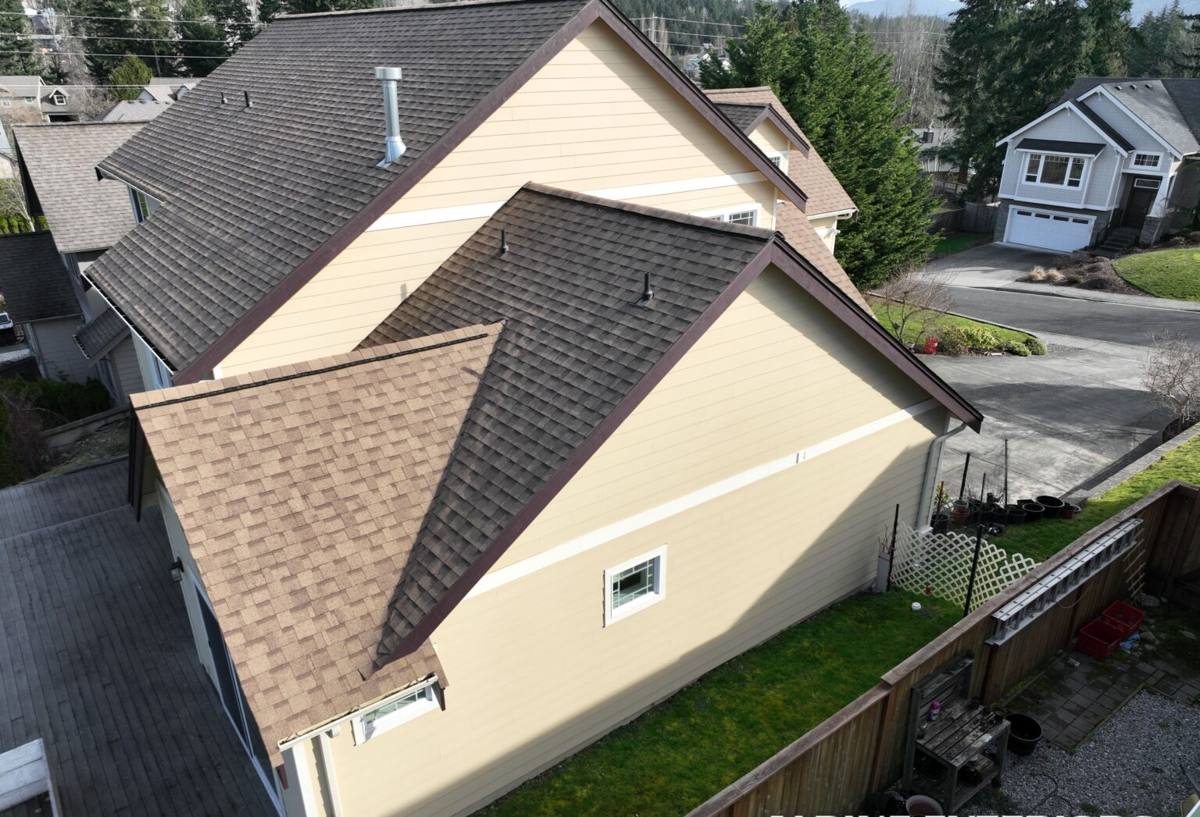
Signs a Birchwood Deck Needs Replacement, Not Just Repair
Not every aging deck needs a full tear-off. But there's a point where patching boards or sistering a joist is just delaying a bigger, more expensive failure. We look for a few specific signs before recommending full replacement over repair:
- Soft or spongy spots in the decking, especially near the house or in shaded corners where moss holds moisture
- Rust streaking or visible corrosion around fasteners, joist hangers, or ledger bolts
- Gaps or separation where the deck ledger meets the house — a common point of water entry and rot
- Persistent moss or dark staining that comes back within weeks of cleaning
- Railings or posts that flex or feel loose when you lean on them
- Visible checking, cupping, or splitting across multiple boards rather than just one or two
If the problems are isolated to a handful of boards and the framing underneath is sound, repair can make sense. If the issues show up in the framing, the ledger connection, or across most of the deck surface at once, replacement is usually the more honest recommendation — and the more cost-effective one over a five- to ten-year horizon.
What a Correct Deck Replacement Actually Involves
A deck replacement done right in this climate isn't just swapping old boards for new ones. It starts below the surface.
Ledger Board and Structural Framing
The ledger board — where the deck attaches to the house — is the single most common failure point on older decks in wet climates. If it wasn't properly flashed when installed, water works its way behind it and rots both the ledger and the rim joist it's bolted to. On a full replacement, we inspect and, where needed, replace the ledger with correct flashing so water sheds away from the house rather than pooling against it. We also check joists, beams, and posts for rot or undersizing relative to the deck's actual span and load, since older decks were sometimes framed to standards that wouldn't pass inspection today.
Footings and Post Bases
Ground contact and standing water are hard on footings over time. We check that posts sit on proper post bases rather than directly on concrete or soil, which keeps end grain away from moisture and extends the life of the structure significantly.
Decking Material Choices
Material choice matters more here than in drier regions, because everything is wet more often. The table below outlines how the common options actually perform under Whatcom County's rain and moss conditions, not just their price tag.
| Material | Moisture Behavior | Moss/Algae Resistance | Maintenance |
|---|---|---|---|
| Pressure-treated wood | Absorbs and releases moisture readily; prone to cupping if not sealed regularly | Low — needs regular cleaning to prevent buildup | Annual cleaning and re-sealing recommended |
| Cedar | Naturally more stable and rot-resistant than pressure-treated pine, but still an organic material | Moderate — still requires periodic cleaning | Sealing every 1-2 years to maintain appearance and performance |
| Composite decking | Doesn't absorb water the way wood does; won't rot or splinter | Better, though surface algae can still form in shaded, damp areas | Occasional washing; no sealing or staining needed |
| PVC/capped decking | Fully moisture-resistant surface; least affected by standing water | Best resistance to moss and algae buildup | Lowest — periodic rinsing is usually enough |
We install all of these materials and will walk you through the honest trade-offs for your specific deck — budget, sun exposure, and how much upkeep you actually want to do — rather than pushing one product as a universal answer.
Fasteners and Hardware
In a salt-air environment, fastener choice is not a minor detail. We use stainless steel or coated fasteners and connectors rated for ground-contact and coastal exposure, matched to whatever decking and framing material is being installed. Mismatched metals — for example, the wrong screw in contact with certain hardware — can accelerate corrosion, so compatibility matters as much as the fastener's individual rating.
Our Deck Replacement Process
We keep the process straightforward and communicate at each stage so there are no surprises partway through the job.
- On-site assessment. We inspect the existing deck, ledger connection, framing, and footings to determine what's driving the wear and whether repair or full replacement is the right call.
- Written estimate. You get a clear scope of work and pricing before anything is scheduled — no vague allowances that turn into surprise change orders.
- Demolition and disposal. The old deck is removed and hauled off, with attention to protecting landscaping and the area around the house.
- Framing and structural work. New or repaired ledger, joists, beams, and footings are installed to current structural standards, properly flashed at the house connection.
- Decking, railings, and hardware installation. Your chosen material goes down with corrosion-resistant fasteners, and railings are set to meet current guardrail height and spacing requirements for elevated decks.
- Final walkthrough. We go over the finished deck with you, including care and maintenance guidance specific to the material you chose.
What Deck Replacement Costs — and What Drives the Range
We don't publish a single flat number because deck cost depends heavily on size, material, and how much structural work is needed underneath. What we can offer is an honest breakdown of what actually moves the price.
| Cost Factor | Why It Matters |
|---|---|
| Deck size and shape | Larger decks and complex layouts (multiple levels, angles, built-in seating) require more material and labor |
| Decking material | Pressure-treated wood costs less upfront; composite and PVC cost more initially but reduce long-term maintenance |
| Framing condition | Rotted joists, a failed ledger connection, or undersized framing add structural work beyond a surface swap |
| Height and railings | Elevated decks require more substantial railings and post bracing than ground-level decks |
| Footings and post bases | Replacing or adding footings to meet current standards affects both labor and material cost |
| Access | Tight side-yard access or a deck that requires material to be carried in by hand can add labor time |
We'll always give you a real, itemized estimate for your specific deck rather than a ballpark that doesn't hold up once the framing is opened up.
Permits and Building Code in Whatcom County
Most deck replacements — especially anything involving structural framing, footings, or a deck attached to the house at a new or repaired ledger — require a building permit through the local jurisdiction. Guardrails on elevated decks, stair geometry, and ledger attachment methods are all points inspectors check closely, particularly in a wet climate where past shortcuts tend to show up as rot later. We handle the permitting process as part of the job so the finished deck is built to code, not just built to look finished.
Maintaining Your New Deck Through Bellingham's Wet Season
Whatever material you choose, a little seasonal upkeep goes a long way in this climate. A simple routine keeps moss from getting a foothold and keeps water moving off the deck instead of sitting on it:
- Sweep leaves and debris off the deck surface regularly, especially in fall
- Keep gutters and downspouts clear so runoff isn't draining directly onto the deck
- Clean visible moss or algae promptly rather than letting it spread
- Check that drainage gaps between boards stay clear of debris
- For wood decks, plan on re-sealing on the schedule appropriate to your species
- Inspect railings and stair connections once a year for looseness
Why Hire a Crew That Already Works in Birchwood
A deck replacement is only as good as the crew's understanding of what the local climate does to it over time. We work throughout Bellingham and Whatcom County, and Birchwood's mix of coastal moisture, moss pressure, and driving rain is territory we already know — not a first attempt. That means fewer surprises during the estimate, framing decisions that account for how wet this area actually gets, and fastener and material choices that hold up rather than needing attention again in a couple of years. It also means straightforward answers when you ask why we're recommending one approach over another, instead of a sales pitch.
If your deck is showing its age or you're just not sure whether it needs repair or full replacement, we're happy to take a look. Fill out the form below for a free, no-pressure estimate — we'll give you a straight answer about what your deck actually needs.