 Bellingham Roofing
 Birchwood's Siding Has to Work Harder Than Most
Birchwood sits close enough to the water and open exposure that homes here take a different kind of weather beating than siding installed further inland or up in the foothills. Whatcom County's marine climate means Birchwood houses deal with salt-laden air moving in off the bay, long stretches of driving rain pushed sideways by wind, and a moss season that can run eight or nine months out of the year on north- and west-facing walls. Siding that isn't built and installed for that specific combination doesn't fail dramatically — it fails slowly, in ways that are easy to miss until the sheathing behind it is already compromised.
Salt air is corrosive to exposed metal fasteners and trim, and it accelerates the breakdown of coatings that aren't formulated to resist it. Driving rain finds every gap in flashing, every under-caulked seam, and every place where siding was nailed too tight or lapped short. And moss doesn't just look bad — it holds moisture against the wall assembly, and moisture held against wood-based siding for months at a time is exactly how rot gets started. A Birchwood home needs a siding system and an installation crew that treat all three of those conditions as the baseline, not the exception.
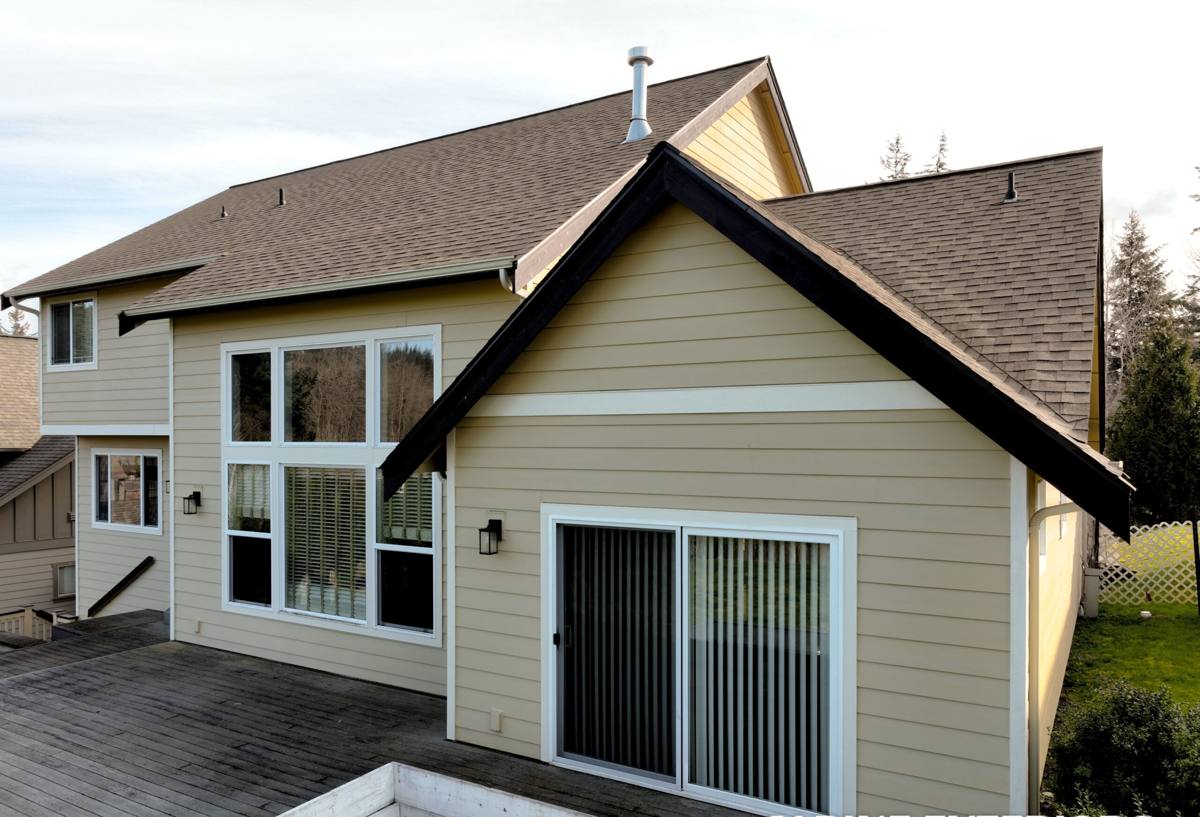
What "Correct" Siding Installation Actually Means Here
A lot of siding problems in this part of Bellingham aren't product problems — they're installation problems. The product on the wall matters, but how it's installed matters just as much, especially in a climate this wet. Correct installation for a Birchwood home includes:
- A drainage plane behind the siding — a water-resistive barrier installed shingle-style so any moisture that gets past the siding has somewhere to go besides the sheathing
- Proper fastener spacing and nail penetration so panels stay secure through wind-driven rain events without working loose over time
- Correct clearance at the ground, roofline, and any horizontal trim — gaps that let water shed away instead of wicking upward into the panel
- Flashing at every window, door, and penetration, installed in the right order so water is always directed outward and down, never trapped behind the cladding
- Caulking and sealant used only where the manufacturer specifies it — over-caulking can trap moisture just as badly as under-caulking lets it in
Skip any one of these and the siding may look fine for a few years while the damage builds behind it. This is the part of the job that separates a crew that's done this in Whatcom County's climate from one that's installing the same way they would in a dry inland market.
Why This Company Installs Only James Hardie Fiber Cement
We install James Hardie fiber cement siding exclusively. We don't offer vinyl, LP SmartSide, Cemplank, Allura, primed spruce, or cedar — not because those products can't be installed well by someone, but because we've made a standard for what goes on the homes we work on, and Hardie is the only product line that consistently meets it for this climate.
Fiber cement is non-combustible, which matters in a region that sees wildfire smoke and periodic burn-ban conditions in dry months. It doesn't expand and contract with moisture the way wood-based products do, which means it holds paint and caulk lines better over time instead of cracking or cupping at the seams. James Hardie's HZ5 product line is engineered specifically for climates like ours — cold, wet, high-moisture — and the factory-applied ColorPlus finish is baked on under controlled conditions rather than field-applied, which gives it better fade and moisture resistance than a job-site paint job and a longer, transferable warranty behind it.
None of that means other products are without merit — vinyl is inexpensive and low-maintenance in the right setting, and cedar has a natural look some homeowners want. But vinyl can warp under intense sun exposure and doesn't offer the fire resistance or rigidity of fiber cement, LP SmartSide requires diligent caulk and paint maintenance to keep engineered wood dry, and cedar demands a maintenance schedule most homeowners underestimate — especially in a climate where moss and moisture pressure never really let up. We'd rather install one product correctly, to spec, every time, than offer five options and hope each one gets the installation attention it needs.
How James Hardie Compares to the Alternatives
| Siding Material | Moisture Behavior in Wet Climates | Maintenance Burden | Fire Resistance |
|---|---|---|---|
| James Hardie Fiber Cement | Dimensionally stable, resists moisture-driven warping | Low — factory finish holds up for years | Non-combustible |
| Vinyl | Doesn't absorb water but can warp under heat/sun stress | Low, but limited repair options if damaged | Combustible, can melt/deform near heat sources |
| LP SmartSide / Engineered Wood | Vulnerable at cut edges and seams if not sealed diligently | Moderate — regular caulk/paint inspection needed | Combustible |
| Cedar | Absorbs moisture, prone to cupping and rot without upkeep | High — refinishing on a recurring cycle | Combustible |
This table reflects general product behavior, not a claim that every installation of every product fails — a well-maintained cedar or LP home can last a long time. It's a summary of why our standard for Birchwood installations lands on fiber cement.
Our Siding Installation Process for Birchwood Homes
Assessment and Wall Inspection
Before we quote a job, we look at what's actually happening behind the existing siding where it's accessible — signs of past moisture intrusion, sheathing condition, and how the current flashing and trim details are handled. This tells us whether it's a straightforward re-side or whether there's underlying repair work to address first.
Weather Barrier and Flashing Detail
Given how much driving rain Birchwood sees, we don't treat the water-resistive barrier as an afterthought. It's installed correctly, lapped in the right direction, and every window and door opening gets flashed before a single piece of siding goes up.
Installation to James Hardie Spec
We install to the manufacturer's published fastening, clearance, and joint requirements — not a shortcut version of it. This is also what keeps the transferable warranty intact if you sell the home down the road.
Final Walkthrough
We walk the finished job with you, cover care basics for ColorPlus finishes, and make sure every question about the installation is answered before we call it done.
Signs a Birchwood Home May Need New Siding Soon
Because siding failure in this climate is gradual, it helps to know what to watch for before it becomes a bigger repair:
- Persistent moss or algae growth that returns quickly after cleaning, especially on north- or west-facing walls
- Soft spots, bubbling, or visible warping in panels, particularly near the ground line or roof intersections
- Paint that's peeling or bubbling rather than just fading — often a sign of moisture trapped behind the surface
- Visible gaps or separation at seams, corners, and trim boards
- A musty smell or discoloration on interior walls that share an exterior with older siding
Any one of these on its own isn't necessarily an emergency, but ignoring several at once usually means the wall assembly is already dealing with moisture it shouldn't be.
Why It Matters That We Work Birchwood Specifically
Siding installation isn't one-size-fits-all across Bellingham. A house a few blocks from open water exposure needs different attention to flashing, fastener choice, and drainage detailing than a home tucked further inland with more tree cover. A crew that's worked Birchwood knows the general exposure pattern homes here face — sideways rain, salt-tinged air, and shaded areas where moss takes hold fastest — and installs accordingly instead of applying a generic approach and hoping it holds up.
That local familiarity also shows up in smaller decisions: how tight to run clearances near grade given the moisture load, where extra flashing attention pays off, and which parts of a Birchwood home's exposure tend to show wear first. None of that replaces a proper on-site inspection of your specific home, but it means the starting point is already informed by what actually happens to siding in this neighborhood over time.
What to Ask Before You Hire a Siding Contractor
Whatever contractor you choose for a Birchwood project, a few questions will tell you a lot about how they'll handle the job:
- Do you install to the manufacturer's published fastening and clearance specifications, or your own shortcut version?
- Who installs the weather-resistive barrier and flashing, and can you walk me through the sequence before siding goes up?
- Is your crew factory-trained or certified on the specific product you're installing?
- What does the manufacturer's warranty actually cover, and does it stay transferable if I sell the home?
- Can you show me how you'll handle the trim, corners, and ground clearance on my specific home?
A contractor who can answer these clearly and specifically — not with a generic sales pitch — is one who understands that the installation is at least as important as the product itself.
Get a Straight Answer on Your Birchwood Siding
If you're noticing moss buildup, soft spots, or paint failure on your Birchwood home, or you're just planning ahead for a re-side, we're happy to take a look and give you a clear, no-pressure assessment of what your home actually needs. Reach out using the form below to schedule a free estimate — no obligation, just a straight answer about your siding.