 Bellingham Roofing
 Composite Decking in Columbia: Built for Bellingham's Marine Climate
Columbia sits close enough to Bellingham Bay that homes here deal with the same weather pattern the rest of the city does, just with the added exposure that comes from being near the water: salt-tinged marine air, rain that drives in sideways as often as it falls straight down, and a moss season that can run most of the calendar year on shaded or north-facing surfaces. A deck is one of the most exposed structures on a property. It has no roof overhang protecting it, it sits low to grade where moisture collects, and it takes direct weather from every angle. When we build or replace a deck for a Columbia homeowner, we're building for that specific combination of conditions, not for a generic climate spec sheet.
Composite decking has become the material we recommend most often in this neighborhood, and for good reason given what wood decking tends to go through here. But composite isn't a single product that behaves the same way regardless of who installs it or which board line gets used. The material choice matters, and so does the framing and fastening underneath it, which is where a lot of decks in this climate actually start to fail.
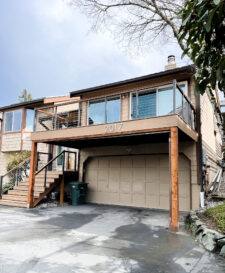
What Bellingham Bay's Climate Does to a Deck
Salt Air and Metal Fasteners
Homes near the bay get a steady flow of moisture-laden, salt-tinged air, not just on stormy days. That kind of sustained exposure is hard on the metal hardware holding a deck together: fasteners, joist hangers, brackets, and ledger bolts. Lower-grade or improperly coated hardware can start corroding years before the decking boards themselves show any wear, and once fasteners weaken, the structural integrity of the deck is compromised even if the surface still looks fine.
Wind-Driven Rain and Standing Moisture
Rain in this part of Whatcom County doesn't just fall, it gets pushed by wind coming off the water. On a deck, that means water finds its way into board gaps, ledger connections, and post bases from angles a simple drainage plan won't account for. Add in Bellingham's relatively low evaporation rate during the wetter months, and moisture can sit against framing and fasteners far longer here than it would in a drier inland climate.
A Long Moss and Mildew Season
Mild temperatures, tree cover, and consistent dampness add up to extended moss and algae growth on decks across Bellingham, and Columbia's mix of mature landscaping and proximity to the water doesn't help. Any decking surface with even slight porosity becomes a growth surface over time, and moss on a walking surface isn't just unattractive, it's a slip hazard that gets worse the longer it's left alone.
Why Composite Decking Fits This Climate
Wood decking, even pressure-treated lumber, is an organic material that absorbs and releases moisture with the seasons. In a climate this consistently wet, that cycle accelerates cupping, splintering, and fastener pull-through, and it puts the homeowner on an ongoing schedule of sealing, staining, and board replacement to keep ahead of it. Composite decking, made from a blend of wood fiber and recycled plastic, doesn't absorb moisture the way solid wood does, which means it doesn't swell, crack, or rot the same way. That's the core reason we lean toward composite for decks in Columbia and elsewhere around the bay.
That said, composite isn't maintenance-free in an absolute sense, and we don't tell homeowners it is. It still needs periodic cleaning to keep moss and algae from taking hold, and the quality of the board itself makes a real difference in how it performs over a decade or two near salt air.
What We Look For in a Composite Board
- A capped profile: Boards with a polymer cap fully encasing the wood-plastic core resist moisture intrusion and staining far better than uncapped composite, especially at cut ends.
- UV-stable color formulation: Fading is a real issue with cheaper composite lines; a board engineered for UV stability holds its color longer under the Pacific Northwest's mix of sun and constant damp.
- Hidden fastener compatibility: A board system designed for a concealed clip fastener gives a cleaner surface with fewer exposed screw heads for water and grime to collect around.
- A real manufacturer warranty: Composite decking warranties vary widely in length and what they actually cover; we check the fine print before recommending a line, not just the marketing claim.
We don't chase the cheapest composite board on the market. A budget composite line that fades, stains, or delaminates within a handful of years ends up costing a homeowner more in the long run than paying for a properly engineered product up front.
What a Correct Composite Deck Installation Actually Requires
The decking boards are only part of the job. A composite deck that holds up in this climate depends on what's underneath it just as much as the surface material.
- Ledger flashing done right: Where the deck attaches to the house, correct flashing keeps water from tracking behind the siding and into the wall assembly, one of the more common sources of hidden rot we find on older decks.
- Corrosion-resistant hardware: Stainless steel or coated structural hardware rated for the exposure this deck will actually see, not generic fasteners that weren't chosen with salt air in mind.
- Proper joist spacing for the board span: Composite boards have manufacturer-specified joist spacing requirements, and undersized spacing leads to bounce, sag, and premature board fatigue.
- Adequate drainage and airflow underneath: A deck built low to grade without ventilation traps moisture against the framing regardless of what decking material sits on top.
- Correct board gapping: Composite expands and contracts with temperature more than people expect; gapping installed too tight can buckle boards during a warm stretch.
A rushed or corner-cut substructure is one of the most common reasons a good composite product develops problems that get blamed on the material instead of the installation.
Composite vs. Other Decking Materials
| Material | Moisture Behavior in This Climate | Ongoing Maintenance |
|---|---|---|
| Composite (capped) | Resists swelling, rot, and splintering; doesn't absorb standing moisture | Periodic cleaning to prevent moss and algae buildup |
| Pressure-treated wood | Absorbs and releases moisture seasonally; prone to cupping and splitting near the bay | Regular sealing or staining, typically every one to three years |
| Cedar | Naturally moisture-resistant but still an organic material that weathers and grays | Sealing or staining to preserve color and slow weathering |
| PVC/plastic decking | Fully moisture-immune but can feel and look less natural underfoot | Low; occasional cleaning |
Composite Decking Cost Factors in Columbia
| Factor | What It Affects | Why It Matters Here |
|---|---|---|
| Deck size and layout complexity | Total material and labor | Multi-level decks and angled cuts common on Columbia's varied lots add labor and waste |
| Substructure condition | Whether framing can be reused or needs replacement | Older decks near the bay often have hidden fastener corrosion or ledger rot not visible from the surface |
| Board line and cap type | Material cost and long-term durability | A fully capped board costs more up front but resists this climate's moisture and staining far longer |
| Railing and fastening system | Material and labor cost | Corrosion-resistant railing hardware is worth the added cost this close to salt air |
| Site access | Labor time and equipment needs | Sloped or landscaped lots typical in Columbia can add setup and material-handling time |
Real numbers depend on the specific property, which is why we walk the site and look at the existing structure before quoting rather than pricing off square footage alone.
Signs Your Columbia Deck Needs Attention
- Moss or algae that returns quickly after cleaning, especially on shaded sections
- Soft, spongy, or visibly sagging boards, particularly near the house or stair stringers
- Rust staining around fasteners or visibly corroded hardware
- Gaps or separation at the ledger board where the deck meets the house
- Boards that have cupped, split, or splintered
- Railing posts that feel loose or move under light pressure
Any one of these is worth a look before it turns into a structural issue rather than a cosmetic one.
Our Process for Columbia Homeowners
We start with an on-site walkthrough, not a phone estimate, because deck condition and yard layout vary too much to price accurately any other way. We check the existing substructure if there is one, note drainage and grade conditions around the deck footprint, and talk through board and railing options based on how the space actually gets used. From there we handle permitting where required, framing and ledger work, decking installation, and a final walkthrough so you know exactly what was done and what maintenance, if any, to expect going forward.
Why Hiring a Crew That Works Columbia Regularly Matters
A contractor who works this stretch of Bellingham regularly has a feel for how bay-adjacent exposure actually plays out on a deck over years, not just how a product performs on a spec sheet. That shows up in small decisions on install day: which fastener grade is worth the upgrade, where extra flashing attention pays off at the ledger, and which board lines have held up on other decks in this same salt-air, high-moss environment. Columbia's mix of established landscaping, sloped lots, and closeness to the water isn't identical to conditions further inland in Whatcom County, and a crew with hands-on local experience accounts for that instead of applying a one-size-fits-all approach.
If you're considering a new deck or need an honest look at one that's showing its age, we're glad to come take a look. Reach out using the form below to schedule a free, no-pressure estimate.