 Bellingham Roofing
 Roofing in Cordata Has to Answer to the Weather
Cordata sits in north Bellingham, and like the rest of Whatcom County it gets the full package: wind-driven rain off the water, salt-laden marine air, and a moss season that can run most of the year under the right (or wrong) conditions. An asphalt shingle roof here isn't just protecting a house from rain falling straight down — it's fighting rain that gets pushed sideways under poorly sealed tabs, air that slowly corrodes exposed metal fasteners, and moss that roots into shingle granules and lifts them from underneath. A roof installed the way a catalog says to install it, without accounting for any of that, tends to show its age early.
We work on homes throughout Bellingham and Whatcom County, and Cordata's mix of older single-family homes and newer construction means we see the full range: roofs that were fine in a drier climate but were never detailed for sustained coastal moisture, and newer roofs that skipped ventilation upgrades because the original builder was working to a budget, not a 30-year lifespan. Either way, the fixes and the standards we build to are the same.
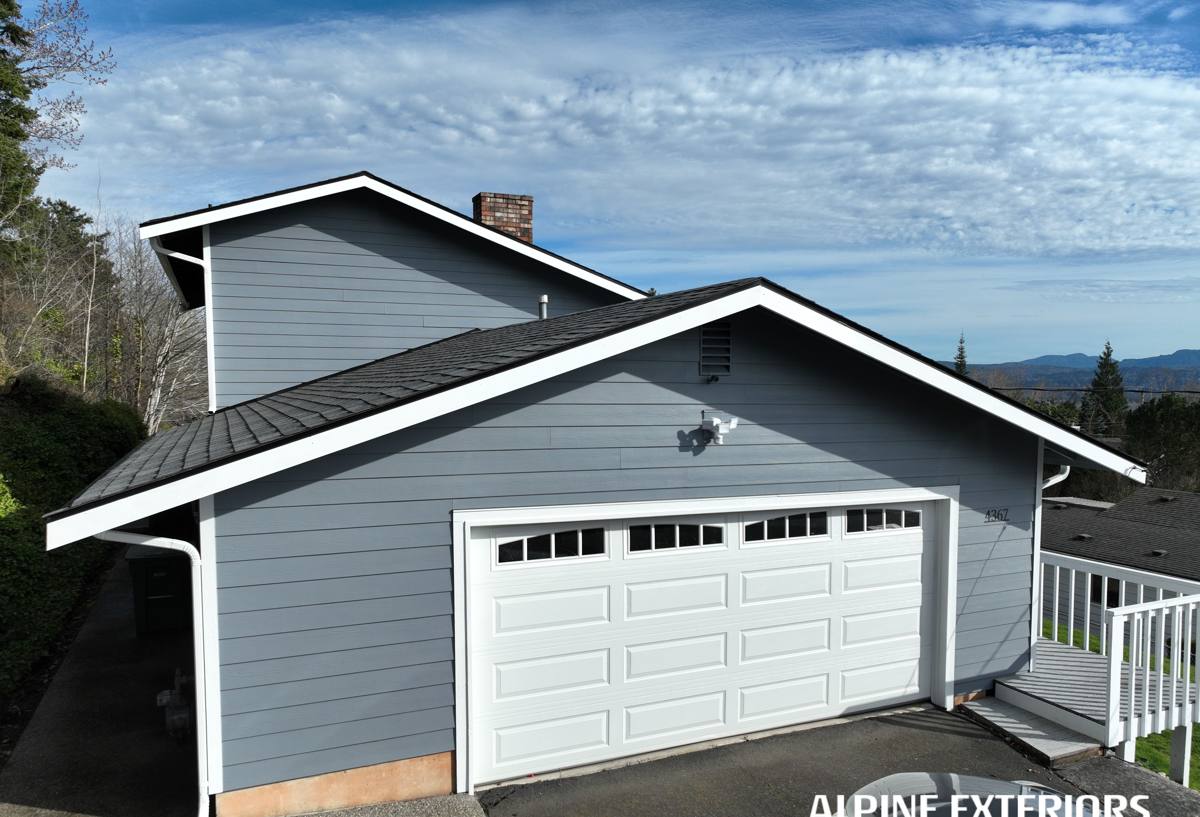
What Actually Wears Out an Asphalt Shingle Roof Here
Moss and Organic Growth
Moss doesn't just sit on top of shingles — it holds moisture against the surface and works its way under the shingle edge and between granules. Over a few seasons that lifts tabs, breaks the seal strip, and opens a path for water. In Cordata's shaded lots and tree-lined streets, north-facing slopes and anything under overhanging branches are the first areas to show green or black streaking.
Wind-Driven Rain
Storms coming off the water don't always drop rain straight down. Gusty, sideways rain finds any gap in a shingle seal, any short nail, or any valley that wasn't lined properly, and pushes water uphill under the shingle course above it. This is why nailing pattern, seal-strip activation, and valley detail matter more here than they would in a calmer, drier climate.
Salt Air and Corrosion
Being close enough to the water to get salt in the air means exposed fasteners, cheap flashing, and unprotected metal drip edge corrode faster than they would further inland. Rust streaks running down a roof slope are usually a sign that the original flashing or fastener grade wasn't suited to a marine climate.
What a Correct Install Looks Like for This Area
A shingle roof is a system, not a single product. Every layer underneath the shingles has to be right for a wet, wind-exposed climate, or the shingles on top are only as good as the weakest layer below them.
- Ice-and-water shield membrane at eaves, valleys, and around every penetration — not just the minimum code requires, but everywhere wind-driven rain is likely to push water backward
- Synthetic underlayment across the full deck, properly lapped and fastened, as the secondary water barrier
- Starter strip at eaves and rakes so the first course has full adhesive contact and wind resistance from day one
- Correct nailing pattern and nail placement — high nails are one of the most common causes of early blow-offs we find on older Cordata roofs
- Metal or woven valleys installed to spec, not just shingles cut and laid over each other
- Corrosion-resistant flashing and fasteners around chimneys, skylights, and sidewalls, sized for coastal exposure
- Balanced intake and exhaust ventilation, so moisture from inside the house isn't adding to what the weather is already doing to the roof deck
Skipping any one of these doesn't usually cause an immediate leak. It shows up two, five, or ten years later as a soft spot, a stain on a ceiling, or shingles that granule out and curl years before they should.
Shingle Options for Cordata Homes
We install both 3-tab and laminated (architectural) asphalt shingles, and which one makes sense depends on the roof's exposure, the home's style, and the budget. Here's how they compare for a climate like this one.
| Factor | 3-Tab Shingles | Architectural (Laminate) Shingles |
|---|---|---|
| Wind resistance | Lower rated, more prone to lifting in gusty coastal storms | Higher rated, better holding power in driving wind |
| Moss resistance options | Available with algae-resistant granules | Available with algae-resistant granules, often standard |
| Typical lifespan in this climate | Shorter, especially with heavy moss exposure | Longer, thicker construction sheds moisture better |
| Appearance | Flat, uniform tab lines | Dimensional, shadow-line look |
| Upfront cost | Lower | Higher, but often lower cost per year of service life |
For most full re-roofs in Cordata we recommend a laminated shingle with algae-resistant granules as the baseline, simply because the wind and moss exposure here tends to shorten the life of a lighter 3-tab product. That said, 3-tab shingles are still a reasonable, lower-cost option for a garage, shed, or a roof with a shorter expected ownership horizon.
Impact-Rated and Heavier Shingle Lines
Some homeowners ask about impact-rated shingles, usually after hail elsewhere in the country makes the news. Hail isn't the main driver of shingle damage in Whatcom County, but the heavier mat construction in these product lines also tends to hold up better against wind uplift and moss intrusion, which is relevant here. We can walk through whether the upgrade cost makes sense for a specific roof.
Our Process, Start to Finish
- On-site inspection. We walk the roof (or use a lift where pitch or access makes that unsafe) and check the deck, flashing, ventilation, and any moss or wear patterns before we quote anything.
- Written estimate. You get a clear scope of work — tear-off or overlay, underlayment and ice-and-water plan, shingle selection, flashing and ventilation work — with a price attached to it, not a vague number.
- Deck check during tear-off. Old shingles come off and we inspect the actual plywood or plank decking underneath. Soft or delaminated sections get replaced before anything new goes down; this gets communicated and priced before we proceed, not discovered as a surprise on the invoice.
- Underlayment and flashing. Ice-and-water membrane, synthetic underlayment, and new flashing go in to the standard described above, sized for this climate rather than a generic minimum.
- Shingle installation. Correct starter course, nailing pattern, and valley work, installed to the manufacturer's specification so the warranty is actually valid if you ever need it.
- Ventilation check. We confirm intake and exhaust are balanced, and recommend upgrades where the attic isn't breathing the way it should.
- Cleanup and magnetic sweep. Old material and debris hauled off, yard and driveway swept for stray nails before we consider the job done.
- Final walk-through. We go over the finished roof with you and answer any questions before we call it complete.
Common Problems We Get Called Out for in Cordata
- Moss buildup and the granule loss or staining left behind after it's removed
- Shingle tabs lifted or torn off after a windstorm, usually starting at ridges, hips, or roof edges
- Nail pops working through the shingle surface, often from a rushed original install
- Rust streaking from corroded flashing or fasteners not rated for salt air exposure
- Slow leaks around chimneys, skylights, or wall-to-roof transitions where flashing has failed
- Dark streaking from algae growth, which is a cosmetic issue that eventually affects granule retention
Most of these are fixable without a full replacement if they're caught early, which is the real value of an annual or post-storm inspection rather than waiting for a ceiling stain to force the issue.
Keeping a New Roof Performing Once It's Installed
A well-installed shingle roof in this climate should need very little from you, but a little attention goes a long way against moss and coastal wear.
- Keep gutters clear so water isn't backing up under the eave edge, especially during heavy fall rain
- Trim back overhanging branches to cut down on shade, debris, and moss spores landing on the roof
- Have moss treated or gently removed before it establishes rather than after it's visibly thick
- Check attic ventilation isn't blocked by insulation, which traps moisture against the underside of the deck
- After any significant windstorm, do a visual check (or have us do one) for lifted or missing tabs
- Address small leaks immediately — a stained ceiling patch is almost always cheaper than the deck repair that follows if it's ignored
What Drives the Cost of a Cordata Re-Roof
Every roof is different, and we won't quote a number without seeing the actual roof, but these are the factors that move the price up or down.
| Cost Factor | Why It Matters |
|---|---|
| Roof size and number of stories | More square footage and steeper access both add labor time |
| Roof pitch and complexity | Steep slopes, multiple valleys, and dormers all slow installation and require more flashing detail |
| Tear-off vs. overlay | A full tear-off costs more upfront but is the only way to properly inspect and repair the deck |
| Decking condition | Soft or rotted plywood found during tear-off adds material and labor to replace it |
| Shingle grade selected | 3-tab, standard architectural, and heavier impact-rated lines each carry different material costs |
| Ventilation upgrades | Adding proper intake or exhaust venting where none existed is an added but worthwhile line item |
| Access and site conditions | Steep driveways, limited staging area, or difficult roof access can add setup time |
As a broad range, straightforward asphalt shingle re-roofs on typical Cordata homes tend to fall in the mid-to-high five figures for larger or more complex roofs, and lower for smaller, simpler ones — but the only way to get a real number is a site visit, which is why we quote in person rather than over the phone.
Why It Matters That We Already Work in Cordata
A crew that mainly works other climates will often install a roof to a generic national spec and call it done. A crew that works Bellingham and Whatcom County every week already knows which slopes hold moss longest, how far wind-driven rain can push under a poorly sealed shingle, and which flashing and fastener grades actually hold up against salt air over years, not just through the warranty inspection. That local pattern-recognition is the difference between a roof that's technically installed correctly and one that's actually built for where it sits.
We're not asking you to take our word for the climate risks — moss, wind, and salt air are simply facts of living in this part of Washington. What we control is whether the roof we install accounts for them, from the first layer of underlayment to the last swept nail in the driveway.
If you're dealing with moss, a nagging leak, or you're just due for a straightforward asphalt shingle roof in Cordata, we're happy to take a look and give you a clear, honest estimate — no pressure, no obligation. The form below gets you started.