 Bellingham Roofing
 Cordata's Climate Is Harder on Siding Than It Looks
Cordata sits in north Bellingham, close enough to the Salish Sea and the marine air that moves through Whatcom County that homes here deal with a specific combination of stresses most siding products were never engineered around: salt-laced air, long stretches of driving rain off the water, and a moss season that can run from fall through spring. None of these individually is dramatic. Together, over years, they're what separates a siding job that still looks sharp at year fifteen from one that's swelling, staining, or delaminating by year eight.
Salt air accelerates corrosion on fasteners and trim metal and speeds the breakdown of lower-grade coatings. Driving rain, especially on west- and south-facing walls, pushes moisture into any seam, lap, or fastener hole that wasn't detailed correctly. And moss and algae, which thrive in Bellingham's shaded, moist microclimates, hold water against the wall surface far longer than an open, sun-exposed wall would ever see. Any siding product can survive one of those conditions. Cordata homes get all three, most winters.
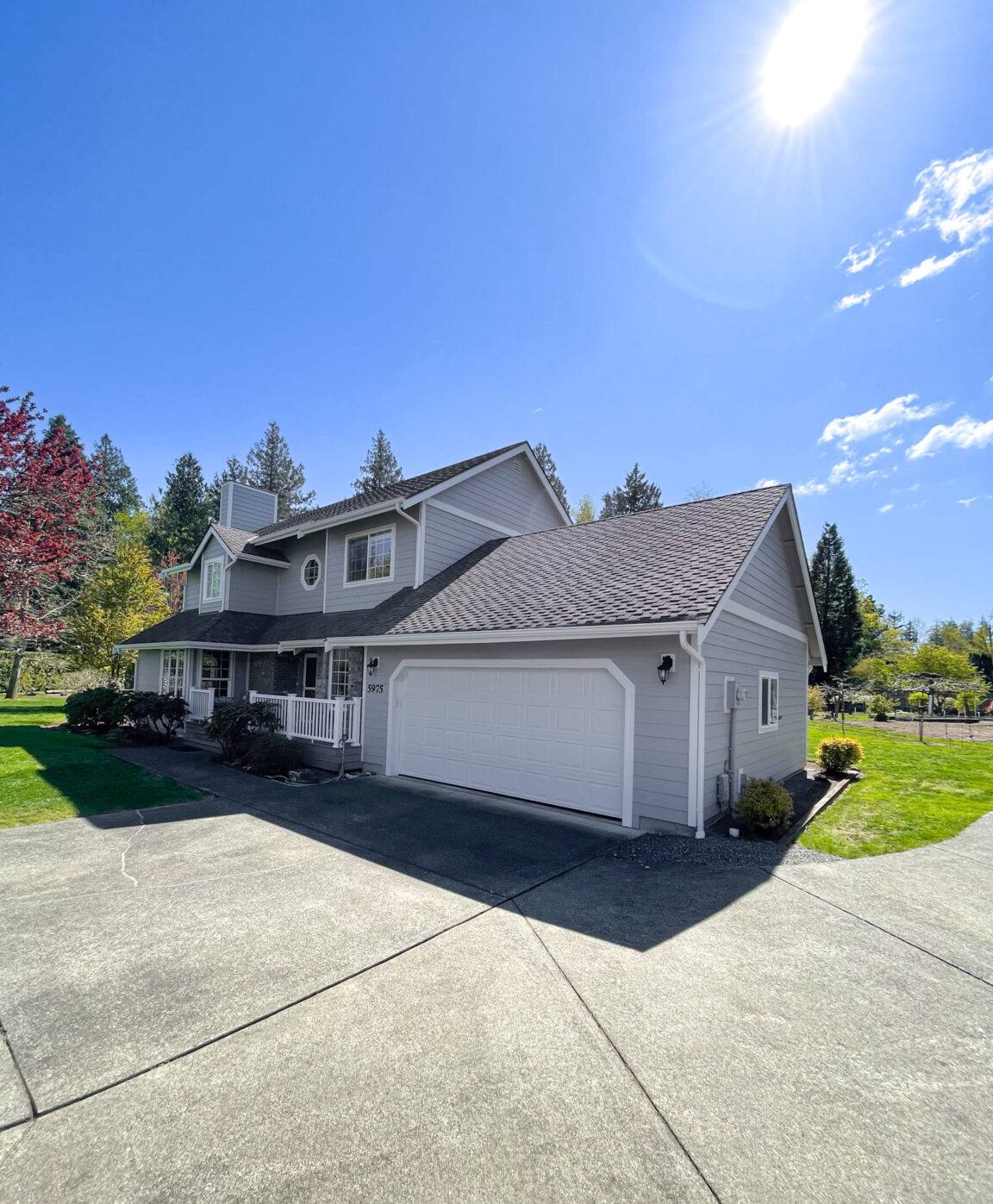
Why We Only Install James Hardie Fiber Cement Here
We standardized on James Hardie fiber cement for every home we side in Whatcom County, Cordata included, because it's engineered for exactly this combination of climate stresses. Hardie's HZ5 product line is formulated for regions with harsher moisture and freeze-thaw exposure, and the material itself is non-combustible, dimensionally stable, and doesn't feed moss and algae growth the way wood-based products can.
The factory-applied ColorPlus finish matters just as much as the substrate. It's baked on under controlled conditions, which gives it far better adhesion and UV stability than a field-applied paint job, and it holds color and sheen through the gray, wet stretches of a Bellingham winter without the chalking or fading you see on older painted siding. Combined with Hardie's transferable warranty, it's a system built to be maintained, not repainted every few years out of necessity.
What This Means Day to Day for a Cordata Homeowner
- Less vulnerability to moisture wicking at laps and butt joints when the install is detailed correctly
- A painted surface that doesn't need recoating on the same short cycle as wood or primed products
- A siding material that won't support rot or insect damage the way wood-based sidings can
- A finish engineered to resist the fading and chalking that marine UV and moisture cause over time
What a Correct Fiber Cement Installation Actually Involves
Fiber cement siding is only as good as its installation. Most of the failures we see on older homes in this area aren't material failures — they're install failures: wrong fasteners, missing or undersized clearances, caulking used where flashing should have been. A correct Hardie install on a Cordata home includes:
- A weather-resistive barrier installed and lapped correctly behind the siding, with all penetrations flashed before the first board goes up
- Proper starter strip and consistent reveal so water sheds off each course instead of tracking backward under the lap above
- Correct fastener type, spacing, and embedment depth — Hardie specifies these for a reason, and under-driven or over-driven nails are one of the most common causes of early failure
- Rigid clearance gaps at grade, roofline, decks, and any hardscape, so the board bottom edge never sits in standing water or gets buried under mulch or soil
- Caulking used only where the manufacturer specifies it, never as a substitute for flashing at windows, doors, and butt joints
- Factory-cut and factory-primed edges preserved wherever possible, with any field cuts sealed per Hardie's specification
Skipping any one of these doesn't usually show up in year one. It shows up in year five or six, as staining, soft spots, or paint failure at specific joints — and by then it's a repair job, not a simple fix.
Comparing Siding Options for Cordata's Climate
| Factor | James Hardie Fiber Cement | Vinyl | Wood / Primed Spruce | LP SmartSide |
|---|---|---|---|---|
| Moisture behavior in driving rain | Stable when installed to spec; doesn't absorb or swell | Sheds water but seams and panels can flex and gap over time | Absorbs moisture, prone to swelling and rot at exposed edges | Engineered wood strand core is more moisture-sensitive than fiber cement |
| Moss and algae resistance | Doesn't feed organic growth; surface holds up under cleaning | Doesn't feed growth, but staining is visible and hard to fully clean | Organic surface can support growth, especially in shaded areas | Wood-based surface is more susceptible than cement-based siding |
| Finish durability in marine UV/salt air | Factory-baked ColorPlus finish holds color for years | Color is through-body but can fade and become brittle with age | Field-applied paint needs recoating on a short cycle | Factory-finished, but substrate limits long-term moisture tolerance |
| Fire resistance | Non-combustible | Combustible, can melt or deform near heat sources | Combustible | Combustible |
| Warranty structure | Long-term, transferable manufacturer warranty | Varies widely by product tier | Typically no meaningful manufacturer warranty on the material itself | Manufacturer warranty, shorter and more installation-sensitive than Hardie's |
We don't install vinyl, LP SmartSide, primed spruce, or cedar on the homes we side. Each has legitimate uses and each performs fine in the right climate and price point. Our position is narrower: for the moisture and salt exposure Cordata homes deal with, fiber cement is the material we're willing to warranty our workmanship against, and Hardie is the specific system we trust to hold up on the other end.
Our Process for a Cordata Siding Project
- Walk and assessment — we look at existing siding, sheathing condition where accessible, drainage at grade, and any problem areas specific to the home's orientation and exposure.
- Scope and product selection — we walk you through Hardie's plank, panel, and shingle options, HZ product line details, and ColorPlus color choices so the finished look fits the home and the street.
- Prep and moisture barrier — old siding comes off, any damaged sheathing is addressed before it's covered up, and the weather-resistive barrier goes on correctly lapped and flashed.
- Installation to Hardie specification — correct fasteners, reveal, clearances, and joint treatment, with attention to the details driving rain exploits first.
- Final walkthrough — trim, caulking lines, and touch-up are reviewed with you before we call the job done.
Signs a Cordata Home's Siding Needs Attention
Because moisture damage on older siding often starts hidden behind the surface, it's worth knowing what to look for before a small problem becomes a sheathing repair:
- Soft or spongy spots when you press on the siding, especially near the bottom courses or below windows
- Persistent dark streaking or green/black growth that comes back quickly after cleaning
- Paint that's peeling, bubbling, or chalking heavily in patches rather than evenly across the wall
- Visible gaps, warping, or buckling at seams and butt joints
- Rust streaking from fasteners, which often signals the wrong fastener type was used originally
- Interior signs like musty smells or staining on walls that share an exterior wall with problem siding
Maintenance in a Moss-Prone, Salt-Air Environment
Fiber cement lowers the maintenance burden compared to wood, but it isn't zero-maintenance in this climate. A periodic soft wash to keep moss and algae from establishing on north- and shade-facing walls, keeping gutters and downspouts clear so water isn't sheeting down the siding face, and keeping soil, mulch, and plantings pulled back from the bottom clearance gap all go a long way toward getting the full lifespan out of the material and finish. None of it is difficult, but it's easy to skip — and skipping it is usually how a 30-year finish turns into a 15-year repaint.
Why Hiring a Crew That Already Works Cordata Matters
Siding installation specs don't change by neighborhood, but the judgment calls do. Knowing which walls in this part of Bellingham take the worst of the driving rain, how much clearance to build in around foundation planting beds that hold moisture longer in this climate, and where moss pressure is worst because of tree cover or shade patterns — that comes from working this area repeatedly, not from a generic install checklist. A crew that already knows Whatcom County's weather patterns is going to make better decisions on flashing details and clearances before problems start, not after a callback.
If you're weighing a siding replacement or repair on a Cordata home, we're happy to take a look and walk you through what we'd actually recommend — no pressure, no upsell into a product we don't stand behind. Reach out through the form below for a free estimate.