 Bellingham Roofing
 Edgemoor's Siding Has a Harder Job Than Most Bellingham Neighborhoods
Edgemoor sits close to Bellingham Bay, tucked into a wooded, hilly stretch of the city where mature tree canopy meets open water exposure. That combination is tougher on exterior siding than most people realize. Homes here deal with salt-tinged air drifting off the bay, driving rain that comes in sideways during winter storms, and long stretches of shade under fir and cedar canopy that keep siding damp for days after a storm passes. Add in Whatcom County's mossy, moisture-heavy climate — mild temperatures that rarely dry things out fast — and you have a recipe for siding that fails years before it should if it wasn't built or installed to handle the exposure.
We've replaced siding on enough homes in this part of Bellingham to know the failure patterns are consistent: moisture wicking into butt joints, moss and algae staining on the shaded north and west walls, and paint or coatings breaking down faster than the manufacturer's warranty would suggest. None of that is inevitable. It's a product and installation problem, and it's fixable with the right material and the right crew.
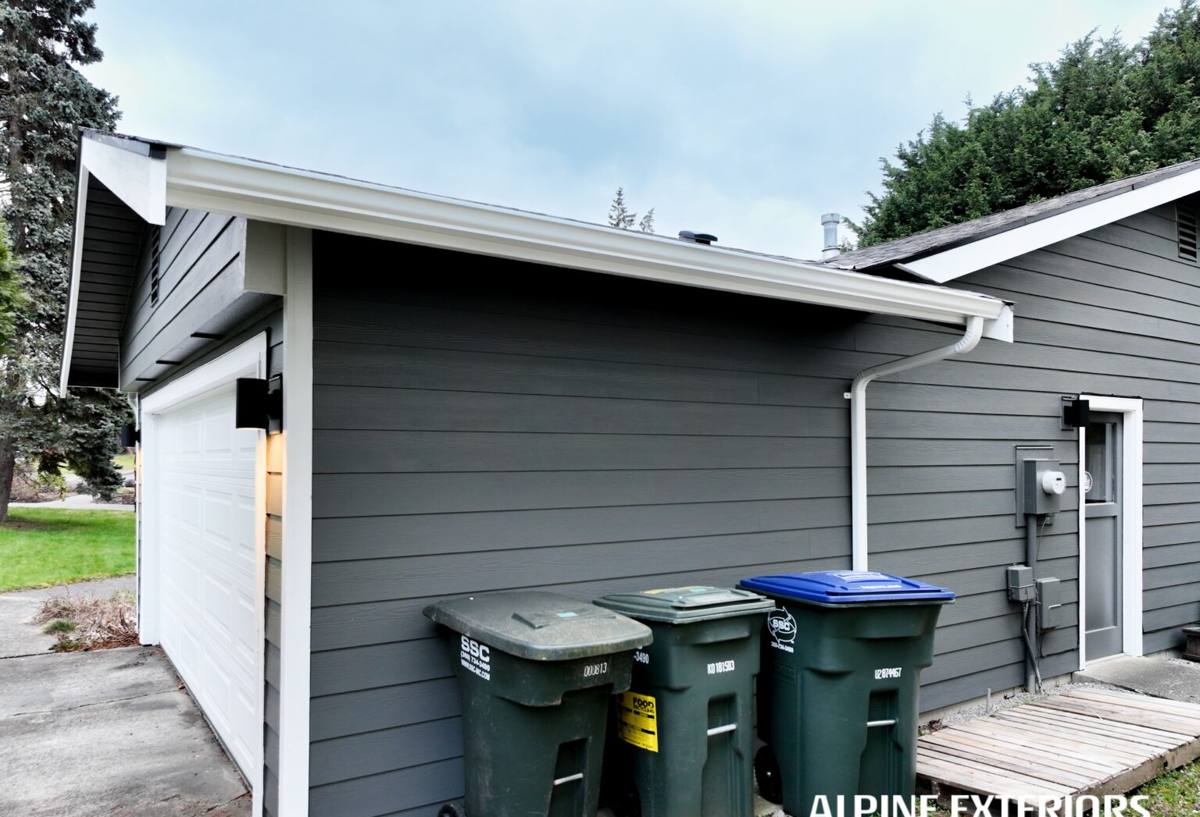
Signs an Edgemoor Home Needs Siding Replacement, Not Just Repair
Not every siding problem calls for a full tear-off. But in a bay-adjacent, tree-shaded neighborhood like Edgemoor, certain warning signs mean patching is just delaying a bigger repair bill.
- Soft or spongy spots when you press on the siding, especially near the bottom courses or below windows
- Persistent moss or dark green-black staining that comes back within weeks of cleaning
- Visible cupping, warping, or delaminating panels, common with older wood or engineered wood products
- Paint that's peeling, bubbling, or needing repainting more often than every 7-10 years
- Gaps opening up at seams, corners, or trim where caulking keeps failing
- A musty smell along interior walls that back up to exterior siding, which can point to moisture getting behind the cladding
- Visible rot at the bottom edge of siding boards or around penetrations like hose bibs and vents
If you're seeing two or more of these, it's worth having someone look at the wall assembly, not just the surface. Surface-level repairs on a compromised water-resistive barrier or sheathing just mean redoing the work in a few years.
Why We Only Install James Hardie Fiber Cement Siding
We made a decision as a company to install one siding system: James Hardie fiber cement. That means we don't install vinyl, LP SmartSide, Cemplank, Allura, primed spruce, or cedar — not because those products have no place in the market, but because after years of doing exterior work in Bellingham's climate, we don't think they hold up as well against what a neighborhood like Edgemoor throws at a house.
What that trade-off looks like in practice
Vinyl siding is affordable and low-maintenance, but it can warp in temperature swings, doesn't hold paint if you ever want a color change, and its seams and J-channels give moisture more places to find a way in over a shaded, damp lot. Engineered wood products like LP SmartSide use wood strand technology with a resin-saturated overlay — a real improvement over old-style hardboard, but they're still wood-based, meaning edge swelling and moisture sensitivity remain a factor if caulking and flashing details aren't maintained. Cedar and primed spruce are beautiful but need real upkeep: repainting, caulking, and moisture vigilance, especially on shaded walls that don't dry out quickly. Cemplank and Allura are also fiber cement, and reasonable products, but we've standardized on one manufacturer, one factory finish system, and one warranty structure so every job we do is consistent and we know exactly how the material behaves over time.
James Hardie fiber cement is non-combustible, dimensionally stable in wet-dry cycling, and comes with a factory-applied ColorPlus finish backed by its own finish warranty separate from the substrate warranty. For a bay-side, moss-prone neighborhood, that combination — a material that doesn't feed mold growth the way wood-based products can, holds paint far longer, and resists moisture-driven warping — is what we're willing to put our name behind.
James Hardie Product Lines Suited to Edgemoor's Conditions
James Hardie engineers its siding by climate zone, and the Pacific Northwest falls into their HZ5 category, formulated for regions with heavy moisture, freeze-thaw cycling, and moss and mildew pressure — exactly what an Edgemoor lot under tree cover deals with. A few product options come up most often on jobs in this area:
HardiePlank lap siding
The most common choice for Edgemoor homes, available in a range of textures from smooth to a cedar-like woodgrain, and it's what most buyers picture when they think "traditional siding" — but built to handle driving rain and humidity without the maintenance cycle of real wood.
HardiePanel vertical siding
Used as an accent or on modern-leaning homes, often paired with lap siding to break up larger wall planes — something we see requested on newer builds and remodels in the area.
HardieTrim boards
Corner boards, window and door trim, and fascia details that match the siding's moisture resistance, which matters because trim failure is often where whole-wall problems start.
ColorPlus factory finish is worth calling out specifically for shaded, mossy lots: the finish is baked on in a controlled environment rather than field-applied, which gives it better adhesion and fade resistance than site-painted siding, and it comes with its own warranty coverage against peeling and cracking.
What a Correct Siding Replacement Actually Involves
Siding replacement isn't just pulling off old boards and nailing up new ones. On a bay-exposed, tree-shaded property, the details behind the siding matter as much as the siding itself.
Tear-off and sheathing inspection
Once old siding comes off, we check the sheathing underneath for rot, soft spots, or prior water damage. This is often where hidden problems surface, especially on walls that have been damp for years under mossy siding.
Weather-resistive barrier
A new, correctly lapped water-resistive barrier goes on before any siding, installed so water sheds down and out rather than getting trapped behind the wall assembly.
Flashing at every penetration
Windows, doors, vents, hose bibs, and any wall penetration get proper flashing. This is one of the most common places we find shortcuts on older installs, and it's usually the reason a home develops localized rot even when the siding itself still looks fine.
Installation to manufacturer spec
James Hardie publishes specific fastening patterns, clearances, and gapping requirements, including ground clearance and roof-to-wall clearance, both of which matter more in a rain-heavy climate. Installing to spec is also what keeps the product warranty valid — a shortcut during install can void coverage the homeowner is counting on.
Caulking and paint touch-up at seams and cuts
Factory-finished edges get field-touched where boards are cut, and seams get properly sealed rather than just caulked over gaps.
Comparing Siding Options for a Bay-Adjacent, Tree-Shaded Lot
| Material | How It Handles Salt Air & Rain | How It Handles Shade & Moss | Maintenance Over Time |
|---|---|---|---|
| Vinyl | Can warp with temperature swings; seams offer entry points for moisture | Moss and mildew can grow on the surface; hard to repaint if it happens | Low, but limited lifespan and no refinishing option |
| Cedar / primed spruce | Attractive but moisture-sensitive; needs sealed end cuts and joints | Prone to moss, mildew, and rot in shaded, damp conditions without upkeep | High — regular painting, caulking, and inspection needed |
| Engineered wood (e.g. LP SmartSide) | Improved over older wood products but still wood-based and moisture-sensitive at edges | Can swell or degrade if caulking and flashing aren't maintained | Moderate — depends heavily on installation quality and upkeep |
| James Hardie fiber cement | Dimensionally stable; resists warping in wet-dry cycling | Doesn't feed mold growth the way wood-based products can; holds factory finish | Low — occasional wash-down, no repainting cycle with ColorPlus finish |
Our Siding Replacement Process for Edgemoor Homeowners
We walk every Edgemoor project the same way, because consistency is what prevents the callback problems we see on rushed jobs elsewhere in Whatcom County.
- On-site walkthrough to assess current siding, sheathing condition, and any trouble spots specific to the home's exposure and shade pattern
- A written scope covering tear-off, sheathing repair (if needed), weather barrier, flashing details, Hardie product and color selection, and trim work
- Material order and delivery timeline, since Hardie products are ordered to spec rather than pulled from generic stock
- Tear-off, sheathing inspection, and repair of any hidden damage before new material goes up
- Installation to manufacturer specification, including fastening, clearances, and flashing at every penetration
- Final walkthrough with the homeowner to review the finished work and warranty documentation
Why a Crew That Already Works in Edgemoor Makes a Difference
Siding work in Edgemoor isn't quite the same as siding work on an open, sun-exposed lot elsewhere in Bellingham. Tree-shaded walls dry differently, driveways and access can be tighter on wooded lots, and the moss and moisture patterns on a bay-facing wall aren't identical to what you'd see a few miles inland. A crew that's already done this work in the neighborhood knows which walls typically need extra attention to flashing and drainage, and doesn't have to learn those lessons on your house. That local pattern recognition is part of what separates a siding job that lasts from one that needs attention again in five years.
Keeping New Siding Looking Right in a Mossy, Rainy Climate
Even the right product benefits from basic upkeep in this environment. A yearly rinse-down to keep organic growth from taking hold, trimming back tree limbs and brush that keep walls in constant shade and moisture, and a quick visual check of caulking at trim and penetrations after major storms will go a long way. James Hardie siding with a ColorPlus finish is built to need far less attention than wood or vinyl, but "low-maintenance" in Whatcom County still means some maintenance — just a lot less than the alternatives.
If your Edgemoor home's siding is showing signs of wear, or you're planning ahead before it becomes a bigger problem, we're happy to take a look and talk through what we'd recommend. Reach out for a free, no-pressure estimate using the form below.