 Bellingham Roofing
 Full Siding Replacement in Fairhaven: When Patching Isn't Enough
There's a point on almost every older Fairhaven home where patching, caulking, and spot-repairing the siding stops being a real solution and starts being a way to delay a bigger decision. That point usually arrives quietly. A section that was repaired two years ago is soft again. A corner that used to just need a fresh coat of paint now has boards that flex under a light push. When that happens, the honest answer isn't another repair, it's a full siding replacement done correctly, from the sheathing out. This page is specifically about that job: what triggers it, what it involves, and how we do it on homes in Fairhaven.
Fairhaven's location on Bellingham Bay puts a specific kind of pressure on exterior walls that isn't identical to what a home ten miles inland deals with. Salt-tinged marine air, rain that arrives sideways more often than straight down, and a moss season that can stretch across most of the year on shaded lots all combine to shorten the working life of siding that isn't built for it, or wasn't installed with real attention to water management in the first place.
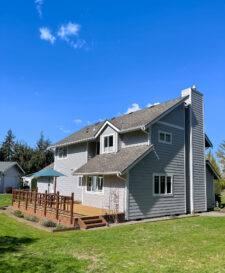
Why Fairhaven's Climate Wears Siding Out Faster
Salt Air and Corrosion
Homes near Bellingham Bay sit in a steady drift of mildly corrosive, moisture-laden air, not just during storms but as background exposure most of the year. It's slow and unglamorous, working on fasteners, flashing, and lower-grade finishes long before it's visible from the curb. By the time rust bleed shows up at nail heads or a finish looks chalky ahead of schedule, that process has usually been underway for years.
Wind-Driven Rain
Rain near open water tends to travel at an angle instead of falling straight, which pushes water into lap joints, trim seams, and wall penetrations that a calmer-climate siding system was never really tested against. This is one of the main reasons a full replacement in Fairhaven has to treat water management as the core of the job, not an afterthought to the material itself.
A Long Moss and Mildew Season
Mild, damp weather combined with mature tree cover on many Fairhaven lots keeps north-facing and shaded walls wet longer between rain events than sun-exposed walls. Porous or moisture-retentive siding becomes a growth surface over time, and moss holds moisture directly against the wall in a way that accelerates whatever decay is already starting underneath.
Hillside Drainage
A good share of Fairhaven sits on sloped ground rising from the waterfront. That terrain affects how water sheets across a lot during heavy rain and how much of it ends up running against the base of exterior walls. On these lots, the transition from grade to siding is one of the first places we check when we're deciding whether a full replacement is warranted.
Repair or Replace? How We Make the Call
Not every siding problem in Fairhaven means tearing the whole house down to the studs. We look at a few specific things before recommending either path:
- How localized the damage is: A single impact-damaged board or a trim piece that's worked loose is usually a repair, not a replacement.
- Whether moisture has been tracking behind the wall assembly: If water has clearly been getting behind the siding for a while, patching the visible surface just hides the problem for another season.
- The age and condition of the material overall: Siding that's near the end of its realistic service life will keep generating new failure points faster than they can be patched.
- What's happening at the substrate: If sheathing or framing is soft or discolored anywhere we can access it, that's usually the deciding factor.
We'll tell you plainly which situation you're in. A repair that will genuinely hold is a better outcome for you than a replacement you didn't need, and we'd rather keep that trust than pad a job.
Why James Hardie Fiber Cement Is What We Replace It With
When a Fairhaven home does need full replacement, the material decision matters as much as the labor. We install James Hardie fiber cement siding, exclusively, because of what we consistently find on tear-offs in exactly this kind of marine climate.
- Non-combustible core: Fiber cement doesn't feed a fire the way wood-based siding can.
- Factory-cured ColorPlus finish: The color coat is applied and cured under controlled factory conditions rather than brushed on-site, which gives it real resistance to fading, chalking, and moisture intrusion at the surface.
- HZ5 climate engineering: Hardie's HZ5 formulation is built for regions with sustained moisture and freeze-thaw cycling, a closer match to coastal Whatcom County than a generic national spec.
- Dimensional stability: It doesn't swell, cup, or warp the way engineered wood can after repeated wet-season moisture cycles.
- A strong transferable warranty: Substantial and honored as long as the installation follows spec, which is why we treat installation detail as seriously as the material choice.
We don't install LP SmartSide, vinyl, Cemplank, Allura, primed spruce, or cedar. Those are legitimate products in the right context, but for a full replacement that has to hold up against salt air, wind-driven rain, and a long wet season, we made the professional call to stand behind one system completely rather than sell whichever option fits a customer's budget that week and quietly pass the maintenance risk downstream.
What a Correct Full Replacement Involves, Step by Step
- Full tear-off: The existing siding comes off entirely rather than being covered over, which is the only way to actually see and address what's happening at the substrate.
- Sheathing and framing inspection: Every accessible section of sheathing gets checked for softness, discoloration, or rot before anything new goes up. Damaged material gets replaced, not sided over.
- House wrap and flashing as one system: Water-resistive barrier, window and door flashing, and penetration details all have to integrate correctly with each other, not just get installed as separate steps in isolation.
- Fastening to spec: Correct nail pattern, spacing, and penetration depth, following Hardie's published installation requirements rather than whatever's fastest.
- Clearance and lap detail: Proper clearance from grade, roofline, and decks, with joints lapped and sealed the way the system is engineered to shed water.
- Finish and cleanup: Trim, caulking at appropriate joints, and full site cleanup, including old material disposal.
A rushed or corner-cut installation is one of the most common reasons a genuinely good siding product ends up with a poor reputation. The material only performs the way it's engineered to when every one of these steps gets real attention, not just the ones that are visible once the job is done.
What We Typically Find Behind Older Siding in Fairhaven
Tear-off is where the real condition of a house gets revealed, and in Fairhaven there are a few things that show up often enough to be worth mentioning honestly:
- Rot or soft sheathing near the base of walls, where splashback and slope-driven runoff concentrate moisture over years
- Corroded or failing fasteners on older installations, consistent with sustained salt air exposure
- Trapped moisture behind siding that was installed without a properly integrated water-resistive barrier
- Moss-fed decay on shaded, north-facing wall sections that stayed damp longer than the rest of the house
- Window and door flashing that was never properly tied into the wall assembly during an earlier renovation
None of this is unusual for homes that have weathered years near the bay. It's exactly why a full tear-off, rather than an overlay, is the right approach on most replacement projects here.
Siding Replacement Cost Factors in Fairhaven
| Factor | What It Affects | Why It Matters in Fairhaven |
|---|---|---|
| Substrate condition found at tear-off | Repair cost before new siding goes on | Years of moisture exposure near the bay can mean sheathing repair is discovered mid-project, not before |
| Home age and trim complexity | Labor time and material quantity | Older Fairhaven homes often have more trim detail and roofline intersections where water can work its way in |
| Wall height and story count | Staging, scaffolding, and labor time | Multi-story homes on sloped lots require more setup before work can begin |
| Site access and slope | Equipment staging and material handling | Hillside terrain common in Fairhaven can add setup time that flatter lots don't require |
| Siding profile and finish selection | Material cost | Lap width, panel style, and ColorPlus color selection all affect the final material price |
Real numbers depend on the specific house and what tear-off reveals, which is why we walk the property in person and give you a written scope before any work starts, rather than pricing off square footage alone.
Our Replacement Process, Start to Finish
- On-site walk-through to assess the current siding, substrate access points, and any visible problem areas
- Written scope covering tear-off, substrate handling, flashing and house wrap detail, and finish selection
- Full tear-off and disposal of the old material
- Sheathing and framing inspection, with any needed repairs handled before new siding goes up
- House wrap, flashing, and James Hardie installation to manufacturer spec
- Daily site cleanup throughout the project, not just at the end
- Final walk-through so you can see the finished work before we call the job done
Why a Crew That Already Works Fairhaven Matters
A crew that replaces siding in this neighborhood regularly knows things a spec sheet doesn't tell you: which wall orientations stay damp longest through a Whatcom County winter, where extra flashing attention on a hillside lot actually pays off, and what a rushed tear-off two streets over turned into a year later. That experience shows up in small decisions on install day, the kind that don't show up on an invoice but determine whether you're dealing with a callback in two winters or not dealing with anything at all. Fairhaven's proximity to Bellingham Bay, its older housing stock, and its sloped terrain aren't identical to conditions elsewhere in Bellingham, and a full replacement done by a crew that treats those differences as real, rather than incidental, tends to hold up longer.
If your Fairhaven home has siding that's past patching, or you're just not sure yet which category it falls into, we're glad to take a look and give you a straight answer. Reach out using the form below to schedule a free, no-pressure estimate.