 Bellingham Roofing
 Fairhaven's Climate Is Rougher on Siding Than It Looks
Fairhaven sits close to Bellingham Bay, and that proximity to saltwater is the first thing to understand about siding here. Salt-laden air travels further inland than most homeowners expect, and over years it works on any exterior material that isn't built to shed moisture and resist corrosion at the fastener line. Add in the driving rain that comes off the Salish Sea during fall and winter storms, and you have wind-driven water hitting walls at angles that a lot of siding systems were never designed to handle.
Then there's moss. Whatcom County's mild, wet stretch from October through April creates a moss season that can run six months or longer in shaded, tree-covered lots — and a lot of Fairhaven's older neighborhoods have exactly that kind of mature tree canopy. Moss and algae don't just look bad; they hold moisture against the wall surface, and on the wrong siding material that trapped moisture is where problems start. Any siding decision for a Fairhaven home needs to account for all three of these factors at once: salt exposure, wind-driven rain, and prolonged damp shade.
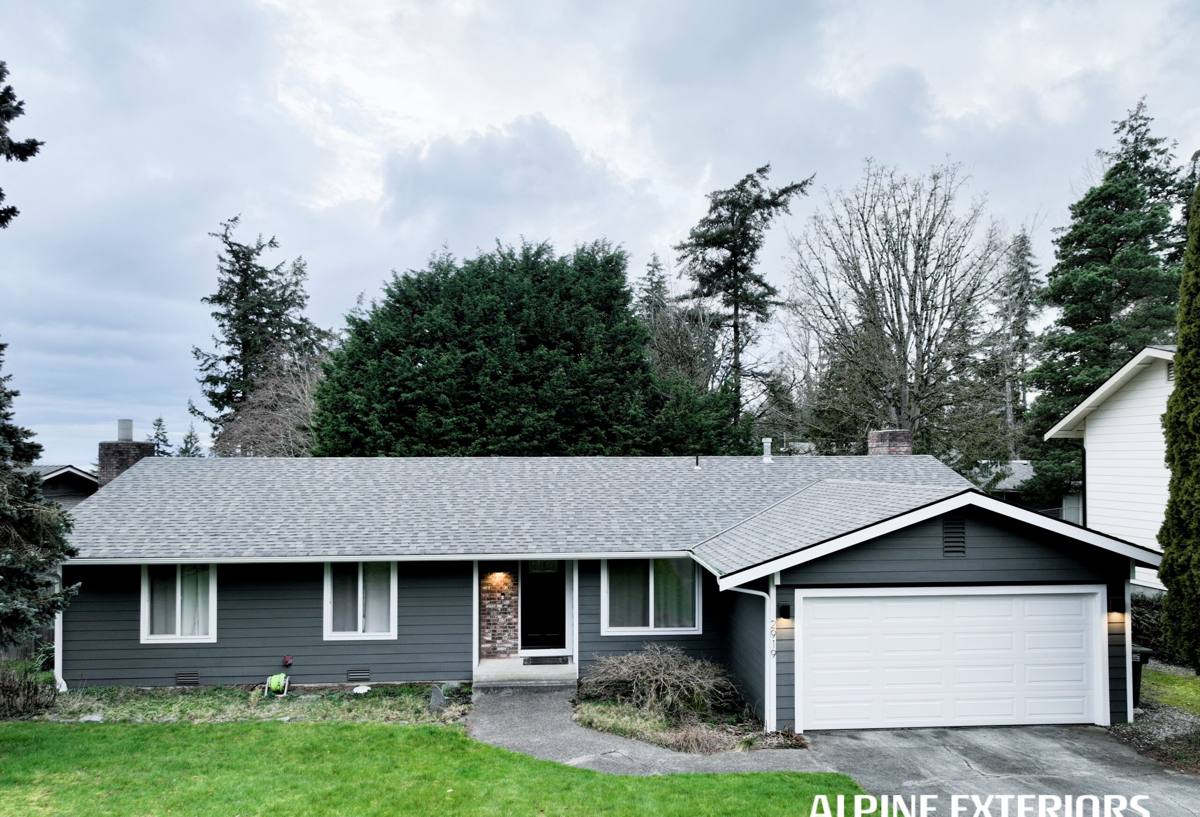
Why Fiber Cement Is the Right Category of Material Here
Fiber cement siding is cement, sand, and cellulose fiber formed under pressure into planks and panels. It doesn't rot, it doesn't provide a food source for moss and algae the way wood fiber does, and it holds its shape through the wet-to-dry cycles that define a Bellingham winter. It's also dimensionally stable across temperature swings, which matters on a coastline where clear, cold nights can follow damp, mild days within the same week.
That stability is the real advantage over the alternatives homeowners usually compare it to. Wood siding needs regular refinishing to keep water out and is a natural host for the moss and mildew that Whatcom County's climate produces in abundance. Vinyl siding can warp or become brittle with temperature cycling and doesn't hold up structurally the way a cement-based product does. Engineered wood products use wood strand or wood fiber substrates that are more moisture-resistant than solid wood, but they're still wood-based, which means the failure mode if water gets past the surface is different — and more serious — than it is with a cement-based product that isn't feeding on the moisture in the first place.
What This Means in Practice for a Fairhaven Home
In a marine climate, siding is doing constant, quiet work: shedding wind-driven rain, resisting the moss and algae that shade and dampness encourage, and holding a factory finish so the house doesn't need repainting every few years. Fiber cement is built for exactly that job. It's not a decorative choice — it's a functional one for this specific climate, and it's the reason we don't treat siding material as a matter of personal preference when a Fairhaven homeowner asks us what to put on their walls.
Why We Install Only James Hardie Products
Not all fiber cement is made the same way, and the differences show up over time, not on install day. We standardized on James Hardie for a specific set of reasons tied to how this climate treats a house: their ColorPlus finish is baked on at the factory under controlled conditions, rather than field-applied after installation, which gives a more consistent, longer-lasting bond than site-painted siding. Hardie also engineers regional product lines — including an HZ5 formulation intended for climates with more moisture exposure — which is directly relevant to a bay-adjacent neighborhood like Fairhaven.
We get asked fairly often why we won't install LP SmartSide, Cemplank, Allura, primed spruce, or cedar, so we'll be straightforward about it. These are legitimate, widely used products, and each has genuine strengths — LP SmartSide is lighter and easier to handle, cedar has a natural appearance many homeowners love, primed spruce is inexpensive up front. But each comes with a trade-off we're not willing to build our reputation on in this specific climate: engineered wood products (like LP SmartSide) are still wood-based and depend heavily on caulking and paint maintenance staying ahead of moisture; cedar and primed spruce require the most frequent refinishing of any siding category and are the most susceptible to the rot and moss growth that Whatcom County's wet season produces; and other fiber cement brands may not offer the same factory finish process or climate-specific engineering that we rely on to stand behind a job for decades, not years. We'd rather install one product system correctly, understand its behavior completely, and warranty it with confidence than offer five options and hope each one performs.
| Factor | James Hardie Fiber Cement | Engineered Wood (e.g. LP SmartSide) | Vinyl | Cedar / Primed Spruce |
|---|---|---|---|---|
| Moisture behavior | Doesn't rot; engineered HZ lines for wet climates | Wood-based; depends on paint/caulk staying intact | Sheds water but can trap it behind panels if installed poorly | Absorbs moisture; prone to rot without upkeep |
| Moss/algae resistance | Doesn't feed growth; still needs periodic rinsing | Wood fiber can support growth if finish is compromised | Doesn't feed growth but growth sits on the surface | Natural wood fiber is a common moss host |
| Finish durability | Factory-baked ColorPlus finish | Factory or field finish, varies by product | Color is through the material; can fade and chalk | Field-applied paint or stain; shortest refinish cycle |
| Fire behavior | Non-combustible | Combustible (wood-based) | Combustible, can deform under heat | Combustible |
| Typical refinish interval | Longest of this group under normal conditions | Shorter than fiber cement | No repainting needed, but limited repair options | Shortest — frequent staining/painting required |
What a Correct Fiber Cement Installation Actually Involves
Fiber cement is only as good as the installation behind it. The material itself resists moisture and rot, but a poorly installed job can still trap water where it shouldn't be, and that's true whether the house is in Fairhaven, on Lummi Island, or anywhere else exposed to Puget Sound weather. A correct install has several non-negotiable parts.
Moisture Management Comes First
Before a single piece of siding goes up, the wall needs a properly lapped weather-resistant barrier, correctly integrated with window and door flashing so that any water that does get behind the cladding has a clear path down and out — not a place to collect. This step is invisible once the job is done, which is exactly why it's the step most likely to get shortchanged by a crew that isn't used to doing it right.
Fastening and Clearances
Hardie siding has specific fastener spacing, embedment depth, and clearance requirements — from the ground, from roof lines, from decks and patios — that are part of the manufacturer's installation instructions for good reason. Get clearances wrong and you create a spot where water sits against the bottom edge of a board; get fastening wrong and boards can work loose or crack over time, especially with the temperature cycling this region sees.
Flashing, Trim, and Butt Joints
Every horizontal joint, every window head, every point where siding meets trim or roofing is a place water wants to get in. Flashing at these transitions, and correctly treated (not just caulked) butt joints between plank ends, are what keep driving rain from Bellingham Bay's storms from finding its way behind the siding field.
Caulking and Touch-Up
Even with a factory finish, cut ends and fastener heads need to be sealed and touched up with manufacturer-approved products. This is a small, easy-to-skip step that has an outsized effect on how the siding performs over the following decade.
How Our Process Works on a Fairhaven Home
We approach every siding job the same structured way, adjusted for what we find on-site.
1. On-Site Assessment
We walk the exterior, check the condition of the existing wall assembly, look for signs of past moisture intrusion, moss buildup, or rot at vulnerable points like window sills and lower wall sections, and note anything specific to the lot — heavy shade, exposure to prevailing wind and rain direction, proximity to the water.
2. Prep and Tear-Off
Old siding comes off, the sheathing underneath gets inspected (and repaired if needed — this is where hidden moisture damage sometimes shows up), and the weather-resistant barrier and flashing system go in correctly before any new material is installed.
3. Installation to Manufacturer Spec
Hardie boards are installed following James Hardie's fastening, clearance, and flashing requirements, not shortcuts. Butt joints, corners, and trim details are treated as part of the water-management system, not just the finished look.
4. Final Inspection and Cleanup
We check clearances, caulking, and finish consistency before calling a job complete, and we clean the site so the only thing left behind is the new siding.
Maintenance in a Salt Air, Moss-Season Climate
Fiber cement lowers the maintenance burden significantly compared to wood, but it isn't zero-maintenance in this climate, and being honest about that is part of doing right by a homeowner. A yearly rinse-down removes salt residue, pollen, and the early stages of moss or algae growth before they get established. Gutters and downspouts should be checked before the fall rains start, since overflow onto the wall surface is one of the more common ways water gets somewhere it shouldn't over the years. It's worth keeping an eye on caulk lines at trim and joints, since caulk has a shorter service life than the siding itself and is cheap to renew before it fails. On heavily shaded lots — common in Fairhaven's older, tree-lined streets — trimming vegetation back from the house improves airflow and sunlight at the wall surface, which does more to slow moss growth than any product applied after the fact.
A Practical Homeowner Checklist
- Rinse siding annually to remove salt film, pollen, and early moss growth
- Inspect and clear gutters and downspouts before the fall rain season
- Check caulk at trim, corners, and joints yearly and renew where it's cracking or pulling away
- Keep shrubs and tree branches trimmed back from exterior walls for airflow and sunlight
- Look at lower wall sections and areas near grade for any signs of moisture staining
- Address any impact damage (from debris, equipment, or storms) promptly rather than leaving cut edges exposed
What to Ask a Contractor Bidding Fiber Cement Work
Fairhaven homeowners comparing bids on siding work benefit from asking pointed questions, because the material cost of Hardie siding is similar from one reputable installer to the next — the real variable is installation quality and manufacturer familiarity.
| Question to Ask | Why It Matters |
|---|---|
| Are you a certified or experienced James Hardie installer? | Correct fastening, clearances, and flashing depend on installer familiarity with the specific product line |
| How will you handle moisture barrier and flashing at windows and joints? | This is the part of the job that determines long-term performance and is invisible once finished |
| What clearance will you maintain from grade, decks, and roof lines? | Wrong clearances are one of the most common causes of premature moisture problems |
| What warranty applies, and is it transferable? | Affects resale value and protects you if a defect shows up years later |
| Do you have experience with homes exposed to this area's salt air and rain? | Coastal exposure and heavy tree shade both change how a wall assembly should be detailed |
Warranty and Long-Term Value
Part of why we standardized on James Hardie is the strength and clarity of the warranty behind the product when it's installed to spec — and the fact that it's transferable if the home is sold, which matters to buyers evaluating exterior condition on a coastal property. A factory-applied finish warranty is a meaningfully different guarantee than a promise on field-applied paint, because the finish process is controlled and consistent rather than dependent on site conditions the day it's applied. For a Fairhaven home facing salt air and a long wet season every year, that difference compounds over the life of the siding.
Siding is also one of the exterior improvements that shows up directly in how a home is perceived on the market, particularly in a neighborhood where buyers are aware of what coastal exposure does to lower-quality materials. A correctly installed fiber cement system is a visible signal that the house has been maintained with the climate in mind, not just cosmetically updated.
Get a Straightforward Look at Your Home
If you're weighing siding options for a Fairhaven home, we're glad to walk the exterior with you, point out anything specific to your lot's exposure or shade, and give you a clear, no-pressure estimate for correctly installed James Hardie siding. There's no obligation — just a straight answer about what your home needs.