 Bellingham Roofing
 Why Blaine's Marine Climate Is Hard on a Roof
Blaine sits at the northern tip of Whatcom County, right on the water and just minutes from the Canadian border. That location is beautiful, but it is also demanding on a roof. Homes here deal with a combination most inland Washington towns don't see in the same intensity: constant marine air carrying salt, driving rain pushed sideways by wind off the water, and a moss season that can run most of the year under the region's tree cover and cloud ceiling. A roof built for a drier, calmer climate simply doesn't hold up the same way out here.
Salt Air and Corrosion
Airborne salt is corrosive to unprotected or poorly coated metal, and it doesn't take a direct waterfront lot to be affected — salt-laden air travels well inland on the wind. Fasteners, flashing, and panel edges are usually the first places corrosion shows up when the wrong materials or finishes were used. This is one of the biggest differences between a metal roof installed by a crew that understands coastal exposure and one installed the same way it would be in a landlocked town an hour east.
Driving, Wind-Driven Rain
Storms off the water don't just drop rain straight down here — wind pushes it sideways and up underneath laps, trim, and flashing that would shed a vertical rain just fine. Seams, ridge caps, and anywhere two roof planes meet are where a marginal installation eventually leaks, sometimes years after the work was done and long forgotten.
A Long Moss Season
Between the humidity, the shade from mature conifers common on Whatcom County lots, and the region's long stretch of overcast days, moss and algae have a lot of time to establish themselves on a roof. On asphalt shingles, moss works its way under the tab edges and lifts them over time. Metal doesn't give it the same foothold, but panel design, finish, and how well the roof sheds water all still affect how much moss and biological growth take hold over the years.
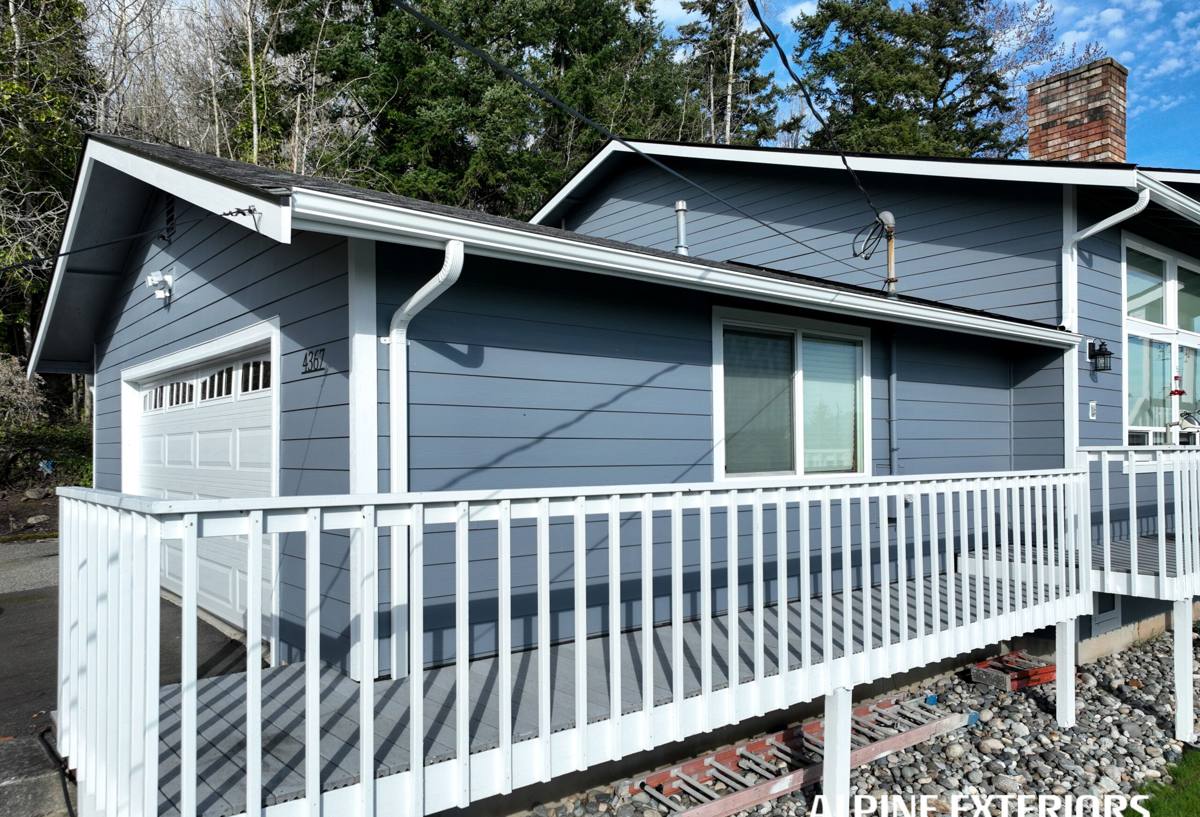
Why Metal Roofing Is a Strong Fit for Blaine Homes
Metal roofing isn't the right choice for every house or every budget, but for this specific climate it solves several problems at once. A correctly installed metal roof sheds wind-driven rain more reliably than a shingle roof because it simply has far fewer overlapping edges for water to find its way under. It also gives moss and algae less to grab onto than a textured shingle surface. And with the right coating system, it resists the slow corrosion that salt air causes to lesser metals and hardware over time.
It's also a long-term decision. Metal roofing costs more upfront than asphalt, but it's typically rated for several times the service life when it's installed and maintained correctly — which matters a great deal on a coastline where re-roofing more often than necessary is expensive and disruptive to a household.
What a Correctly Installed Metal Roof Involves
The metal panels themselves get most of the attention, but they're only one part of a larger system. In a climate like Blaine's, the details underneath and around the panels are what actually determine whether a roof performs well for decades or starts developing problems within five years.
Underlayment and Moisture Barrier
A synthetic or self-adhered underlayment rated for both the panel system and the climate goes down first. In a high-moisture, wind-driven-rain environment, we treat this layer as a genuine second line of defense, not a formality — it's what protects the roof deck if wind ever manages to push water past a seam or around a penetration.
Fasteners and Hardware Rated for Salt Exposure
Exposed fasteners, clips, and trim screws are common failure points on coastal metal roofs when the wrong grade of hardware gets used. We match fastener and flashing metal to the panel material to avoid galvanic corrosion — mixing incompatible metals against one another is one of the more common mistakes that shows up as rust streaks and failed seals within just a few years near the water.
Flashing, Valleys, and Penetrations
Every roof-to-wall transition, valley, chimney, vent pipe, and skylight curb is a place where two materials meet, and that's exactly where wind-driven rain gets tested hardest. These get formed and sealed specifically for the panel profile in use on that roof, not fit with generic trim pieces after the fact.
Ventilation
Metal roofs need proper intake and exhaust airflow beneath them just as much as shingle roofs do, if not more. In a humid coastal climate, inadequate ventilation traps moisture against the underside of the deck, which can lead to condensation problems that have nothing to do with the roof surface itself and everything to do with how the roof was vented.
Choosing a Metal Roofing System for a Blaine Home
Metal roofing isn't one single product — the panel style has a real effect on how the roof performs in this specific climate. Here's how the common options compare for a coastal Whatcom County home:
| System | Performance in Driving Rain | Moss/Algae Resistance | Typical Lifespan |
|---|---|---|---|
| Standing seam (concealed fastener) | Best — raised seams shed wind-driven rain with no exposed screws to fail | Very good — smooth, steep-shedding surface | 40-70 years |
| Exposed-fastener panel | Good if installed and maintained correctly; fasteners are the weak point over time | Good | 25-40 years |
| Metal shingle/shake profile | Good, though more laps than standing seam | Good | 30-50 years |
For homes closest to the water or most exposed to wind, we generally steer clients toward standing seam because it has no exposed fasteners for salt air to attack and the fewest joints for wind-driven rain to exploit. Exposed-fastener panels remain a reasonable, more economical option on less exposed roofs, provided the fasteners get inspected and re-seated on a normal maintenance schedule rather than ignored for years at a time.
Our Process, Start to Finish
The steps don't change much from house to house, but how carefully each one is carried out is what separates a roof that lasts from one that doesn't.
- On-site assessment. We look at the existing roof, deck condition, ventilation, and exposure — is the house waterfront, up on a bluff, or tucked back in the trees — because that changes our recommendation.
- System and finish selection. We walk through panel profile, gauge, and coating options based on that exposure and the homeowner's budget, not a one-size-fits-all answer.
- Tear-off and deck inspection. Old roofing comes off and the deck gets checked for rot or soft spots before anything new goes down — covering up a bad deck is how roofs fail early.
- Underlayment and moisture barrier installation. The full moisture barrier goes down before a single panel is set.
- Panel installation, flashing, and trim. Everything is fabricated and fitted to the actual roof, not pieced together from generic stock trim.
- Final walkthrough. We go over the finished roof with the homeowner, including what a normal maintenance schedule looks like for their specific setup.
Maintenance in a Salt Air, Moss-Prone Environment
Metal roofing is lower-maintenance than asphalt, but "low-maintenance" doesn't mean "no maintenance" — especially this close to the water. A short annual routine catches almost everything before it turns into a repair:
- Clear needles, leaves, and debris from valleys and gutters, especially under overhanging conifers where moss gets a foothold fastest
- Check exposed fasteners, if that system is installed, for backing out or early rust, and re-seat or replace as needed
- Rinse off accumulated salt residue and grime periodically rather than letting it sit against the finish for months
- Inspect flashing around chimneys, vents, and skylights for any lifting or worn sealant
- Trim back branches that keep sections of the roof shaded and damp longer than they need to be
- Have a professional look at the roof after any major windstorm, since that's when flashing and trim take the most abuse
What Affects the Cost of a Metal Roof in Blaine
There's no honest flat number for metal roofing — cost depends on the roof itself and the choices that make sense for this climate. The main variables we walk homeowners through are:
| Factor | Why It Matters Here |
|---|---|
| Panel material and gauge | Heavier-gauge steel or aluminum with a marine-grade coating costs more but resists salt exposure longer |
| Panel system | Standing seam costs more than exposed-fastener panels but has fewer long-term weak points |
| Roof complexity | Valleys, dormers, and multiple penetrations mean more flashing work and labor time |
| Deck condition | Rot or soft decking found at tear-off adds repair cost before new roofing can go on |
| Coating/finish grade | A better paint system costs more upfront and holds color and corrosion resistance far longer in salt air |
| Access and roof pitch | Steeper or harder-to-access roofs take longer and cost more in labor |
We would rather walk a homeowner through these factors on their actual roof than hand out a number that doesn't hold up once we're actually up there measuring.
Why It Matters That We Already Work in Blaine
A crew that only occasionally works this far north tends to treat Blaine like any other Whatcom County stop — same materials, same details they'd use in a drier, less exposed town further inland. A crew that works here regularly already knows which fastener grades hold up against the salt air, which panel systems handle wind-driven rain off the water without leaking at the seams, and how much moss pressure a shaded roof is really under before the first inspection ladder even goes up. That local pattern recognition is the difference between a roof that's simply installed to code and one that's installed for the specific conditions it has to survive for the next several decades.
It also means straightforward, unhurried communication with someone who can look at a Blaine roof and tell you honestly what it needs, rather than a generalized pitch written for anywhere.
If you're weighing metal roofing for a home in Blaine, we're glad to take a look and put together a straightforward, no-pressure estimate — use the form below to get started.