 Bellingham Roofing
 Puget's Siding Problem Isn't Like Everywhere Else
Homes in the Puget area, tucked close to Bellingham Bay and exposed to the open air moving off the water, take a different kind of weathering than a house fifteen minutes inland. It's not one dramatic storm that does the damage — it's the daily grind of salt-laden air working into seams and fasteners, driving rain that hits siding sideways instead of straight down, and a moss season that runs longer here than in most of Whatcom County because the shade, humidity, and mild temperatures rarely let surfaces fully dry out. Any one of those factors is manageable. All three, year-round, is what separates a Puget siding repair job from a generic patch-and-paint.
We work this specific pocket of Bellingham regularly, which matters more than it sounds. A crew that only sees a neighborhood once a year treats every job as a fresh diagnosis. A crew that's already been in and out of Puget homes knows which siding materials, which orientations, and which original installation shortcuts tend to fail first here — and that shortens the guesswork on your repair.
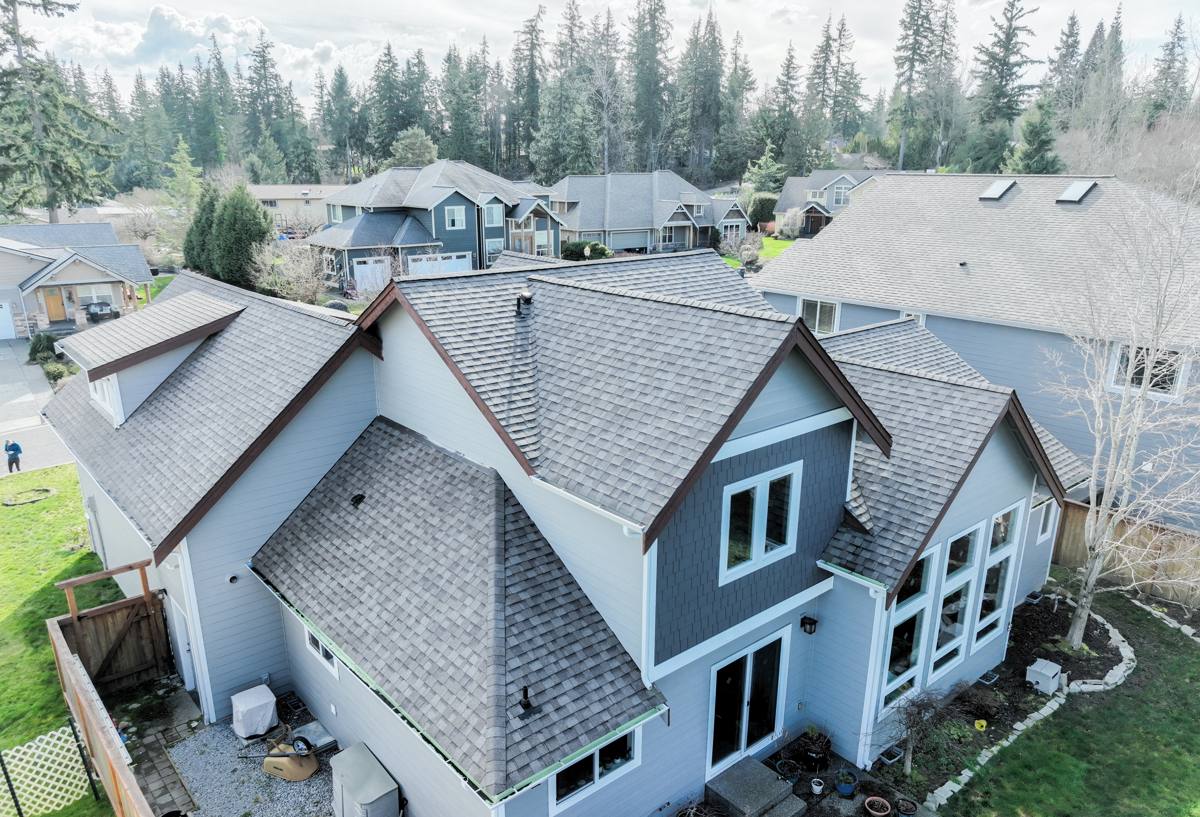
What's Actually Failing When Siding "Goes Bad" in a Marine Climate
Siding repair isn't just cosmetic patching. In a climate like this, the failure almost always starts with moisture getting somewhere it shouldn't and staying there. The visible symptom — a soft board, a bulging panel, a streak of dark staining — is usually the last stage of a problem that's been building behind the surface for a while.
The three failure patterns we see most in Puget
- Moisture intrusion at seams and penetrations. Butt joints, corner trim, and anywhere siding meets a window, vent, or hose bib are the weak points. Driving rain pushes water sideways into gaps that would never see moisture in a calmer climate.
- Moss and organic growth holding water against the surface. Moss doesn't just look bad — it's a sponge sitting directly on your siding, keeping the material damp long after the rain has stopped. On wood-based products especially, that constant dampness accelerates rot.
- Salt-air corrosion of fasteners and metal flashing. Nails, screws, and flashing that aren't rated for coastal exposure corrode faster here. Once a fastener weakens, the siding panel it's holding starts to shift, and shifting panels open new gaps for water.
Any competent repair has to address the moisture source, not just the visible damage. Replacing a rotted board without fixing the flashing detail or drainage path behind it just buys you a year or two before the same spot fails again.
Signs Your Puget Home Needs Siding Repair Now
Most siding problems are easier and cheaper to fix early. Waiting usually doesn't save money — it just moves the repair from "patch a section" to "replace a wall's worth of sheathing." Walk your exterior and look for these:
- Soft or spongy spots when you press on the siding, especially near the bottom courses and around window trim
- Visible moss or algae buildup that hasn't washed off after a few dry days
- Paint that's bubbling, peeling, or flaking in patches rather than evenly across a wall
- Dark streaking or staining running down from seams, corners, or trim joints
- Gaps opening up at butt joints or where siding meets trim boards
- Any warping, cupping, or visible separation between siding panels
- A musty smell or visible staining on interior walls that back up to exterior siding
If you're seeing more than one or two of these, especially on the sides of the house that face prevailing wind and rain, it's worth having someone look before the next wet season.
Repairing Different Siding Materials: An Honest Breakdown
We install James Hardie fiber cement exclusively for new siding and full replacements — we don't install LP SmartSide, vinyl, Cemplank, Allura, or unprimed cedar or spruce, and we're upfront about why on our other pages. But repair work is different from new installation: plenty of Puget homes already have one of these materials on the walls, and a repair call means working with what's there, not what we'd have chosen.
What that looks like in practice
| Existing siding | Repair reality in this climate |
|---|---|
| James Hardie fiber cement | Repairs are straightforward — the material itself doesn't rot or absorb water, so most repair work is fastener, flashing, or caulk-joint related, not material replacement. |
| Wood (cedar, spruce) | Prone to moisture absorption and rot in shaded, damp spots; repairs often mean cutting out and replacing whole boards, and repainting/resealing exposed cuts immediately. |
| Engineered wood (LP SmartSide and similar) | Edge and seam swelling is the common failure point if moisture gets into the substrate; repairs need to fully dry and reseal the area or the swelling returns. |
| Vinyl | Doesn't rot, but becomes brittle with age and UV exposure, and can crack or warp; matching discontinued colors/profiles for a patch repair is often the hardest part. |
When we repair non-Hardie siding, we do the job right for the material that's there — proper flashing, correct fastener spacing, matched caulking. We just won't pretend a wood or engineered-wood repair is a permanent fix in a climate that keeps testing it. If a homeowner is looking at a repair bill that's creeping toward the cost of a section replacement, that's usually the point where we'll talk honestly about whether patching again makes sense or whether it's time to talk about a Hardie replacement on that section or the whole house.
What a Correct Siding Repair Involves
A repair that actually holds up in Puget's climate isn't just swapping a damaged board for a new one. Here's what we check and do on every repair call:
- Diagnose the moisture path first. Before touching the damaged siding, we trace how water got in — a failed caulk joint, a flashing gap, a moss mat holding water, or a fastener that backed out.
- Check what's behind the siding. If the sheathing or house wrap underneath shows water damage, replacing just the visible siding without addressing that layer is a wasted repair.
- Replace damaged material with a matching or compatible product. Matching profile, thickness, and reveal so the repair doesn't stand out and doesn't create a new water trap at the transition.
- Correct the flashing and drainage detail. If the original installation had a shortcut — missing kick-out flashing, wrong lap direction, caulk used where flashing should have been — we fix that as part of the repair, not just the symptom.
- Reseal and finish to match. Paint, caulk, and trim work finished so the repair blends and stays weathertight, not just patched and left exposed.
Skipping any of those steps is how a "repair" turns into a callback six months later.
Repair vs. Replace: How We Help You Decide
Not every damaged section needs full replacement, and not every repair is worth doing twice. A few honest factors we walk through with Puget homeowners:
| Factor | Leans toward repair | Leans toward replacement |
|---|---|---|
| Extent of damage | Isolated to one or two sections | Spread across multiple walls or elevations |
| Age of existing siding | Siding is otherwise in good shape, recently installed | Siding is near or past its expected service life |
| Underlying material condition | Sheathing and house wrap behind the damage are dry and sound | Water has clearly compromised the structure behind the siding |
| Repeat problem history | First time this spot has failed | Same area has been patched more than once |
| Material available for repair | Matching material is still available | Original product is discontinued or mismatched |
We'll always give you a straight answer on which side of that table your house falls on, and we won't push a full replacement when a proper repair will genuinely hold.
Why It Matters That We Already Work in Puget
Siding repair in a coastal-influenced climate rewards local familiarity. A crew that's worked several homes in the same general area has a working sense of which exposures take the worst weather, how long moss tends to build back after a cleaning, and which original construction details in homes from a given era tend to need attention first. That's not a substitute for inspecting your specific house, but it means less time spent guessing and more time spent fixing the actual problem.
It also means we're not disappearing after the invoice. A siding repair that was done right should hold — but if something related comes up down the line, you're calling a crew that already knows your house and your neighborhood, not starting from zero with someone new.
Keeping a Repair From Becoming a Repeat Repair
Once a repair is done, a little upkeep goes a long way in this climate:
- Rinse moss and algae off siding before it builds into a thick mat, especially on shaded north- and west-facing walls
- Keep gutters clear so overflow isn't running down the siding face
- Trim back vegetation and landscaping that keeps siding shaded and damp
- Recaulk seams and trim joints on the same cycle you'd repaint or reseal, rather than waiting for a visible gap
- Walk the exterior once a year, ideally before the wet season starts, and press-test any spot that looks suspect
None of that is complicated, but it's the difference between a repair that lasts and one that needs redoing in a couple of years.
If you're seeing soft spots, moss buildup, or staining on your Puget-area home, we're happy to take a look and give you a straightforward, no-pressure estimate on what it'll actually take to fix it right. Use the form below to get started.