 Bellingham Roofing
 Siding Replacement in Puget: Why an Aging Wall Needs More Than a Patch
Puget is a residential neighborhood in the Bellingham area, and like most of the housing stock across Whatcom County, a good share of the homes here are old enough that their original siding is well past its useful life. Siding replacement is a different job than new-construction siding, and it's different again from a repair. It means removing an exterior wall system that's already been absorbing Bellingham's weather for decades, finding out what that weather did underneath it, and rebuilding the wall correctly before a new siding product ever goes on. We do this work regularly in Puget, and the pattern is consistent: houses in this part of Bellingham deal with salt air, driving rain, and a long moss season, and any siding replacement that doesn't account for all three tends to fail again faster than it should.
This page is specifically about siding replacement for Puget homes — not new construction, not a general overview of siding products. If your existing siding is cracking, delaminating, or letting moisture behind it, this is the process and the reasoning that goes into fixing that correctly.
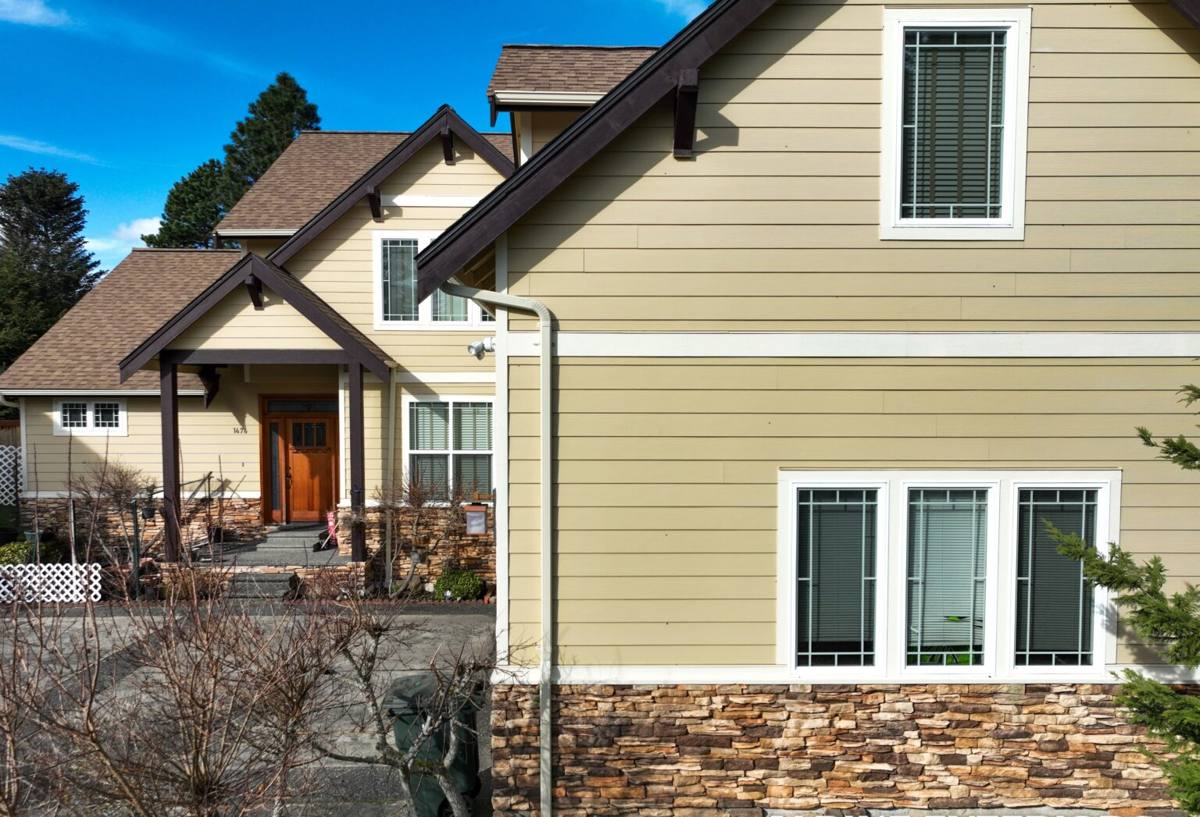
What Bellingham's Climate Does to Siding That's Already Aging
Salt Air and Slow Corrosion
Whatcom County sits close enough to Puget Sound and Bellingham Bay that a mild salt content rides in on the marine air across most of the county, not just directly on the waterfront. On siding that's already 20, 30, or more years old, that steady salt exposure has usually had time to work on fasteners, flashing, and any exposed metal trim. It's common to find corroded nail heads or degraded flashing on a Puget tear-off well before the siding face itself looks obviously bad — the damage starts at the hardware and works outward.
Driving Rain and What It Finds Underneath
Pacific storm systems moving through Whatcom County don't just drop rain straight down; wind pushes it sideways into walls, especially around windows, corners, and anywhere two building materials meet. On an aging siding system, years of that sideways-driven rain finding small gaps in caulking, laps, or trim joints adds up. By the time a homeowner is ready to replace the siding, it's common to find sheathing that's been quietly wicking moisture for years behind a wall that looked fine from the street.
A Long Moss Season Wears Down the Surface
Mild temperatures and near-constant moisture give moss and mildew a growing season that can run most of the year on shaded or north-facing walls in Puget. Older siding materials with any surface porosity — especially wood-based products — give moss more to grip onto as the surface ages and the factory finish, if there ever was one, wears away. That surface breakdown is often what finally pushes a homeowner from "needs painting again" to "needs full replacement."
Signs a Puget Home Needs Siding Replacement, Not Another Repair
A lot of homeowners try to patch or repaint aging siding for a few extra years before committing to replacement, which is a reasonable instinct when the damage is minor. The signs below usually mean patching has stopped being the right call:
- Boards that are soft, spongy, or crumble slightly when pressed, especially low on the wall or near grade
- Paint that won't hold anymore even after fresh coats — it bubbles, peels, or fails again within a year or two
- Visible cracking, delamination, or warping across multiple sections of the wall, not just one damaged board
- Rust staining running down from fasteners or trim, a sign the hardware underneath is already corroding
- Persistent moss or dark staining that comes back quickly after cleaning, especially on shaded elevations
- Soft or discolored sheathing visible at trim edges, outlets, or anywhere the old siding has already pulled away slightly
- Rising energy bills paired with drafty walls, which can point to a wall assembly that's no longer sealing the way it should
Any one of these on its own might still be repairable. Several of them together, especially spread across more than one wall, usually mean the wall assembly has been compromised for a while and a full replacement will cost less over time than another round of patch repairs.
Why We Only Replace Siding with James Hardie
We used to install a broader range of siding products. We narrowed that down to James Hardie fiber cement after seeing, over and over on tear-offs like the ones we do in Puget, which materials actually held up to Whatcom County's combination of salt air, driving rain, and moss, and which ones quietly failed again within a decade or two.
- Non-combustible core: Fiber cement doesn't feed a fire the way wood-based siding products can, which matters for both safety and insurance considerations.
- Factory-applied ColorPlus finish: The color is baked on under controlled factory conditions instead of brushed on in the field, so it resists fading, chalking, and moisture better than a repainted surface ever will.
- Climate-engineered HZ product lines: Hardie's HZ5 formulation is built specifically for regions with sustained moisture and freeze-thaw cycling, which describes Whatcom County well.
- Dimensional stability: Fiber cement doesn't swell, cup, or warp the way engineered wood products can after repeated wetting, which is exactly the failure pattern we see most on old siding replacements.
- Strong transferable warranty: Hardie backs correctly installed products with one of the stronger warranty structures in the siding industry, and that warranty can transfer if the home sells.
What We Won't Install, and Why
We don't install LP SmartSide, vinyl siding, Cemplank, Allura, primed spruce, or cedar. Each of those products has a place in the broader market and homeowners elsewhere who are satisfied with them. But when we're replacing siding that already failed once under Bellingham's climate, we've made a professional call to install one system we fully stand behind rather than offer a cheaper alternative that shifts the same maintenance burden and moisture risk back onto the homeowner a decade from now.
What Correct Siding Replacement Actually Involves
Tear-Off and Substrate Inspection
The old siding has to come off before anyone can tell what's really going on underneath, and this is the step that matters most on a replacement job. We inspect the sheathing, framing, and house wrap once the old material is removed, and any soft or water-damaged wood gets repaired or replaced before new siding ever goes up. Skipping this step and installing new siding over a compromised substrate just hides the problem for a few more years.
Weather Barrier and Rain Screen Detailing
A properly lapped house wrap or weather-resistive barrier, combined with a small drainage gap behind the new siding, gives any moisture that does get past the exterior surface a way to drain and evaporate instead of sitting against the wall. This detail carries more weight on a replacement job in a wet climate like Bellingham's than it would somewhere drier, because the wall has already shown it's vulnerable once.
Fastening, Flashing, and Sealed Joints
Hardie specifies fastener type and spacing for a reason, and correct flashing at every window, door, and wall penetration is what actually keeps wind-driven rain from tracking behind the new siding the way it did behind the old. Butt joints and trim transitions get sealed deliberately rather than left to caulk alone, since caulk is the first thing to fail under repeated wet-dry cycling.
None of this is exotic work. It's the manufacturer's own installation specification, followed consistently on the parts of the job that are hardest to see once the new siding is up and the crew has moved on.
Our Siding Replacement Process for Puget Homes
- Walk-through and assessment: We look at the existing siding, trim, and any visible signs of moisture or damage before giving a real scope of work.
- Tear-off: Old siding comes off in sections so the crew can assess the wall as they go rather than all at once, limiting how long any wall sits exposed.
- Substrate repair: Any soft sheathing or framing found underneath gets repaired before moving forward — this is where the real scope of a job can change once the wall is opened up.
- Weather barrier and flashing: House wrap, flashing, and rain-screen detailing go in correctly around every window, door, and penetration.
- Hardie installation: Siding goes on to manufacturer specification, with correct fastener type, spacing, and joint sealing throughout.
- Trim and final detailing: Trim, corners, and transitions get finished out and inspected before the crew leaves the site.
Cost Factors for a Puget Siding Replacement
| Factor | Why It Affects Cost | Puget-Specific Consideration |
|---|---|---|
| Home size and wall complexity | More square footage and more corners, gables, or trim details mean more material and labor | Older Puget homes often have more architectural detail than newer builds |
| Substrate condition | Damaged sheathing or framing found during tear-off adds repair scope | Homes with decades of salt air and driving rain exposure more often need substrate repair |
| Siding profile and trim style | Lap width, shake-style panels, and trim board choices vary in material and labor cost | Matching an existing architectural style can add trim complexity |
| Access and site conditions | Landscaping, fencing, and multi-story sections all affect labor time | Mature tree cover on some Puget lots can affect both access and moss exposure |
These are general cost drivers, not a quote. Every home in Puget has a slightly different history, wall condition, and layout, so we walk the property and inspect the existing siding before putting a real number on the work. What looks like a straightforward replacement from the driveway can turn into a larger scope once tear-off reveals what's actually underneath, which is also why we're cautious about estimates given without seeing the house.
Timing and Why a Crew That Already Works Puget Matters
Timing Around Bellingham's Weather
Whatcom County's wettest, windiest stretch typically runs from late fall through winter, and siding replacement goes more smoothly when walls can be opened up, repaired, and closed back in during a drier stretch of weather. Spring and summer generally offer the most stable working conditions for tear-off and installation. That said, siding that's already letting moisture into the wall doesn't benefit from waiting for the ideal season, so a home showing active signs of water intrusion is worth addressing on its own timeline.
Local Experience
A crew that replaces siding across Puget and the surrounding Bellingham area regularly sees how salt air, driving rain, and moss actually behave on real houses here over a full year, not just how a product performs on a spec sheet. That experience shapes practical decisions on tear-off day — where to expect substrate damage, which walls have taken the most weather, and which flashing and fastening details are worth the extra time so a homeowner isn't dealing with the same problem again in another fifteen years.
If your Puget home's siding is cracking, staining, holding moss, or just past the point where another repaint makes sense, we're glad to take a look and give you a straightforward, honest assessment. Reach out using the form below to schedule a free, no-pressure estimate.