 Bellingham Roofing
 Columbia's Siding Problem Isn't Like Other Neighborhoods'
Every Bellingham neighborhood deals with Pacific Northwest weather, but Columbia's location puts homes in a specific combination of stresses: proximity to Bellingham Bay means a steady dose of salt-laced air, the neighborhood's mix of tree cover and low winter sun keeps north- and shade-facing walls damp for weeks at a stretch, and the long stretch of wet months between fall and spring gives moss and algae plenty of time to take hold before anyone notices. None of these factors is dramatic on its own. Together, over years, they're exactly what breaks down siding that wasn't built or installed for this climate.
We install siding across Whatcom County, and the calls we get from Columbia homeowners tend to follow a pattern: paint that's failing years ahead of schedule, soft or crumbling spots near the bottom of walls, and a greenish-black film that keeps coming back no matter how often it's pressure washed off. Those aren't cosmetic problems. They're symptoms of moisture getting into the siding material itself, and by the time they're visible, the damage is usually further along than it looks from the ground.
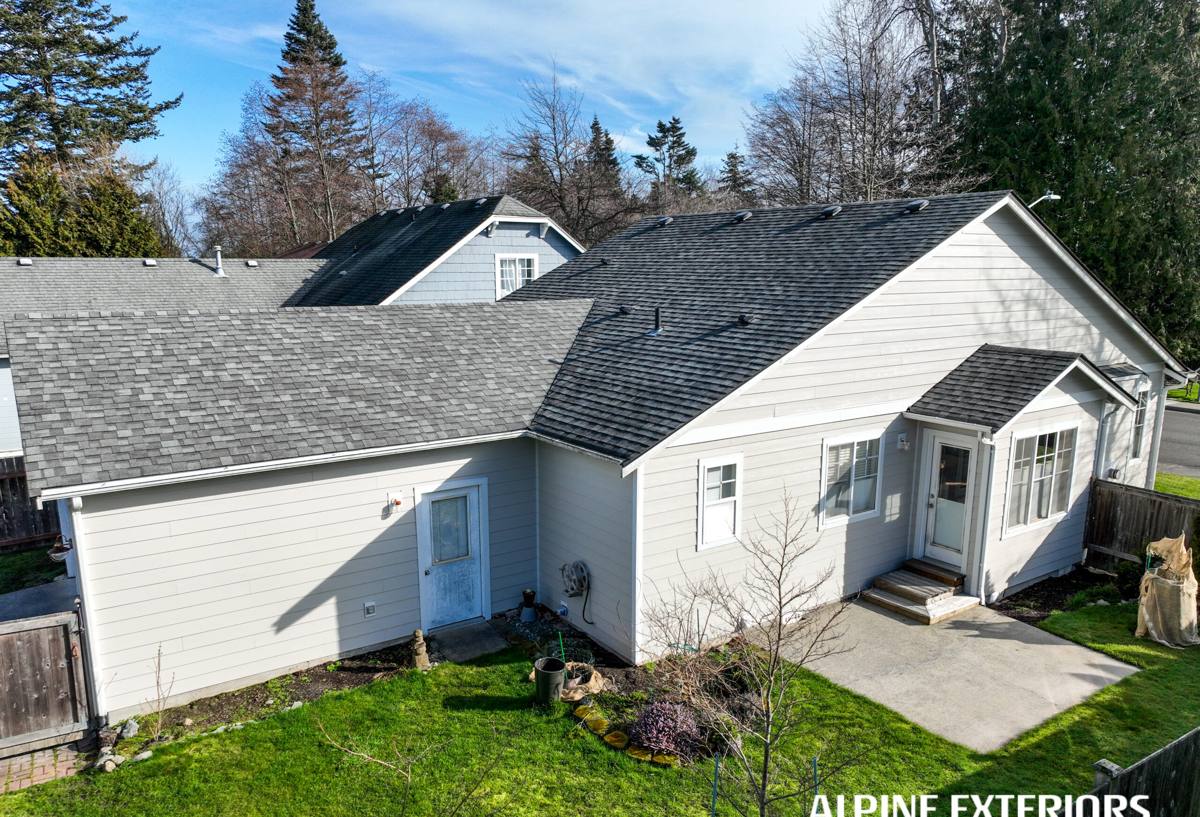
What Salt Air, Rain, and Moss Actually Do to a Wall
Salt Air
Airborne salt from the bay doesn't just sit on the surface — it's hygroscopic, meaning it actively pulls moisture out of the air and holds it against whatever it's landed on. On wood-based siding products, that means the material stays damp longer than it would from rain alone, even on days when it isn't raining at all. Combined with UV exposure, it also accelerates the breakdown of paint and factory coatings, which is why homes closer to the water tend to need repainting more often than homes just a few miles inland.
Driving Rain
Bellingham's rain rarely falls straight down. Wind-driven rain gets pushed sideways into wall assemblies, especially around windows, corners, and anywhere siding meets trim. If the water-resistive barrier behind the siding, the flashing details, and the siding material itself aren't all doing their job together, water finds its way behind the cladding — and once it's behind the siding, it can sit there for months before it shows up as a stain or a soft spot on the outside.
Moss and Organic Growth
Moss needs three things to establish itself on a wall: moisture, shade, and a surface it can grip. Columbia's tree canopy and the number of homes with shaded north walls check the first two boxes automatically. The siding material determines the third. Porous or textured surfaces give moss and algae something to hold onto and feed on; dense, factory-finished surfaces give them much less to work with.
What "Correct" Siding Installation Actually Means
The siding material itself only does half the job. A huge share of the moisture failures we get called out to inspect in Bellingham aren't a materials problem at all — they're an installation problem. A correct installation, regardless of the product, includes:
- A continuous, properly lapped water-resistive barrier (house wrap) behind the siding, with all seams and penetrations sealed
- Correctly flashed windows, doors, and any wall penetration so water sheds outward instead of tracking inward
- Adequate ground clearance and flashing at the base of the wall so splash-back and standing water can't wick into the bottom edge of the siding
- Proper fastening — correct fastener type, spacing, and depth for the specific product, not generic staples or overdriven nails
- Correctly sized gaps and sealant joints where the manufacturer calls for them, and no sealant where it isn't supposed to be used
- Trim and caulking details that are actually maintained, not just installed once and forgotten
Skip any one of these and it doesn't matter how good the siding material is — water will eventually find the weak point. This is why we treat installation quality as equal in importance to product choice, and why a rushed crew with the right materials can produce worse long-term results than a careful crew with a lesser product.
Why We Install James Hardie Fiber Cement — and Only That
We made a decision to standardize on James Hardie fiber cement siding across every job we take, including here in Columbia, and we don't install vinyl, LP SmartSide, or other fiber cement brands. That's not a marketing position — it's a practical one, built on what actually holds up in this climate over decades, not just the first few years.
Fiber cement is non-combustible, which matters increasingly in Washington as wildfire risk has become a bigger part of insurance and building conversations statewide. It doesn't rot, delaminate, or feed insects the way wood-based products can. James Hardie's HZ5 product line is engineered specifically for the freeze-thaw, high-moisture conditions of our region, and the ColorPlus factory finish is baked on under controlled conditions — a more durable, consistent bond than field-applied paint, which is one of the main reasons ColorPlus-finished homes hold their color longer than repainted siding, salt air or not.
None of this means fiber cement is maintenance-free or that installation quality stops mattering once you've picked the right product — it doesn't. It means the material itself isn't the weak link. Combined with correct installation, it's the combination we're willing to put our name behind.
James Hardie vs. Other Common Options
| Factor | James Hardie Fiber Cement | Vinyl | Wood-Based (LP SmartSide, cedar, primed spruce) |
|---|---|---|---|
| Moisture/rot resistance | Does not rot; engineered for wet climates | Won't rot, but can trap moisture behind it if installed poorly | Vulnerable to moisture intrusion and rot if coating fails |
| Fire rating | Non-combustible | Combustible, can melt/warp near heat | Combustible |
| Finish longevity | Factory-baked ColorPlus finish, long fade resistance | Color molded in, can fade/chalk over time | Depends entirely on paint/coating maintenance schedule |
| Impact/moss resistance | Dense, engineered surface resists impact and organic growth better than porous wood | Can crack in cold, brittle with age | More susceptible to moss/algae on porous surfaces |
| Typical warranty | Long-term, transferable manufacturer warranty | Varies widely by manufacturer/tier | Varies; often shorter on the finish than the substrate |
Our Installation Process
Every job starts with an actual look at the wall assembly, not just the visible siding. On older Columbia homes especially, we want to know what's underneath before we quote anything, because hidden sheathing damage changes the scope of the job.
- Assessment. We inspect the existing siding, trim, and — where accessible — the sheathing and framing behind problem areas, so surprises get caught before the crew shows up, not during teardown.
- Removal and prep. Old siding and any compromised sheathing or framing come off and get replaced. This is the point where hidden moisture damage, if any, gets fully exposed and addressed.
- Water-resistive barrier. A new, continuous house wrap goes on with correctly lapped and taped seams, sized for the wall assembly.
- Flashing. Windows, doors, and penetrations get flashed to shed water outward, following manufacturer and code details rather than shortcuts.
- Siding installation. James Hardie panels or lap siding go on to manufacturer fastening specs — correct nailing pattern, gaps, and clearances.
- Trim, caulking, and touch-up. Final trim work and sealant joints are finished to manufacturer detail, with ColorPlus touch-up product where a fastener or cut edge needs it.
- Walkthrough. We go over the finished job and what routine maintenance (if any) it actually needs going forward.
Signs a Columbia Home May Need New Siding
| What you're seeing | What it usually means |
|---|---|
| Recurring moss/algae after cleaning | Moisture is retained at or near the surface; may or may not indicate deeper damage yet |
| Paint failing within 2-3 years of repainting | Moisture is likely moving through the siding material itself, undermining the coating |
| Soft or spongy spots when pressed | Active rot or moisture saturation in the siding or sheathing behind it |
| Visible warping, buckling, or gaps between boards | Material failure or fastening issues; water intrusion risk is high |
| Stains or discoloration below windows or seams | Flashing or sealant failure allowing water to track down the wall |
Why Hiring a Crew That Already Works in Columbia Matters
Bellingham building code, permitting requirements, and typical wall assemblies aren't identical to what you'd find in a drier inland market, and a crew that mostly works elsewhere can miss details that matter here — proper rain-screen gaps for high-moisture zones, ground clearance requirements, or how to detail a wall that's shaded most of the year. A crew that's already worked houses in and around Columbia has usually already run into whatever your particular street or lot layout is going to throw at them, whether that's mature tree cover, tight side-yard clearances, or older sheathing that needs extra attention during tear-off.
There's also a practical local-logistics side to this: permitting, disposal, and scheduling all go smoother with a crew that already has those relationships and routines dialed in for Whatcom County jobs, rather than figuring it out for the first time on your house.
Questions Worth Asking Before You Hire
- Are you licensed and insured to work in Washington State, and can you provide proof?
- What siding products do you install, and why did you choose them?
- Will you inspect the sheathing behind the old siding before quoting, or only after teardown begins?
- What's your approach to flashing and water-resistive barrier detailing, specifically?
- What warranty applies to the material, and separately, what warranty applies to your labor?
- Have you worked on homes in this neighborhood or similar older Bellingham housing stock before?
If a home in Columbia is showing any of the signs above, or if it's simply due for a look before the next wet season sets in, we're glad to come take a look. A free, no-pressure estimate is the easiest way to find out what shape your siding is actually in and what your options are.