 Bellingham Roofing
 Bellingham's Coastal Climate Puts Sehome Siding to the Test
Sehome sits close enough to Bellingham Bay to catch the salt-laden air blowing in off the water, and far enough into the Pacific Northwest's wet belt to see rain for a good chunk of the year. That combination is rougher on exterior siding than most homeowners realize. Salt air accelerates corrosion on fasteners and metal trim, driving rain finds every gap in flashing and caulk, and Whatcom County's long, mild, damp winters give moss and algae months at a time to take hold on north-facing walls and anything shaded by trees or eaves.
None of this means siding is doomed — it means siding needs to be installed and repaired with this climate in mind, not treated like it's going up in a dry inland town. A repair that looks fine on a sunny July afternoon can fail by the following February if it wasn't done with Bellingham's weather in mind.
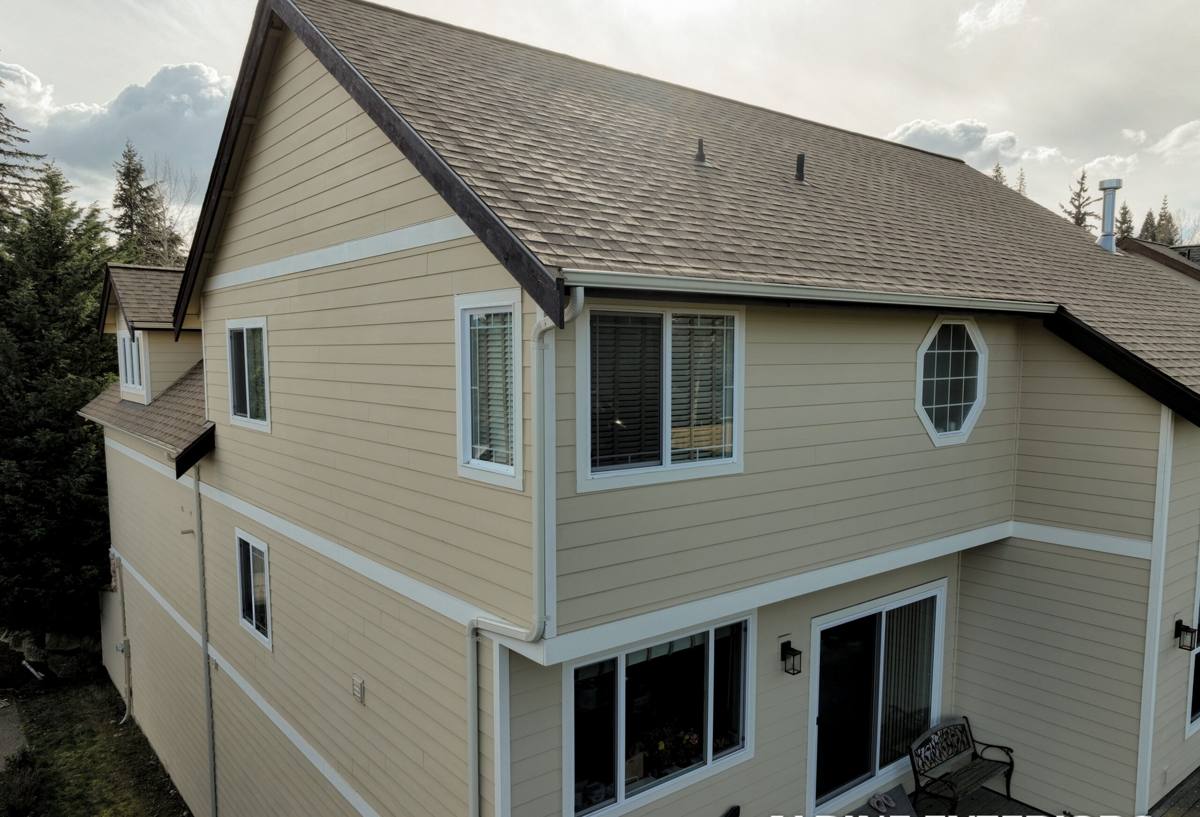
What We See Most Often on Sehome Siding Repair Calls
Every neighborhood has its own pattern of wear, and Sehome — with its mix of older homes and newer construction, mature trees, and sloped lots common throughout central Bellingham — tends to show a few recurring issues:
Moss and algae staining
Shaded walls, especially those facing north or tucked under overhangs, stay damp longer after every rain. Over a full moss season, that moisture holds against the siding surface, feeding growth that traps even more water against the wall.
Fastener and flashing corrosion
Salt-influenced air speeds up corrosion on nails, screws, and thin metal flashing. Once a fastener starts to rust and lose its grip, a siding panel can loosen, and a loose panel lets in wind-driven rain.
Caulk and joint failure
Bellingham's freeze-thaw swings are mild compared to inland climates, but repeated wet-dry cycling still breaks down caulk and sealant faster than manufacturers' lab tests suggest. Once a joint opens up, water gets behind the siding rather than running off the face of it.
Signs It's Time to Call for Siding Repair
Catching damage early is almost always cheaper and less disruptive than waiting. Homeowners in Sehome should watch for:
- Dark green or black staining that keeps returning after cleaning, particularly on shaded or north-facing walls
- Soft, spongy, or bubbling spots when you press on the siding, which often signal moisture trapped underneath
- Visible gaps, cracks, or warping at panel seams and corner trim
- Rust streaks running down from nail heads or metal flashing
- Paint that's peeling, bubbling, or failing faster than it should for its age
- Musty smells or unexplained moisture inside walls near exterior corners
- Panels that flex, rattle in the wind, or feel loose to the touch
Any one of these can be minor on its own. Several appearing together, or appearing on the same wall repeatedly, usually points to a moisture problem working its way behind the siding rather than just a surface issue.
What a Correct Siding Repair Actually Involves
A siding repair done right is not just popping in a matching piece and caulking the edges. It starts with figuring out why the damage happened in the first place — otherwise you're just patching the symptom and the same spot fails again next winter.
Diagnose before you patch
We pull back damaged sections to check the water-resistive barrier, flashing, and framing underneath before deciding on a repair plan. If the sheathing behind the siding has absorbed water, replacing the visible siding alone won't solve anything.
Fix the water path, not just the symptom
Most siding failures trace back to water getting in somewhere — a missing kick-out flashing, a caulked joint that should have been left open to drain, or trim installed tight against a horizontal surface instead of sloped to shed water. A correct repair addresses that entry point, not just the stained board.
Match materials and reinforce weak points
Where we're repairing James Hardie fiber cement siding, we use Hardie-approved materials, fasteners rated for coastal exposure, and factory-matched ColorPlus finish so the repair blends in rather than standing out as an obvious patch.
Repair or Replace? How We Help You Decide
Not every damaged section needs full replacement, but there's a point where patching stops making financial sense. We walk Sehome homeowners through this honestly rather than defaulting to the more expensive option.
| Factor | Usually Points to Repair | Usually Points to Replacement |
|---|---|---|
| Extent of damage | Isolated to one or two wall sections | Spread across multiple elevations |
| Underlying moisture | Sheathing and framing are dry | Sheathing shows rot or sustained wetness |
| Siding material | Still James Hardie or comparable fiber cement | Original material was vinyl, LP SmartSide, or aging cedar |
| Age of siding | Well within expected service life | Near or past the end of its practical life |
| Cause of failure | One-off installation or flashing defect | Systemic issue — wrong product or bad original install |
If your current siding isn't James Hardie, we'll still repair what can be reasonably saved. But if the underlying material is failing because of what it is — not just how it was installed — we'll say so plainly, and explain why replacing with Hardie fiber cement is the better long-term move for a Bellingham exterior.
Our Siding Repair Process
- Inspection. We look at the visible damage and check surrounding areas, flashing, and trim for related issues before quoting anything.
- Moisture check. Where damage suggests water intrusion, we open up the affected section to check the sheathing and barrier before closing anything back up.
- Honest scope. We tell you what actually needs to be repaired, what could be repaired but is close to end-of-life, and what should be replaced — with reasoning, not upselling.
- Repair or replacement. Work is done with Hardie-approved materials and fastening methods suited to a coastal, high-moisture climate.
- Finish match. Where possible, we match ColorPlus factory finish so repaired sections don't stand out from the rest of the wall.
- Final walk-through. We show you what was done and what to watch for going forward, especially on shaded or north-facing walls prone to moss.
Why We Repair and Replace with James Hardie Fiber Cement Only
We install and repair exclusively with James Hardie fiber cement siding. We don't work with vinyl, LP SmartSide, Cemplank, Allura, or primed spruce and cedar, and that's a deliberate standard, not a lack of options.
In a climate like Bellingham's — salt air, sustained rain, and a moss season that runs much of the year — the material matters as much as the workmanship. Fiber cement doesn't rot, doesn't feed moss and algae the way untreated wood can, and doesn't warp or buckle the way vinyl can under heat and impact. Hardie's HZ5 product line is engineered specifically for climates with cold, wet weather, and the factory-applied ColorPlus finish holds color far longer than field-applied paint, which matters when a repaired section needs to match the rest of the house years down the road. It also carries a strong, transferable warranty, which is worth something when a home in Sehome eventually changes hands.
That said, this page is about repair, not a sales pitch — if your home has non-Hardie siding, we'll still repair it fairly and tell you honestly when repair makes sense versus when the material itself is working against you.
The Value of a Crew That Already Works in Sehome
Siding repair done by a crew that already knows Bellingham's weather patterns, Whatcom County permitting, and how houses in this area are typically built saves you from guesswork. We know what moss growth on a north wall usually means before we even pull the first board, we know which fastener types hold up against the salt air off the Bay, and we know how local building and trim details tend to be put together, which speeds up both diagnosis and the repair itself. That local familiarity also means fewer surprises mid-project and a repair that's built to handle what next winter actually brings, not a generic weather assumption.
After the Repair: Keeping Moss and Moisture Away
A good repair holds up longer with a little basic upkeep, especially through a long Pacific Northwest moss season:
- Trim back tree limbs and shrubs that keep siding shaded and damp
- Rinse moss and algae growth off gently before it builds up thick enough to hold moisture against the wall
- Keep gutters clear so overflow doesn't run down the siding face
- Check caulking at trim and window joints once a year, before the wet season sets in
- Watch previously repaired areas after the first few heavy rain events each fall
If you're seeing moss stains, soft spots, or loose panels on a Sehome home, it's worth getting an honest look before a small repair turns into a bigger one. We're happy to walk your property, explain what we find, and put together a free, no-pressure estimate — no obligation either way.