 Bellingham Roofing
 Siding Repair Built for Silver Beach's Conditions
Homes in the Silver Beach neighborhood take a specific kind of beating year-round. Like much of Bellingham, the air here carries a steady dose of moisture off the water, the tree cover keeps large parts of the exterior shaded for much of the year, and the rain doesn't fall in short bursts so much as settle in for days at a time. That combination is hard on any exterior cladding, but it's especially hard on siding that wasn't built with this climate in mind. When a repair call comes in from Silver Beach, we're not treating it like a generic siding job — we're treating it like a job that has to hold up against salt-laden air, driving rain, and a moss season that can stretch longer here than it does further inland.
A siding repair that only addresses the visible symptom — a cracked board, a stained panel, a soft spot near a downspout — without accounting for what's causing it will fail again, usually within a year or two. Our approach starts with figuring out why the siding failed in the first place, then repairing it in a way that actually holds up to the next several winters.
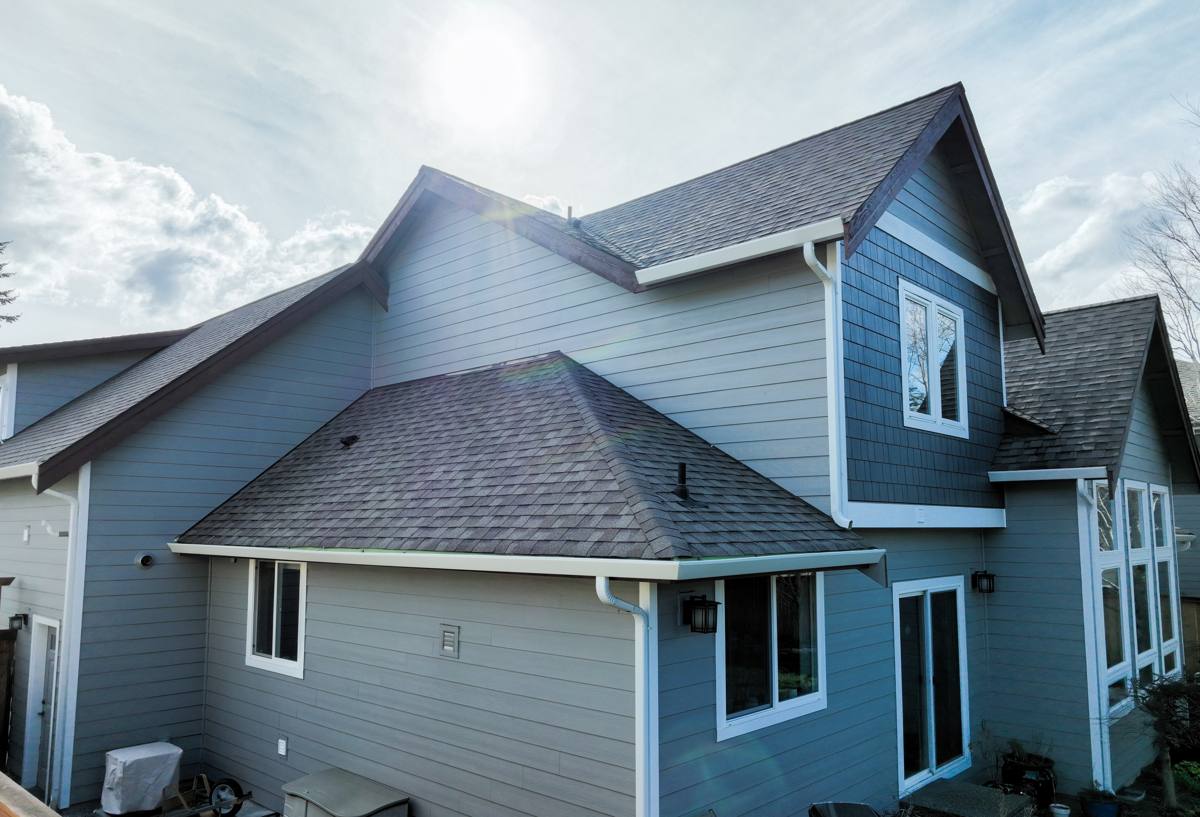
Why Silver Beach's Climate Is Tough on Siding
Salt Air and Moisture
Proximity to the water means airborne moisture and salt exposure are part of daily life for exterior materials here, even on homes that aren't right on the shoreline. Salt-laden air accelerates corrosion on fasteners and trim, and it speeds up the breakdown of coatings and finishes that aren't built to resist it. Over years, this shows up as premature fading, chalking paint, and metal flashing or nails that rust and stain the siding around them.
Driving Rain
Whatcom County doesn't just get rain — it gets wind-driven rain that hits siding at an angle, working its way into seams, butt joints, and anywhere caulking has shrunk or separated. Once water gets behind the siding, the damage often isn't visible until it's already significant: soft sheathing, stained interior walls, or a musty smell in a room that shares a wall with the affected area.
Moss and Shade
Mature tree cover is one of the things people love about this part of Bellingham, but it also means many homes stay shaded and damp for long stretches, which is exactly what moss and algae need to take hold. Moss on siding isn't just a cosmetic problem — it holds moisture directly against the surface far longer than open sunlight would allow, which accelerates rot in wood-based products and can stain and etch other materials over time.
Signs Your Siding Needs Attention
Most siding failures give warning signs well before they become structural problems. Homeowners in Silver Beach should watch for:
- Soft or spongy spots when you press on the siding, especially near the bottom courses or under windows
- Visible cracking, buckling, or warping in individual boards or panels
- Persistent green or black staining that comes back shortly after cleaning
- Paint that's peeling, bubbling, or chalking heavily in patches rather than evenly across the wall
- Gaps opening up at seams, corners, or trim boards where caulking has shrunk or pulled away
- Rust streaks running down from nail heads or metal flashing
- A musty odor or visible mold on an interior wall that backs up to an exterior section showing damage
Any one of these on its own might be minor. Several appearing together, or appearing in the same location repeatedly, usually points to a moisture pathway that needs to be found and closed — not just patched over.
What a Correct Repair Actually Involves
A siding repair that's done right isn't just about swapping a damaged board for a new one. It involves a few steps that are easy to skip if a crew is moving fast:
- Diagnose the source, not just the symptom. We look at what let moisture in or accelerated wear — failed caulking, a missing kick-out flashing, a clogged gutter dumping water onto a wall, or simply age and sun exposure on a section without much tree cover.
- Check what's behind the siding. Once a section is open, we inspect the water-resistive barrier and sheathing underneath. If those are compromised, replacing the visible siding alone just repeats the failure.
- Repair the water management, not just the cladding. That means correcting flashing details, re-establishing proper drainage planes, and making sure water has somewhere to go besides into the wall assembly.
- Match materials and installation method. Patchwork that doesn't match the existing siding's material, profile, or fastening pattern tends to fail at the seam between old and new, and it looks obviously mismatched.
- Finish with the right caulking and paint or factory finish. Sealant choice and application matter as much as the repair itself in a climate that sees this much sustained rain.
Repair or Replace? What We Look At
Not every problem calls for full replacement, and not every problem should be patched. The right call depends on how far the damage has spread and what's causing it.
| Situation | Usually Repair | Usually Replace |
|---|---|---|
| Damage limited to one or two boards/panels | Yes, if sheathing underneath is sound | No |
| Rot or soft sheathing found behind siding | Only the affected section, if isolated | Yes, if spread across multiple walls |
| Siding is original wood or older composite nearing end of service life | Short-term only | Yes, repairs won't keep pace with failures |
| Persistent moss/algae staining despite cleaning | Sometimes, with drainage and shade corrections | Yes, if the material itself is absorbing moisture |
| Isolated impact damage (branch strike, equipment bump) | Yes | No |
When damage is contained and the underlying structure is sound, targeted repair is the honest recommendation — there's no reason to replace an entire elevation over a problem confined to a few square feet. When the damage points to a material or installation issue that's likely to keep recurring, we'll tell you that plainly rather than repairing the same spot twice.
Why We Repair With and Recommend Only James Hardie Fiber Cement
We install and repair James Hardie fiber cement siding exclusively — we don't install vinyl, LP SmartSide, cedar, primed spruce, or other fiber cement brands. That standard matters directly to repair work, not just new installs. When we're patching a section of siding, the material we use to patch it needs to hold up the same way the rest of the wall does, and Hardie's fiber cement composition simply behaves better in conditions like Silver Beach's than the alternatives.
Fiber cement is non-combustible and doesn't absorb water the way wood-based or wood-fiber products do, which matters directly in a climate with this much sustained rain and shaded, damp wall sections. Hardie's ColorPlus factory finish is baked on and engineered to resist the fading and chalking that salt air and UV exposure cause faster in field-applied paint. And Hardie's HZ5 product line is specifically engineered for cold, wet Pacific Northwest climates — it's not a generic national product with a marketing label slapped on for our region.
That said, we're honest about the trade-offs. Fiber cement is heavier and less forgiving to install than vinyl, and it requires correct fastening, gapping, and caulking to perform as designed — sloppy installation on any siding material, including Hardie, is what causes early failures. It's also a bigger upfront investment than vinyl or engineered wood siding. We think that investment pays off in a coastal, wet climate through longevity, a strong transferable warranty, and far less repair work down the road — which is exactly the kind of call we make with every homeowner considering repair versus replacement here.
If your existing siding is a different material, we'll still assess and repair it honestly. But when a homeowner is facing a section of siding that's failed repeatedly, or a wall that's due for a larger replacement, we'll explain why we'd put Hardie on it instead of matching the original material.
Our Repair Process
Every repair call in Silver Beach follows the same process, whether it's one panel or a full wall section:
- An on-site inspection where we look at the damaged area and the surrounding conditions — shade, drainage, gutter performance, and grade slope near the foundation
- An honest assessment of whether the issue is isolated or a sign of a broader problem, explained in plain terms
- A written estimate that separates the visible repair from any water management corrections needed
- Careful removal of damaged material without disturbing sound siding around it
- Inspection and repair of the water-resistive barrier and sheathing before anything new goes back on
- Installation matched to existing reveal, fastening pattern, and finish wherever possible
- A final walkthrough so you know exactly what was found and what was done
Why Local Experience in Silver Beach Matters
Siding failures in this neighborhood tend to follow patterns tied to shade, wind exposure, and proximity to moisture — patterns that look different from what you'd see on a siding job in a drier, more open part of Whatcom County. A crew that already works this area knows to check the shaded north walls first, knows which flashing details tend to fail under driving rain, and isn't guessing at how much moss recovery a wall needs before the underlying material is compromised. That local pattern recognition is often the difference between a repair that lasts and one that needs revisiting next winter.
Bellingham's weather doesn't take a break for a siding repair to cure or a caulk joint to set, so timing and technique matter as much as material selection. We plan repair work around the conditions we know this climate will throw at a wall, not around a generic install schedule that assumes drier weather.
Get a Straight Answer About Your Siding
If you're seeing staining, soft spots, cracked panels, or persistent moss on your Silver Beach home's siding, it's worth getting a professional look before the problem spreads. We'll give you a clear, no-pressure assessment of what's actually happening, what it will take to fix it correctly, and whether repair or replacement makes more sense for your situation. Use the form below to request a free estimate.