 Bellingham Roofing
 Metal Roofing in Sudden Valley: Built for the Lake, the Shade, and the Rain
Sudden Valley sits on the south shore of Lake Whatcom, a wooded residential community with its own private road network and homeowners association, tucked into the hills southeast of Bellingham. It's one of the more heavily forested settings in this part of Whatcom County, and that combination of dense tree canopy, lake humidity, and a long wet season puts a specific kind of stress on a roof. Metal roofing has become one of the more common upgrades we install here, and for good reason: on a lot that rarely gets a full day of direct sun, a smooth, non-porous roofing surface that sheds water and resists moss buildup solves problems that shingles just don't solve as well.
This page is specifically about metal roofing for Sudden Valley properties — what the local climate demands from it, what a correct installation actually involves, and why hiring a crew that already knows this particular community matters. If you're comparing metal against asphalt shingles in general, that's a broader conversation; here we're focused on what works on a shaded, lakeside lot in this part of Whatcom County.
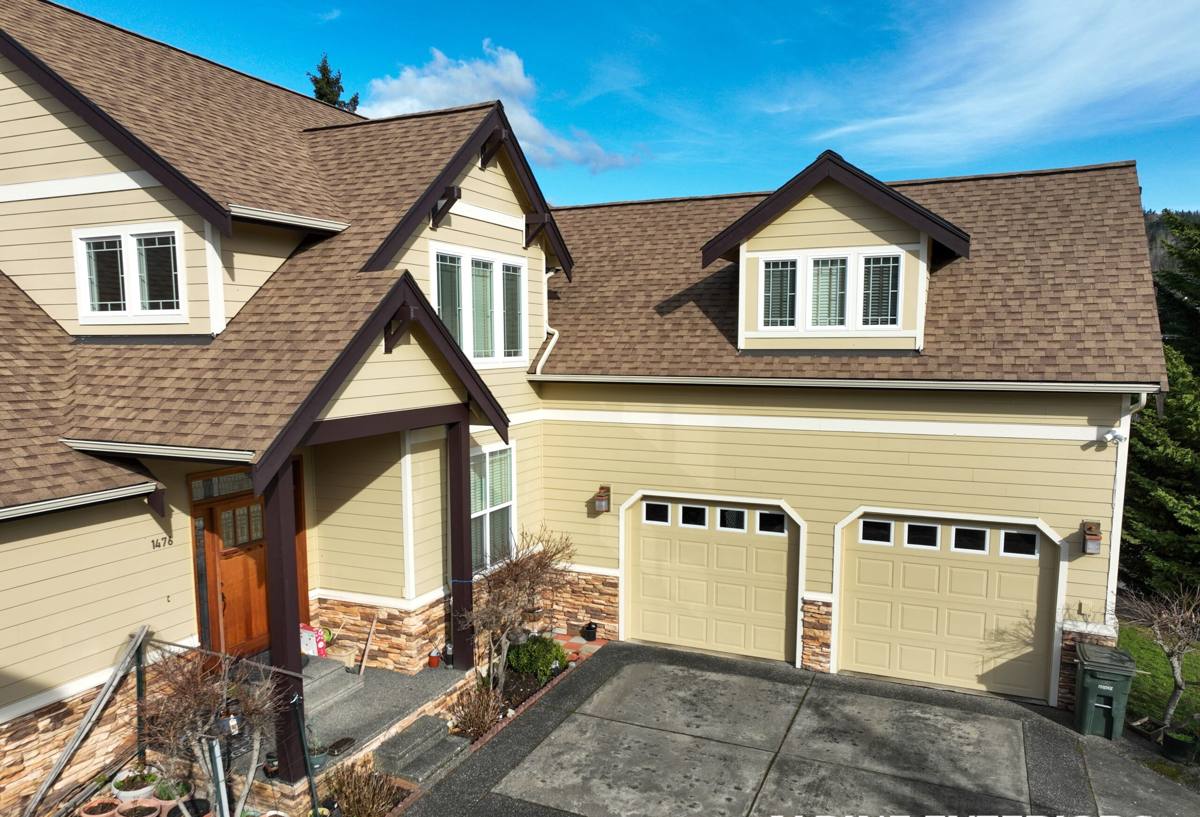
What This Climate Does to a Roof in Sudden Valley
Regional Salt Air and Corrosion
Whatcom County's marine climate carries salt-laden air off Bellingham Bay and the Salish Sea across the whole region, and that moisture-and-salt combination accelerates corrosion on unprotected metal components — fasteners, flashing, vents, and any exposed steel. Sudden Valley itself sits inland from the immediate waterfront, so it doesn't take the same direct salt spray a bluff-top property closer to the Sound would. But the broader regional air quality still carries enough of that salt influence, layered on top of Lake Whatcom's own humidity, that we don't treat this as a low-corrosion zone. Panel coatings, fastener grade, and flashing material all get chosen with that in mind, not just for looks.
Driving Rain and Uneven Exposure
Sudden Valley's terrain is hilly, with homes sitting at a range of elevations and orientations relative to the lake and the surrounding ridgelines. That means wind-driven rain doesn't hit every roof plane the same way — a slope facing open water or a break in the tree line can take a heavier, more direct load than a slope tucked under canopy on the opposite side of the same roof. Metal roofing sheds that water efficiently once it's on the roof, but the flashing and seam details that get the water there in the first place have to account for that variability, not assume uniform exposure across the whole structure.
Heavy Shade and a Long Moss Season
Most Sudden Valley lots sit under significant second-growth forest, and many roofs have at least one section that gets very little direct sun for most of the year. Shade plus humidity plus mild temperatures is the exact recipe for moss, and that recipe stays active here longer than it does on a more open, sun-exposed property. This is one of the strongest arguments for metal roofing in this specific community: moss struggles to get a foothold on a smooth standing seam panel the way it does on the textured, porous surface of an asphalt shingle, which matters a great deal on a roof that rarely dries out completely between storms.
Choosing the Right Metal Roofing System
"Metal roofing" isn't one product — the panel style you choose changes how it performs, how it looks, and what it costs. For a shaded, moisture-heavy property like a typical Sudden Valley home, the differences matter more than they would on a drier lot.
| System | How It Sheds Water & Moss | Appearance | Typical Fit for Sudden Valley |
|---|---|---|---|
| Standing seam | Concealed fasteners, raised interlocking seams; excellent water shedding and moss resistance | Clean, modern vertical lines | Strong default choice for shaded, high-moisture lots |
| Exposed-fastener panel | Screws penetrate the panel face; performs well when fasteners and washers are maintained | More traditional agricultural/rib look | Workable option, but fastener upkeep matters more under heavy tree debris |
| Metal shingle / stone-coated panel | Interlocking shingle profile; sheds water well, mimics shingle or shake appearance | Traditional shingle or shake look | Good where HOA aesthetics call for a less "industrial" roofline |
We lean toward standing seam on most Sudden Valley homes because the concealed-fastener design gives moisture the fewest places to sit and the fewest exposed metal points to corrode over time. That said, roof pitch, budget, and how a given system will look against the surrounding tree line and neighboring homes are all part of the conversation — we'll walk through the real trade-offs rather than pushing one system by default.
Fasteners, Flashing, and Coating Matter More Than the Panel Itself
The panel gets most of the attention, but on a property like this, the details around it decide how the roof actually performs over twenty or thirty years. That means corrosion-resistant fasteners rated for sustained moisture exposure, not the cheapest option that meets minimum code. It means flashing at every valley, chimney, vent penetration, and roof-to-wall transition lapped and sealed correctly, since that's where wind-driven rain finds its way in first. And it means a factory-applied panel coating — most quality systems use a Galvalume or similar corrosion-resistant substrate with a baked-on finish — chosen for how it holds up to this region's combination of moisture and salt-influenced air, not just for color matching.
What a Correct Metal Roof Installation Involves
A metal roof is only as good as what's underneath it and around it. On every Sudden Valley installation, that means:
- Underlayment rated for sustained moisture exposure, installed as a full water-resistant barrier under every panel
- Ice-and-water shield at eaves, valleys, and other spots where water and debris naturally collect
- Properly lapped and sealed flashing at every valley, chimney, skylight, and roof-to-wall transition
- Panel fastening and seam spacing that matches the manufacturer's specification for this region's wind and moisture loads
- Attic and roof deck ventilation that lets trapped moisture escape rather than condensing against the underside of the panels
- Corrosion-resistant fasteners, trim, and flashing throughout — not just at the panel field
None of these add significant cost relative to the panels themselves, but skipping any of them is exactly what turns a fifty-year roofing material into a roof with a leak in year eight. On a heavily shaded, tree-covered lot where problems don't dry out and announce themselves quickly, getting these details right the first time matters even more than it would on an open, sunny property.
Cost Factors for a Metal Roof in Sudden Valley
Metal roofing costs more upfront than asphalt shingles, and the honest answer to "what will it cost" depends on several variables specific to the property. Rather than quoting a number that doesn't mean much without context, here's what actually moves the price on a job like this.
| Factor | Why It Matters Here |
|---|---|
| Roof pitch and complexity | Steeper roofs and homes with multiple valleys, dormers, or roof-to-wall transitions take more labor and more flashing detail |
| Panel system chosen | Standing seam typically costs more than exposed-fastener panel or stone-coated shingle systems |
| Tear-off vs. overlay | Removing an existing roof down to the deck costs more than a straightforward tear-off-and-replace, but lets us inspect and correct any deck damage first — important on a lot that's stayed damp for years |
| Access and site conditions | Private-road access, steep driveways, and dense tree cover around the home can affect staging and material delivery |
| Deck repair needs | Roofs with long-term moss or moisture damage sometimes need sections of the roof deck replaced before new panels go on |
We'll give a firm, itemized number after walking the actual roof, not a rough estimate over the phone. If budget is the main constraint, we'll also be honest about where a metal shingle or exposed-fastener system gets you most of the performance of standing seam at a lower price point.
Signs an Existing Roof Should Be Replaced With Metal
- Moss buildup on shaded slopes that returns quickly after every cleaning
- Granules collecting in gutters and downspouts, a sign an aging asphalt roof is breaking down
- Debris from surrounding trees accumulating in valleys faster than it can be cleared
- Water staining on interior ceilings near exterior walls after a heavy or extended rain
- Soft spots, sagging, or visible deck movement near penetrations and eaves
- Repeated repairs to the same section of roof over the past few years
Any one of these is worth a look before it turns into a deck-level repair. A roof that's already showing several of them is usually a stronger candidate for full replacement than another round of patching.
Our Process, From Estimate to Cleanup
We start with an on-site walk of the existing roof, paying close attention to how shade, tree cover, and water flow vary across the different slopes — that variation matters more on a Sudden Valley property than it does on a typical open lot. From there we put together a clear, written scope covering the panel system, underlayment, flashing details, and any deck repair we expect to need, along with a firm price, before any work begins. During the tear-off and install, we protect landscaping and gutters from falling debris, and we do a full site cleanup — including a magnetic sweep for stray fasteners — once the job is done. We'll also walk you through the coating warranty and any manufacturer-specific maintenance recommendations for the system installed.
Why a Crew That Already Works Sudden Valley Matters
Sudden Valley is a private community with its own internal roads and an active homeowners association, and a crew that regularly works here already understands the practical side of that — how to schedule around community access, and how exposure and shade change from one lot to the next even within the same neighborhood. Many homes in Sudden Valley fall under the community's architectural guidelines, so we're mindful of panel color and profile choices from the start rather than raising it as an afterthought once materials are ordered. That local familiarity also shows up in the technical decisions: which roof faces need extra flashing attention because they catch wind off the lake, and which fastener grade actually holds up in a shaded, humid microclimate versus a drier inland property elsewhere in the county.
A Simple Checklist Before Hiring for Metal Roofing Here
- Ask which panel system they recommend for your roof's pitch and shade exposure, and why
- Confirm current Washington contractor licensing and active liability insurance
- Ask specifically how they handle flashing at valleys and roof-to-wall transitions
- Ask about experience working within HOA or private-road communities, including access and scheduling
- Get a clear, written scope and firm price before signing anything
If you're weighing metal roofing for a home in Sudden Valley, we're glad to walk the roof with you and give an honest read on what it actually needs — no pressure, no upsell script. Reach out using the form below for a free estimate.