 Bellingham Roofing
 Why Siding Matters More in Barkley Than in Drier Parts of the Country
Barkley sits inside Bellingham, close enough to the water and the marine air pattern that comes with it that siding here works harder than siding in most of the country. Salt-tinged air, wind-driven rain off the Sound, and a long, damp moss season stack up year after year. Siding in this neighborhood isn't just a cosmetic layer — it's the primary barrier standing between your framing and a climate that stays wet for months at a stretch. When that barrier is installed wrong, or built from the wrong material, the consequences show up slowly: a soft spot behind a window, a stain that won't scrub off, paint that won't hold past a couple of seasons.
Homes in this part of Whatcom County don't get the brutal freeze-thaw cycles you'd see inland, but they get something arguably harder on siding: near-constant humidity, low winter sun that leaves shaded walls damp for days, and salt-laden coastal air that accelerates corrosion on fasteners and hardware. Any siding installation in Barkley has to be planned around that reality, not around a generic national spec sheet.
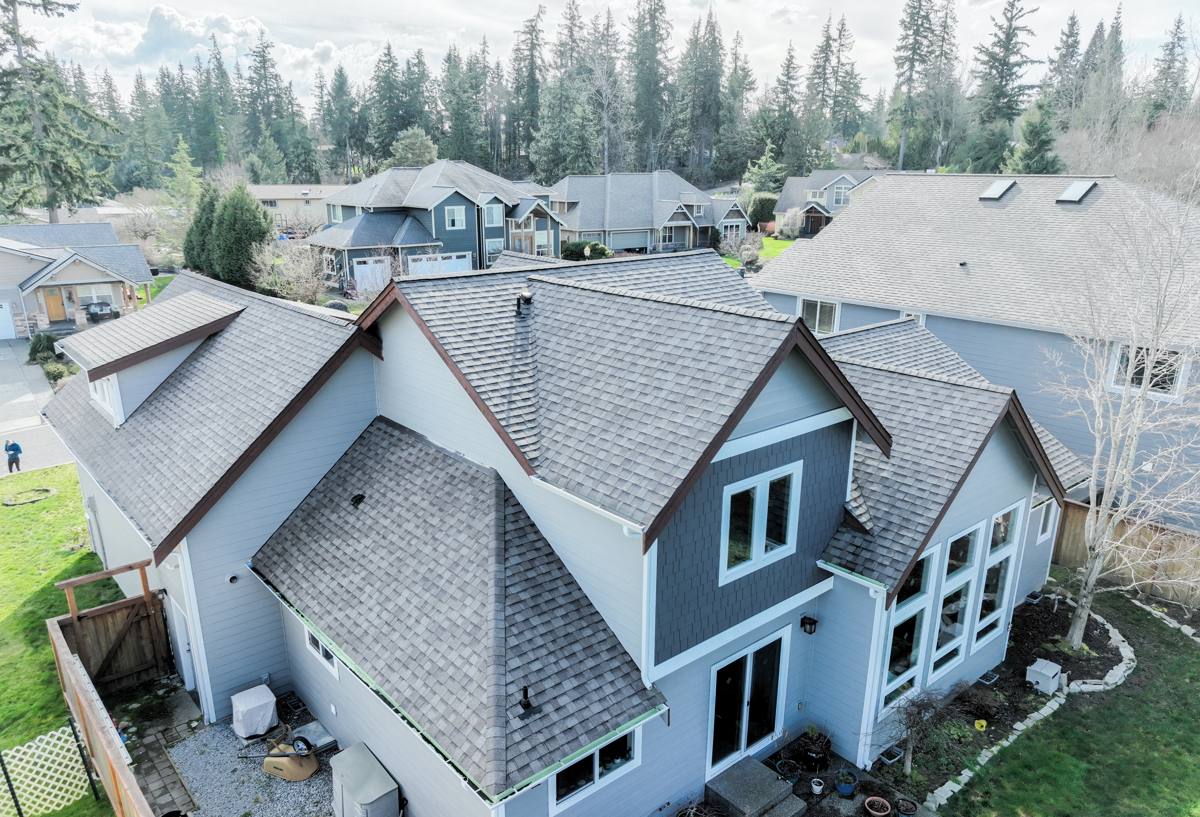
What Bellingham's Marine Climate Actually Does to Siding
Driving Rain and Wind-Loaded Walls
Storms coming off the water don't just fall straight down — wind pushes rain sideways into wall assemblies, especially on west- and south-facing exposures. That means seams, laps, and penetrations (hose bibs, light fixtures, vents) take on water pressure that a calm-climate installation would never see. Flashing details and lap spacing that would be "good enough" in a dry inland town are not good enough here.
Moss, Algae, and Prolonged Dampness
Bellingham's moss season runs long — shaded roof lines, north walls, and anything under tree cover stay damp for weeks at a time. Moss and algae don't just look bad; they hold moisture against the siding surface and, on materials that aren't dimensionally stable, that trapped moisture is what starts the real damage: swelling, softening, and paint failure.
Salt Air and Metal Fatigue
Proximity to Bellingham Bay means airborne salt reaches inland further than people expect, especially on breezy days. Salt exposure accelerates corrosion on uncoated fasteners, trim hardware, and lower-quality flashing metals. Over a decade or two, that corrosion is often what actually fails first — not the siding panel itself.
Signs a Barkley Home Needs New Siding
- Paint that's peeling, bubbling, or needing repainting far more often than the rest of the house
- Soft or spongy spots when you press on siding near the bottom courses or around windows
- Visible warping, cupping, or gaps opening up between boards
- Persistent moss or dark streaking that comes back within a season of cleaning
- Rising energy bills that track with drafts or cold spots near exterior walls
- Visible rot at butt joints, corners, or anywhere trim meets siding
Any one of these on its own might be minor. Two or three together usually means the siding system — not just the paint — has reached the end of its useful life.
Why We Only Install James Hardie Fiber Cement
We made a decision a long time ago to install one siding system: James Hardie fiber cement. Not vinyl, not LP SmartSide, not primed spruce or cedar, not other fiber cement brands. That's a narrower lineup than most contractors offer, and it's intentional. In a climate like Bellingham's, the material matters as much as the installation.
Fiber cement is non-combustible and dimensionally stable — it doesn't swell, warp, or rot the way wood-based products can when they take on moisture repeatedly over a rainy season. James Hardie's HZ5 product line is specifically engineered for climates like ours, with moisture and freeze-thaw performance built into the formulation rather than relying entirely on field-applied coatings. The factory-applied ColorPlus finish is baked on under controlled conditions, which holds color and resists the chalking and peeling that field-applied paint struggles with in a climate this damp. That matters directly for the maintenance side of moss season — a stable, tightly bonded finish gives algae and moss less to grip onto and makes cleaning less likely to damage the surface.
We're not going to tell you every other product is worthless — vinyl is inexpensive and low-maintenance in the right setting, and engineered wood has genuine fans. But we've settled on what we're willing to put our name behind in this specific climate, and that's Hardie. If a homeowner wants a different product, we're happy to point them toward what we do install and why, but we don't install materials outside that standard.
What a Correct Installation Actually Involves
The material is only half the equation. A lot of siding failures we see in this region trace back to installation shortcuts, not the product itself. On a proper job, that means:
Weather-Resistive Barrier and Flashing First
Before a single piece of siding goes up, the wall needs a correctly lapped weather-resistive barrier and properly integrated flashing at every window, door, and penetration. In a wind-driven-rain climate, this layer is what actually keeps water out if — or when — it gets past the siding surface.
Clearances and Fastening
James Hardie specifies clearances from grade, roof lines, and decks, along with fastener patterns and spacing. Skipping these — nailing too close to panel edges, burying the bottom edge in mulch or hardscape, over-driving fasteners — is exactly the kind of shortcut that turns into rot or cracking a few years down the line, and it's exactly what voids the manufacturer's warranty.
Caulking and Joint Treatment
Butt joints, corners, and trim intersections need to be treated to Hardie's spec, not improvised. In a climate where those joints face sustained rain exposure, this detail work is where a lot of the long-term performance actually lives.
Our Process for a Barkley Siding Installation
- On-site assessment — we walk the home, check the current siding and sheathing condition, note exposure to wind and shade, and identify any moisture damage that needs addressing before new siding goes up.
- Product and color selection — walking through James Hardie's HZ5 lines and ColorPlus palette options suited to the home and neighborhood.
- Tear-off and substrate check — removing existing siding and inspecting sheathing and framing for hidden rot or water damage, addressed before anything new is installed.
- Weather barrier and flashing installation — the unglamorous work that determines whether the job holds up in a coastal storm.
- Hardie installation to manufacturer spec — correct clearances, fastening, and joint treatment throughout.
- Final walkthrough and cleanup — reviewing the finished work with the homeowner and clearing the site.
Comparing Siding Options for This Climate
| Factor | James Hardie Fiber Cement | Vinyl | Untreated Wood / Primed Spruce |
|---|---|---|---|
| Moisture stability | Dimensionally stable, engineered for wet climates | Won't rot, but can warp or crack in temperature swings | Prone to swelling, cupping, and rot with sustained moisture |
| Finish durability | Factory-baked ColorPlus finish, long color hold | Color molded in, can fade over time | Relies on field-applied paint, needs frequent recoating |
| Fire resistance | Non-combustible | Combustible | Combustible |
| Moss/algae resistance | Tight, stable surface resists buildup | Smooth surface, moderate resistance | Textured grain holds moisture and organic growth |
| Typical lifespan when installed to spec | Multiple decades, strong transferable warranty | Long-lasting but can become brittle | Shorter, maintenance-dependent |
Choosing a Siding Contractor in Barkley
The neighborhood's mix of shaded lots, coastal wind exposure, and varying home ages means a contractor who's actually worked this specific area brings real value — they've already seen which walls take the worst weather, which older homes have hidden moisture issues behind the siding, and what flashing details actually hold up here.
- Ask specifically what siding system they install and why — a contractor with one standard product usually has a defensible reason, not just a supplier relationship
- Confirm they follow James Hardie's published installation instructions, including clearances and fastening — this is what keeps the manufacturer warranty valid
- Ask how they handle the weather-resistive barrier and flashing, not just the visible siding
- Get specifics on how sheathing damage, if found during tear-off, gets addressed and priced
- Check that written estimates spell out product line, color, and scope — not just a lump-sum number
Maintenance After Installation
Correctly installed Hardie siding is low-maintenance compared to wood, but "low" isn't "none," especially with Bellingham's moss season. A periodic gentle rinse (never high-pressure blasting directly at seams or up under laps) keeps organic growth from establishing, and an annual walk-around to check caulking at trim and penetrations catches small issues before they become water intrusion. Keeping gutters clear and vegetation trimmed back from walls also goes a long way toward reducing the sustained dampness that drives moss growth in the first place.
If your Barkley home's siding is showing its age — or you're planning ahead before the next wet season sets in — we're happy to take a look and walk you through what a James Hardie installation would involve for your specific home. Reach out for a free, no-pressure estimate using the form below.