 Bellingham Roofing
 Sehome's Climate Is Rougher on Siding Than It Looks
Sehome sits close enough to Bellingham Bay to catch salt-laden air on windy days, and like the rest of Whatcom County it sees long stretches of steady, driving rain from fall through spring. Add the tree cover that gives many Sehome streets their shade, and you get a textbook recipe for moss, algae, and slow moisture intrusion on exterior walls. None of this is dramatic on its own — no single storm damages a house. It's the accumulation, year after year, that wears down the wrong siding material faster than most homeowners expect.
Salt air corrodes fasteners and trim hardware over time. Driving rain — rain that hits the wall sideways instead of falling straight down — pushes moisture into seams, laps, and butt joints that would stay dry in a calmer climate. And a long moss season means anything with texture or porosity becomes a growth surface for algae and moss spores for months at a time. Siding here isn't just a cosmetic choice; it's a moisture-management system that either holds up to this pattern or slowly fails because of it.
What This Means for Sehome Homes Specifically
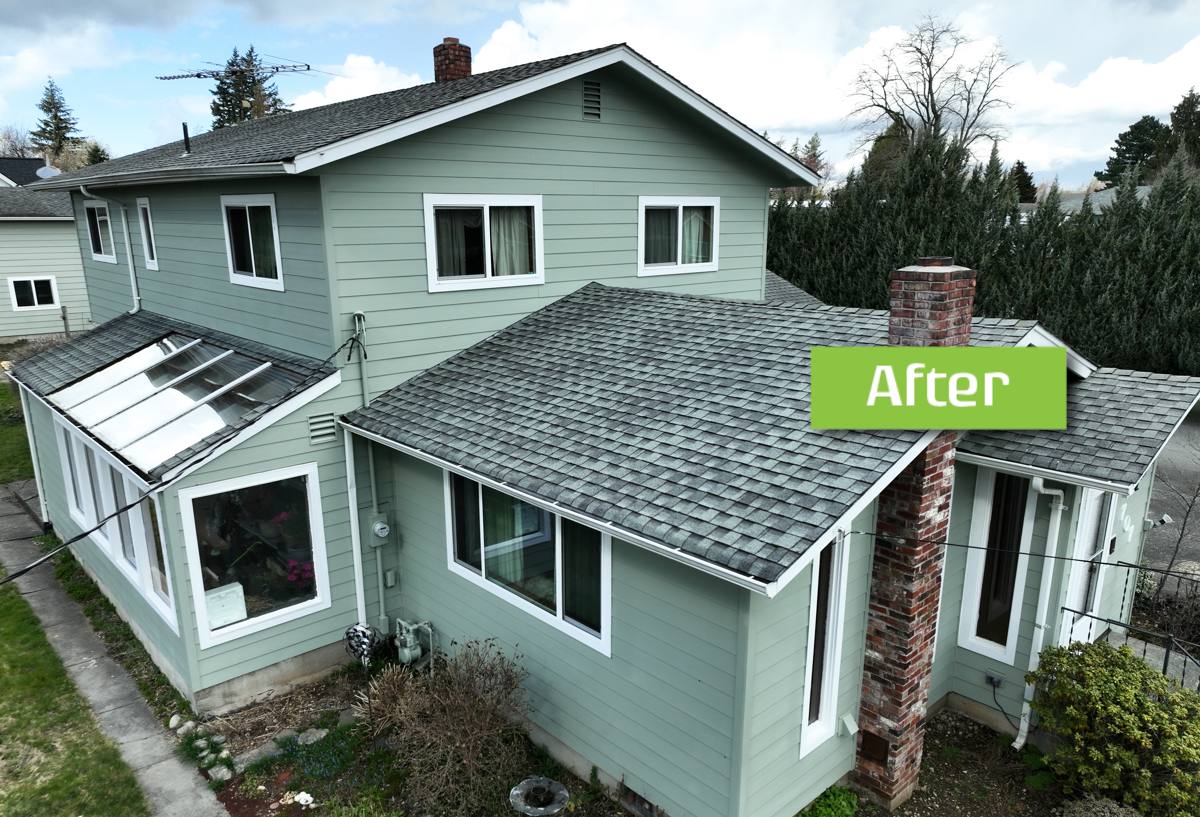
A lot of the housing stock in and around Sehome is older, which means original siding, trim, and flashing details that were built to a different (often lower) standard than what we'd install today. When we're called out to look at siding in this neighborhood, we commonly find the same handful of problems: caulk that's failed at trim joints, wood or composite siding that's absorbed moisture at the bottom courses, and moss buildup in shaded areas that's been left to sit against the wall instead of being cleaned or, better, engineered against in the first place.
None of that is unique to Sehome — it's a pattern across Bellingham and Whatcom County generally. But the tree canopy and proximity to the water make the moss and moisture problems show up a little sooner and a little worse here than in drier, more open parts of the region. That's the context we bring into every estimate: we're not guessing at what Pacific Northwest coastal weather does to a wall, we're accounting for it up front.
Why We Install James Hardie and Nothing Else
We made a deliberate decision to install only James Hardie fiber cement siding — not vinyl, not LP SmartSide, not Cemplank or Allura, not primed spruce or cedar. That's not a marketing position, it's a standard we hold because of what we've seen those other products do (and not do) in exactly this kind of climate over time.
Fiber cement vs. the alternatives, briefly
Vinyl siding is inexpensive and low-maintenance, but it's a petroleum-based product that expands and contracts with temperature swings, can crack in impact events, and doesn't hold paint if a homeowner ever wants to change the color. LP SmartSide and other engineered wood products use a wood-strand core, which means any breach in the factory coating — a cut edge, a fastener hole, a scratch — creates a path for moisture to reach wood fiber that will swell and deteriorate if it stays wet. Cedar and primed spruce are natural wood: beautiful when new, but they need ongoing painting, caulking, and moisture vigilance to survive a climate with this much sustained rain and shade.
James Hardie fiber cement is cement, sand, and cellulose fiber — it doesn't have an organic core to rot, it doesn't burn, and it doesn't expand and contract the way vinyl does. That doesn't mean it's maintenance-free or bulletproof; it means the failure modes we worry about with the other products largely aren't in play with Hardie, which matters a lot in a place where the siding is wet more often than it's dry.
The Hardie Product System, Not Just the Board
HZ5 engineering for this climate
James Hardie manufactures its siding in climate-specific "HZ" formulations. Western Washington falls into the HZ5 zone, engineered for regions with significant moisture exposure and freeze-thaw cycling. The board itself is denser and formulated differently than the versions sold in dry southern climates — this isn't a one-size-fits-all product, and installing the wrong regional formulation is one of the quieter mistakes some crews make.
ColorPlus factory finish
Most of what we install uses Hardie's ColorPlus finish — a baked-on, factory-applied coating that's more consistent and more resistant to fading and moss staining than field-applied paint. It also comes with its own finish warranty separate from the substrate warranty, which matters because a lot of "siding failure" homeowners see elsewhere is really finish failure — chalking, fading, or a surface that's lost its ability to shed water and resist algae growth.
Warranty structure
Hardie backs its fiber cement with a 30-year non-prorated limited warranty on the substrate, and the ColorPlus finish carries its own separate coverage. It's also transferable to a new owner within the warranty window (with standard registration), which is a real factor if a Sehome homeowner sells within a couple decades of the install — something that's not typical with paint-grade wood siding warranties.
What a Correct Installation Actually Involves
The product only performs to spec if it's installed to spec. James Hardie publishes detailed installation requirements, and in a climate like ours, skipping them is exactly how a good product ends up with a bad reputation. A correct installation includes:
- Proper starter strip and minimum ground clearance so the bottom edge of the siding never sits in standing water or constant splash-back
- Correct fastener type, spacing, and depth — over-driven or under-driven nails are one of the most common defects we find on re-siding jobs
- Weather-resistant barrier installed and lapped correctly behind the siding, not just "a house wrap exists somewhere"
- Flashing at every window, door, and roofline intersection, installed to shed water outward and downward, not just caulked and hoped for
- Proper joint treatment at butt seams and corners, using the manufacturer's specified sealant and gapping — not just running a bead of caulk and moving on
- Field-cut edges primed or sealed before installation, since a raw cut edge is the one place moisture can get into the board itself
Mistakes we see and correct
The most common issues we find when we're called to inspect or replace existing siding — Hardie or otherwise — are insufficient ground clearance, missing or improperly lapped flashing around windows, and caulk used as a substitute for flashing rather than a supplement to it. In a climate with this much horizontal rain, those shortcuts show up as moisture problems within a few years, not decades.
Our Process, Start to Finish
We start with an on-site inspection and honest assessment of the existing wall assembly — not just the siding, but what's behind it. If there's hidden moisture damage, we tell you before work begins, not after we've already opened the wall. From there:
- Written estimate covering the full scope: tear-off, any sheathing or moisture repair needed, weather barrier, Hardie product line and color, trim, and installation labor
- Scheduling that accounts for our actual rain windows — we don't leave a wall open to the weather overnight if we can avoid it
- Removal of existing siding and inspection of the sheathing underneath for rot or moisture damage before anything new goes up
- Weather barrier and flashing installed per manufacturer spec at every penetration
- Hardie siding installed to the HZ5 fastening and clearance requirements
- Final walkthrough where we point out what we did and why, so you know what's behind the new wall, not just what it looks like
Why a Crew That Already Works Sehome Matters
Siding installation isn't generic across the country, and it isn't even fully generic across Bellingham. A crew that regularly works Sehome's older housing stock has already dealt with the specific quirks that come up here — original wall assemblies from different eras, tree-shaded lots with slower drying times, proximity to salt air near the bay. That experience shows up in small decisions: where to add extra flashing attention, which corners of a lot need a closer look for moss and moisture history, how to sequence the job around our wetter months instead of fighting them.
It also means we're not learning the neighborhood on your project. When we quote a job in Sehome, we're pricing it against what we already know this area's homes tend to need — not a generic national average.
Comparing Siding Options for a Coastal Whatcom County Climate
| Factor | James Hardie Fiber Cement | Vinyl | Engineered Wood (LP SmartSide) | Cedar / Primed Spruce |
|---|---|---|---|---|
| Moisture tolerance | Non-organic, does not rot | Sheds water but seams can trap moisture behind panels | Wood core vulnerable if coating is breached | Absorbs moisture; needs ongoing sealing |
| Moss/algae resistance | Factory finish resists staining | Prone to surface algae in shade | Prone to surface growth over time | High — porous surface, frequent target |
| Fire performance | Non-combustible | Combustible | Combustible (wood-based) | Combustible |
| Repainting needed | Rarely, with ColorPlus finish | Never repaints well | Periodic, as coating wears | Every few years |
| Typical warranty | 30-yr non-prorated, transferable | Varies, often prorated | Manufacturer-specific, often shorter | No manufacturer warranty (natural material) |
This is a general comparison, not a claim about any specific competing product's failures — the point is simply why fiber cement, engineered for this exact climate, is what we've standardized on.
Signs Your Sehome Home May Need New Siding
- Persistent moss or algae staining that returns within months of cleaning
- Soft spots, bubbling, or visible warping, especially near the bottom courses or under windows
- Paint that's peeling or bubbling rather than just fading evenly
- Caulk that's cracked, shrunk, or pulled away at trim and joint lines
- Visible gaps or daylight at corners, window trim, or the foundation line
- Rising energy bills that aren't explained by anything else — a sign the wall assembly may no longer be sealing properly
If any of that sounds familiar, or you're just planning ahead for a siding project in Sehome, we're happy to come take a look. Estimates are free, there's no pressure, and we'll give you a straight answer about what your home actually needs — use the form below to get started.