 Bellingham Roofing
 Deck Repair Built for Columbia's Weather, Not Just Any Deck
The Columbia neighborhood sits close enough to Bellingham Bay that homes here deal with a specific combination of punishment most inland decks never see: salt-laden air moving in off the water, driving rain that comes in sideways during winter storms, and a moss season that can run from October well into spring. Any one of those is manageable on its own. Together, they age a deck faster than most homeowners expect, especially if the deck was built to a generic spec rather than for this exact climate.
We repair decks in and around Columbia regularly, and the failure patterns we see are consistent. Fasteners corrode faster near the water. Moss holds moisture against boards long after a storm has passed, keeping wood wet for days instead of hours. Ledger boards and stair stringers — the parts bolted to the house or buried against soil — take the brunt of it because they're the last to dry out. A repair that doesn't account for all of that is a repair that fails again in a year or two.
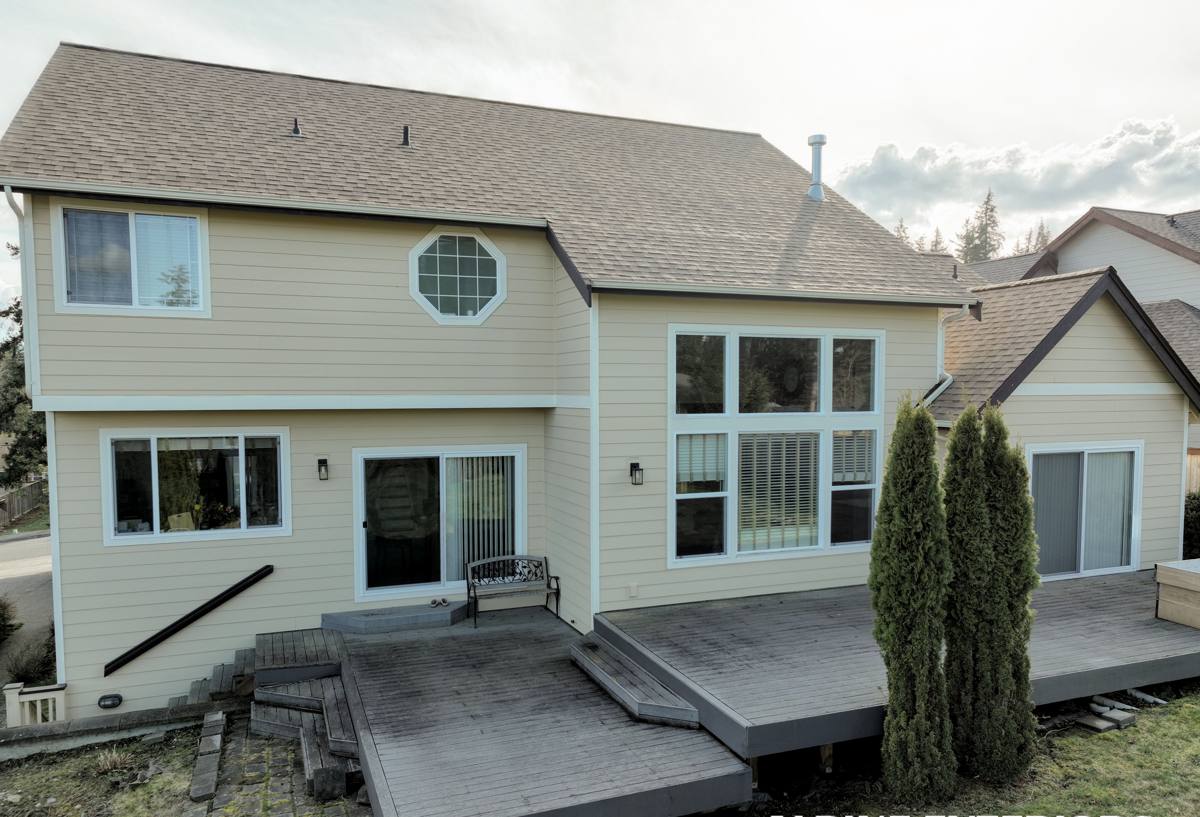
Signs Your Deck Needs Repair, Not a Full Rebuild
Most decks don't need to be torn out. They need the failing 10-20% addressed correctly while the sound structure stays in place. Here's what we check for on every inspection:
- Soft, spongy, or bouncy spots when you walk the deck surface
- Boards that stay dark, damp, or moss-covered longer than the rest of the deck after rain
- Rust streaks running down from screws or nail heads
- Gaps opening up between boards, or boards cupping and pulling away from joists
- Railing posts that wiggle at the base, or a top rail that flexes when you lean on it
- Visible daylight or gaps at the ledger board where the deck meets the house
- Stair stringers that feel spongy or show splitting near the ground
- A musty smell or soft wood at deck posts where they meet footings
If what you're seeing is limited to a few boards, loose railings, or surface wear, that's a repair. If the framing underneath — the joists, beams, or ledger connection — is compromised across a large section, that's a different conversation, and we'll tell you honestly which one you're looking at.
What a Correct Deck Repair Actually Involves
It Starts Underneath, Not on the Surface
Replacing a warped board is easy. Finding out why it warped is the actual job. Before we swap anything out, we get underneath the deck and check the framing: joists for rot or splitting, the ledger board connection to the house, post bases for water pooling, and the flashing (or lack of it) where the deck meets siding. In Columbia's climate, a huge share of "surface" problems trace back to moisture getting trapped somewhere it shouldn't — usually at a connection point that was never flashed correctly to begin with.
Fasteners Matter More Here Than in Drier Climates
Salt air accelerates corrosion on standard fasteners. If a deck was built with the wrong grade of screw or nail, you'll see rust streaks and weakened holding power well before the wood itself is a problem. Any repair we do near the water uses fasteners rated for coastal exposure — it costs a little more up front and saves the homeowner from redoing the same repair in three years.
Matching New Wood to Old
Board replacement isn't just pulling one out and nailing a new one in. New lumber needs to be the right moisture content before it's installed, gaps need to be spaced correctly to allow for seasonal movement, and fasteners need to land solidly in the joist below, not just tacked to the neighboring board. Rushed board swaps are one of the most common repair mistakes we get called out to fix a second time.
Common Deck Materials We Repair in Columbia
| Material | How It Handles This Climate | Typical Repair Needs |
|---|---|---|
| Pressure-treated lumber | Good rot resistance if sealed regularly; vulnerable at cut ends and fastener holes | Board replacement, re-sealing, fastener upgrades |
| Cedar | Naturally moisture-resistant but softer; can gray and split without upkeep | Sanding, re-staining, splitting/checking repair |
| Composite decking | Resists rot well but the hidden framing underneath still needs the same protection | Board and clip replacement, framing inspection below |
| Older/unknown mixed decking | Common on homes that have had partial repairs over the years | Full assessment first — repair approach depends on what's actually there |
Whatever the deck is built from, the framing underneath is almost always wood, and that's usually where the real problem is hiding — regardless of what the walking surface is made of.
Our Repair Process
- On-site inspection. We walk the full deck, get underneath it, and check the ledger, posts, and stair connections — not just the boards you can see from the top.
- Honest scope. We tell you what's actually failing, what's still sound, and what we'd watch but not touch yet. If it's a rebuild situation, we say so plainly.
- Written estimate. Clear pricing before any work starts — no surprise add-ons once we're into the job.
- Repair work. Framing and connection issues get fixed first, then boards, railings, and stairs.
- Final check. We walk the deck with you when it's done so you can see exactly what changed.
Repair vs. Replace: What Actually Drives the Decision
| Factor | Leans Toward Repair | Leans Toward Replacement |
|---|---|---|
| Framing condition | Joists and beams are solid, dry, no rot | Rot or soft spots in multiple structural members |
| Age of the deck | Under 15-20 years, built to a reasonable original spec | Original build was undersized, poorly flashed, or very old |
| Extent of damage | Isolated boards, railings, or stairs | Damage spread across most of the deck surface and framing |
| Ledger connection | Properly flashed and bolted, no water intrusion | Missing flashing or rot at the house connection |
| Your plans for the space | Happy with current size and layout | Want a different footprint, railing style, or added features |
In our experience, most decks we're called out to in Columbia land on the repair side of this table — the framing is generally salvageable, and the failures are concentrated in boards, fasteners, and a handful of moisture-trapped connection points.
Dealing with Moss, Algae, and Salt Air Between Repairs
A repair is only as good as the maintenance that follows it. Whatcom County's wet season gives moss and algae months to establish themselves on a deck surface, and once moss takes hold it holds water against the wood constantly, which is exactly the condition that causes rot in the first place. Salt air adds a second, separate problem: it accelerates corrosion on fasteners and hardware even when the wood itself looks fine.
A few habits go a long way between professional maintenance visits:
- Sweep leaves and debris off the deck regularly through fall and winter — trapped debris holds moisture
- Keep gutters and downspouts near the deck clear so runoff isn't draining directly onto it
- Rinse off surface moss and algae before it gets established, rather than after
- Reseal or restain wood decking on the schedule the product calls for — driving rain wears finishes down faster here than in drier parts of the state
- Check railings and stair connections for movement once or twice a year
Permits and Code Considerations
Not every deck repair requires a permit, but structural work — replacing framing, altering the ledger connection, or changing railing height and spacing — often does under Whatcom County and City of Bellingham building rules. Railing height and baluster spacing in particular get checked closely, since those are safety-code items, not just aesthetic choices. We'll flag when a repair crosses into permit territory before we start, so there are no surprises partway through the job.
Why Hire a Crew That Already Works in Columbia
A deck repair in this neighborhood isn't the same job as a deck repair twenty miles inland. Crews that don't regularly work this close to the water sometimes underestimate how fast salt air and moisture cycling will undo a repair that wasn't detailed correctly the first time. We work on homes throughout Bellingham and Whatcom County, and the coastal-adjacent work — Columbia included — is where the details around flashing, fastener selection, and moisture management matter most. Getting those right the first time is the difference between a repair that lasts and one you're paying for again in two winters.
We also give you a straight answer, even when it's not the answer that leads to the biggest invoice. If a repair will genuinely hold up, we'll tell you that instead of pushing a rebuild you don't need.
Get a Free, No-Pressure Estimate
If your deck in Columbia is showing soft spots, moss buildup, rust streaks, or a shaky railing, it's worth a proper look before winter rain makes the problem worse. Fill out the form below for a free estimate — we'll assess what's actually going on and give you an honest recommendation, no pressure either way.