 Bellingham Roofing
 Columbia's Climate Is Harder on Siding Than It Looks
Columbia sits close enough to Bellingham Bay that homes here deal with a specific combination of punishment: salt-laden air moving in off the water, wind-driven rain that hits walls sideways instead of straight down, and a long stretch of the year — often October through May — where surfaces stay damp enough for moss and algae to take hold and never fully dry out. Any one of those things is manageable. All three, year after year, is what actually wears siding out.
Salt air accelerates corrosion on fasteners and trim. Driving rain finds every gap, seam, and poorly flashed penetration and pushes water behind the cladding instead of letting it run off. And a long moss season means anything that traps moisture against the wall — bad caulk joints, tight-to-grade siding, clogged gutters dumping water down a wall — gets a lot more time to do damage before a dry spell gives it a break. Whatcom County's marine climate isn't extreme in the way a hurricane zone is, but it's relentless, and relentless is what actually breaks siding down over time.
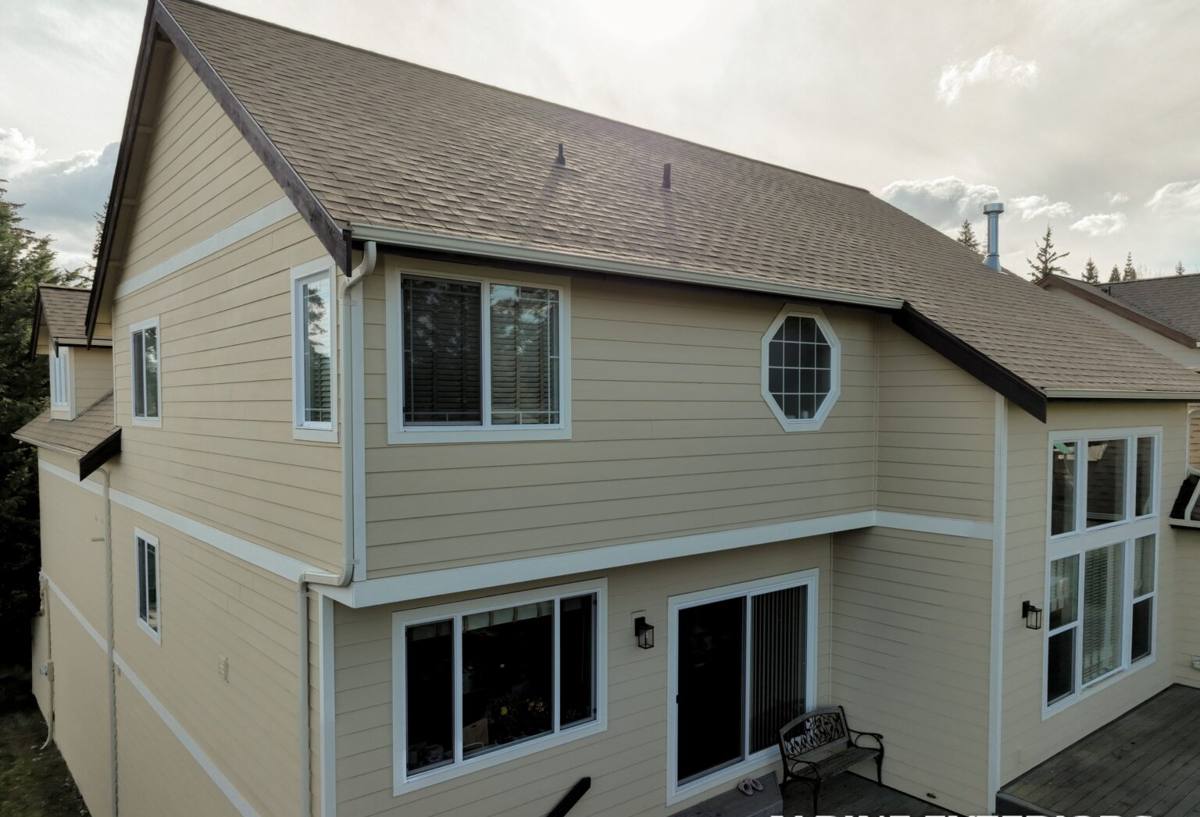
What This Means for a Columbia Home Specifically
Houses in this neighborhood tend to be exposed to at least one full weather-facing side that takes the brunt of storms coming off the bay. That's usually the side that shows problems first — cracked caulk, peeling paint, soft trim, or visible moss buildup lower on the wall where moisture sits longest. If your siding is original to the house or hasn't been touched in a couple decades, this is exactly the kind of wall to have looked at, because whatever is happening there is happening slower everywhere else too.
This is also why we don't treat "siding replacement" as a one-size-fits-all job. A wall that takes direct wind-driven rain needs different attention at the seams and flashing than a sheltered wall on the same house. Getting that distinction right is a big part of what separates siding that lasts thirty-plus years from siding that needs attention again in ten.
Why We Only Install James Hardie
We standardized on James Hardie fiber cement siding for homes in this area, and the marine climate is a big reason why. Hardie's HardiePlank and HardiePanel products in the HZ5 formulation are engineered specifically for wetter, harsher climates like ours — the fiber cement composition doesn't absorb and swell with moisture the way wood-based products can, and it won't rot. It's also non-combustible, which matters as wildfire smoke and dry-season fire risk have become more of a factor in the Pacific Northwest even in a generally wet region like Whatcom County.
The factory-applied ColorPlus finish is another piece of why it holds up here. It's baked on in a controlled environment rather than field-painted, which means better adhesion and a finish that resists the fading and peeling that salt air and UV exposure cause on site-painted surfaces. That matters more in Columbia than in a drier inland location, because the combination of salt, moisture, and sun cycling wet-to-dry is exactly what breaks down a weaker paint job fastest.
We don't install vinyl, LP SmartSide, cedar, or primed spruce, and we're upfront about why: those products each have real trade-offs — vinyl can warp and fade and doesn't hold paint if you ever want to change the color; engineered wood products need diligent caulk and moisture management to avoid edge swelling; cedar and primed wood need ongoing maintenance and are more vulnerable to the rot risk that a wet coastal climate creates. Hardie isn't magic — it still has to be installed correctly — but it starts from a materially better position for a climate like ours.
What a Correct Installation Actually Involves
Fiber cement siding is only as good as the install behind it. Most of the siding failures we get called out to look at aren't a materials problem — they're an installation problem. In a climate like Columbia's, a few details matter more than they would in a drier region:
- Proper gapping and clearance — siding needs the manufacturer-specified gap from decks, roof lines, and grade so water has somewhere to go instead of wicking up into the bottom edge of the boards.
- Correct fastening — nails or screws placed per Hardie's fastening schedule, not overdriven (which cracks the board's water-resistant edge) and not underdriven (which lets the board move and eventually crack).
- Flashing at every penetration — windows, doors, hose bibs, light fixtures, vents — anywhere something goes through the wall is where driving rain finds its way in if flashing is skipped or done wrong.
- A functioning water-resistive barrier — the house wrap and drainage plane behind the siding is what actually keeps a home dry; the siding is the first line of defense, not the only one.
- Sealed and painted cut edges — every field cut exposes raw fiber cement that needs to be sealed before the board goes up, or that cut edge becomes the first place moisture gets in.
Skip any one of these and you can end up with a wall that looks fine for a couple of years and then starts failing from the inside out — which is a much more expensive repair than replacing siding that simply wore out on schedule.
How Our Process Works
We walk every side of the house before quoting anything, paying particular attention to whichever elevation takes the most direct weather. That inspection tells us whether we're dealing with straightforward siding replacement or whether there's underlying sheathing or framing damage that needs to be addressed first — something that's more common on older homes in wetter parts of Bellingham than people expect.
- Assessment — full exterior walkthrough, noting problem areas, trim condition, and any signs of moisture intrusion at penetrations.
- Tear-off — removal of existing siding down to the sheathing, with an honest look at what's underneath before anything new goes up.
- Repair as needed — any soft or damaged sheathing gets replaced; we don't cover over a problem with new siding.
- Weather barrier install — house wrap and flashing detail work, done correctly at every window, door, and penetration.
- Hardie installation — correct gapping, fastening schedule, and course alignment, matched to the HZ5 product spec for this climate.
- Trim, caulking, and touch-up — sealing cut edges and finishing details that keep water out long term.
- Final walkthrough — we go over the finished work with you before calling the job done.
Comparing Siding Options for a Marine Climate
| Factor | James Hardie Fiber Cement | Vinyl | Engineered Wood / Cedar |
|---|---|---|---|
| Moisture resistance | High — won't rot or swell | Doesn't absorb water, but seams and gaps can let it behind the panel | Vulnerable at edges and cuts if maintenance lapses |
| Salt air / coastal durability | Engineered for it (HZ5 line) | Can chalk and fade faster near salt air | Needs regular repainting or sealing to hold up |
| Fire resistance | Non-combustible | Melts/deforms under heat | Combustible |
| Finish longevity | Factory-baked ColorPlus finish | Color molded in, can fade over time | Field-applied paint/stain, shorter repaint cycle |
| Maintenance | Occasional washing, no repainting for years | Low, but limited repair/color options | Regular painting, caulking, and moisture checks |
Every product on that list has a legitimate use case somewhere. For a home in Columbia dealing with salt air, driving rain, and a long damp season, fiber cement gives you the fewest long-term maintenance headaches and the most predictable lifespan.
Signs Your Current Siding Needs a Closer Look
- Visible moss or dark streaking low on the wall or in shaded, less-ventilated areas
- Cracked, missing, or shrunken caulk at trim, windows, and butt joints
- Soft spots when you press on siding or trim, especially near ground level
- Peeling or bubbling paint that keeps coming back after repainting
- Warped, bowed, or separated boards, particularly on the side facing the prevailing weather
Any of these can be an early warning rather than an emergency — but in this climate, small gaps don't stay small for long once water finds them.
Maintenance That Actually Matters Here
James Hardie siding is low-maintenance, not no-maintenance. In a marine climate like Bellingham's, the few things worth staying on top of are: keeping gutters clear so water isn't sheeting down a wall, rinsing off moss and algae buildup before it gets established (a soft wash, not a pressure washer aimed at seams), and having caulk joints checked every few years since UV and moisture cycling are what break caulk down first. None of that is a big job, but skipping it is how a 30-plus-year product ends up needing early attention.
Why It Matters to Hire a Crew That Already Works This Area
Siding installed to spec in Arizona and siding installed to spec in Columbia aren't quite the same job, even though the manufacturer's instructions are the same document. A crew that already works Whatcom County knows which elevations on a given lot layout tend to take the worst weather, understands how moss and moisture behave here across a full winter season, and doesn't have to relearn regional flashing details on your house. That familiarity shows up in fewer callbacks and a longer-lasting result — not because the material changes, but because the judgment calls around it do.
If your Columbia home's siding is showing its age, or you're planning ahead before the next wet season sets in, we're happy to take a look and give you a straightforward, no-pressure estimate — no invented urgency, just an honest read on where things stand. The form below gets you started.