 Bellingham Roofing
 Building a Deck for a Happy Valley Lot
Happy Valley sits in the hills of south Bellingham, and that hillside setting shapes almost every deck project we take on there. Lots slope, mature trees hold heavy shade over big parts of a yard, and homes range from older bungalows to newer infill construction, often on the same block. On top of all that, the neighborhood shares the same coastal Whatcom County weather as the rest of Bellingham: salt-tinged marine air, rain that comes in sideways as often as it falls straight down, and a moss season that can run most of the year on shaded ground. A deck built for Happy Valley has to answer both problems at once, the terrain and the climate, not just one or the other.
This page covers what that actually looks like: what the neighborhood's site conditions demand from a deck, what a correctly built one involves, how our process runs from first visit to finished project, and why it matters to hire a crew that already works this specific part of Bellingham.
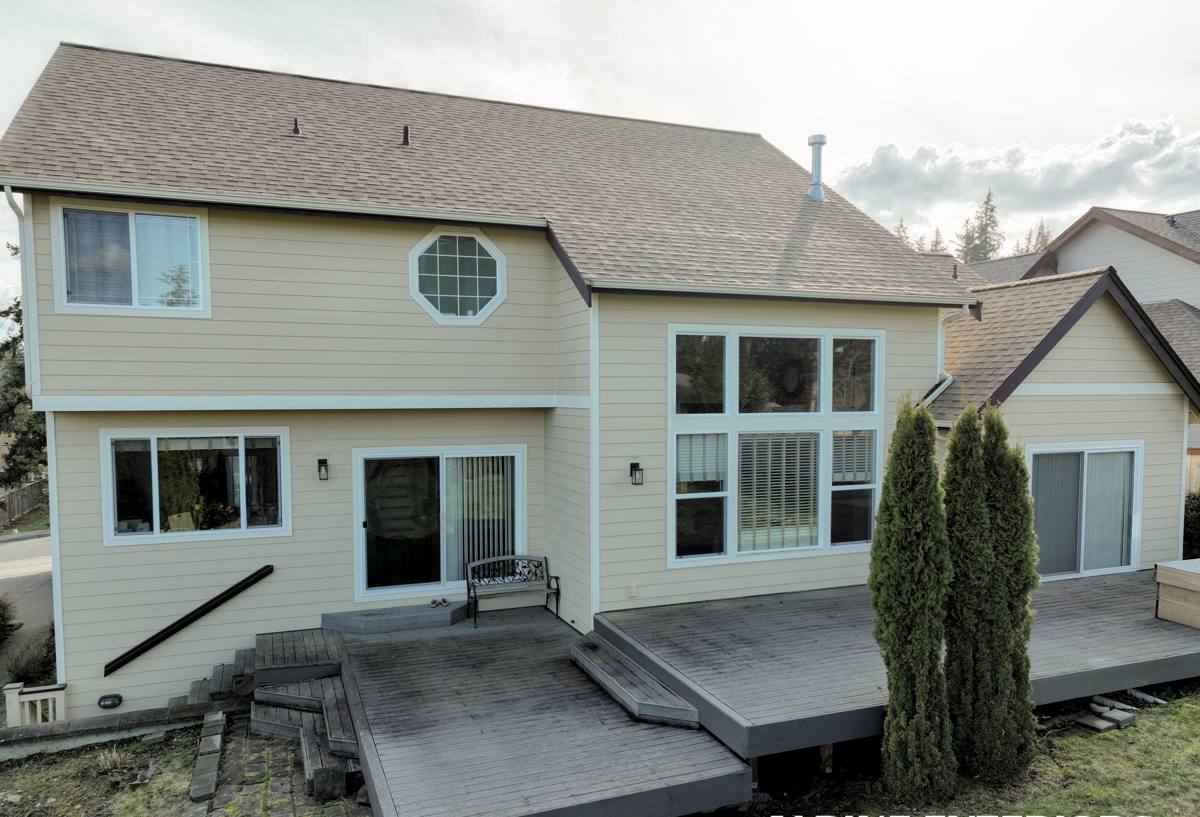
What Happy Valley's Site Conditions Do to a Deck
Slope and Grade Change
Sloped and terraced lots are common in Happy Valley, and that changes the deck conversation before material selection even comes up. A walkout deck on flat ground and an elevated deck stepping down a hillside are structurally different projects — different footing depths, different post heights, different bracing needs to keep the structure rigid under lateral load. Getting the grading and drainage right underneath a sloped-lot deck matters just as much as anything visible above it, since water that isn't directed away from the house or from downhill neighbors can turn into a much bigger problem than a deck repair.
Mature Tree Canopy
Many Happy Valley properties sit under a real tree canopy, which is part of the neighborhood's character but also a direct factor in how a deck performs. Heavy shade keeps decking surfaces damp longer after rain, which is exactly the condition moss and mildew need to take hold. Conifers add their own wrinkle in the form of needle litter and sap, which can clog board gaps and stain some decking finishes if it's left to sit. Root systems near the build area can also affect where footings can go, which is something worth identifying before a design is finalized rather than after excavation starts.
Salt Air and Driving Rain
Like the rest of Bellingham, Happy Valley gets a steady flow of moisture-laden, salt-tinged air off Bellingham Bay and the Salish Sea, along with rain that's frequently pushed sideways by wind rather than falling straight down. That combination accelerates corrosion in exposed hardware and drives moisture into places a purely vertical rainfall pattern wouldn't reach — under railings, into ledger connections, and between boards that aren't gapped correctly. A deck built without that in mind can look fine through its first summer and start showing problems by its second or third wet season.
Choosing Decking Material for a Shaded, Sloped Lot
Material choice matters everywhere in this climate, but a shaded Happy Valley lot narrows the tradeoffs further, since moss resistance and moisture behavior carry more weight here than they would on a sunny, open site.
| Material | Handles Shade & Moss | Handles Salt Air & Moisture | Upkeep |
|---|---|---|---|
| Cellular PVC | Excellent — non-porous, no wood fiber to hold moisture | Excellent | Occasional washing |
| Capped composite | Strong on most product lines | Strong — cap layer resists moisture and staining | Occasional washing |
| Uncapped composite | Fair — more prone to buildup in constant shade | Moderate | Periodic cleaning |
| Cedar | Fair when sealed regularly | Moderate — needs sealing to hold up | Regular oiling or sealing |
| Pressure-treated wood | Poor without frequent treatment | Weak against sustained exposure over time | Regular sealing or staining |
Wood can still make sense on a Happy Valley deck, especially where budget or a specific look matters more than minimizing upkeep, but it asks more of the homeowner in a shaded, damp yard than composite or PVC does. We'll walk through the real tradeoffs for your specific site rather than pushing one material as the only option.
What a Correctly Built Deck Involves Here
The decking surface is what people notice, but on a Happy Valley lot the framing, fasteners, and drainage underneath are what determine whether the deck is still solid in ten years. A build done right on this kind of site includes:
- Footings sized and placed for the actual slope and soil conditions on site, not a generic flat-lot layout
- Stainless steel or coastal-grade corrosion-resistant fasteners throughout, given the salt exposure common across Bellingham
- Correct board spacing for drainage and material movement, so wind-driven rain and shade-trapped moisture can actually clear the surface
- Proper ledger flashing where the deck ties into the house, especially important on older Happy Valley homes where the original wall assembly may need extra attention at that connection
- Post and railing attachment sized for the actual height and exposure of an elevated or hillside-stepped deck
- Grading and drainage paths underneath and around the structure that move water away from the foundation and any downhill neighbors' property
- Ventilation under the deck so shaded ground moisture doesn't sit against the framing between storms
- Design accounting for nearby tree roots and canopy, both for footing placement and for the maintenance the homeowner will realistically deal with later
Skip the underlying details and the deck can still look good the day it's finished. The consequences usually surface a couple of wet seasons later, in a soft joist, a loosening post, or moss that keeps coming back no matter how often it's cleaned.
Elevated Decks and Hillside Structural Considerations
A meaningful share of Happy Valley decks involve some amount of elevation, whether that's a full walkout from an upper floor or a deck stepping down a graded backyard. Elevated structures carry different guardrail height and structural requirements than a low deck sitting close to grade, and those requirements are there because the consequences of getting them wrong are more serious on a taller structure. Stairs on a sloped lot also need real attention to landing points and grade transitions so they're stable and code-compliant rather than just a set of steps bolted onto whatever grade happened to be there. We size posts, footings, and bracing for the specific height and slope of your site rather than applying one standard spec to every deck regardless of elevation.
How Our Process Works
We start with a site visit, because on a Happy Valley lot the slope, tree layout, and existing structure condition tell us more than a set of dimensions ever could. We look at grade change across the build area, sun and shade patterns through the day, root locations near likely footing spots, and how the deck will actually connect to the house. From there we talk through decking material and layout options that fit the site, the budget, and how the space will actually get used.
Permitting for deck construction in Bellingham generally follows standard setback, structural, and elevation requirements, and we handle that process as part of the job rather than leaving it for the homeowner to navigate. Once permitted, framing and footings go in first, sized for the site's actual slope and load, followed by decking, railing, and any stairs. We finish with a plain walkthrough of what your specific material and site will realistically need from you going forward.
What to Expect for Ongoing Maintenance
Even a well-built deck on a shaded Happy Valley lot needs some routine attention to hold up over time. A short list worth keeping on hand:
- Rinse or sweep the deck surface regularly, especially in fall and winter when leaf and needle litter builds up fastest under tree cover
- Keep gaps between boards clear so water can actually drain and airflow can dry the surface between rain events
- Check railing posts and hardware once a year for early corrosion or loosening, particularly before the wet season sets in
- Trim back branches that overhang the deck to cut down on debris, shade, and trapped moisture where it's practical to do so
- Address any soft framing, standing water, or drainage issues underneath the deck right away rather than waiting — those are structural concerns, not cosmetic ones
Why a Crew That Already Works Happy Valley Matters
A contractor who mostly builds on flat, open lots can still frame a deck competently, but a hillside, tree-covered neighborhood like Happy Valley brings up questions that don't come up as often elsewhere: how to size footings for a graded lot without over- or under-building, where root systems are likely to interfere with a planned layout, and which decking lines actually hold up against sustained shade rather than just performing well on a spec sheet. Working this part of Bellingham regularly means we've already worked through those judgment calls on other properties nearby, not guessing at them for the first time on yours.
That familiarity also shows up in smaller decisions — how to orient stairs on a sloped yard, which corner of a shaded deck is going to need the most drainage attention, and being straightforward with homeowners about what their specific lot and tree cover realistically mean for upkeep down the road.
If you're planning a new deck, replacing an aging one, or just want an honest read on what your Happy Valley property would need, we're glad to walk the site with you. Reach out using the form below to schedule a free, no-pressure estimate.