 Bellingham Roofing
 Board & Batten Siding, Built for How Sudden Valley Actually Sits
Sudden Valley homes don't sit out in the open the way a lot of Bellingham neighborhoods do. Lots here are wooded, shaded by mature conifers, and close to Lake Whatcom, which means siding on these homes deals with a different moisture pattern than a house on a cleared lot closer to downtown. Board and batten siding has become a popular choice for the area because it fits the architectural character homeowners want — clean vertical lines, a modern-cabin or craftsman look that reads well against a tree line — but the look only holds up if the material and the installation are matched to what this specific setting does to siding over time.
This page is about that one service, in that one neighborhood: what board and batten siding needs to survive in Sudden Valley, what a correct installation actually involves, and how we approach the job differently than a crew that only shows up here once.
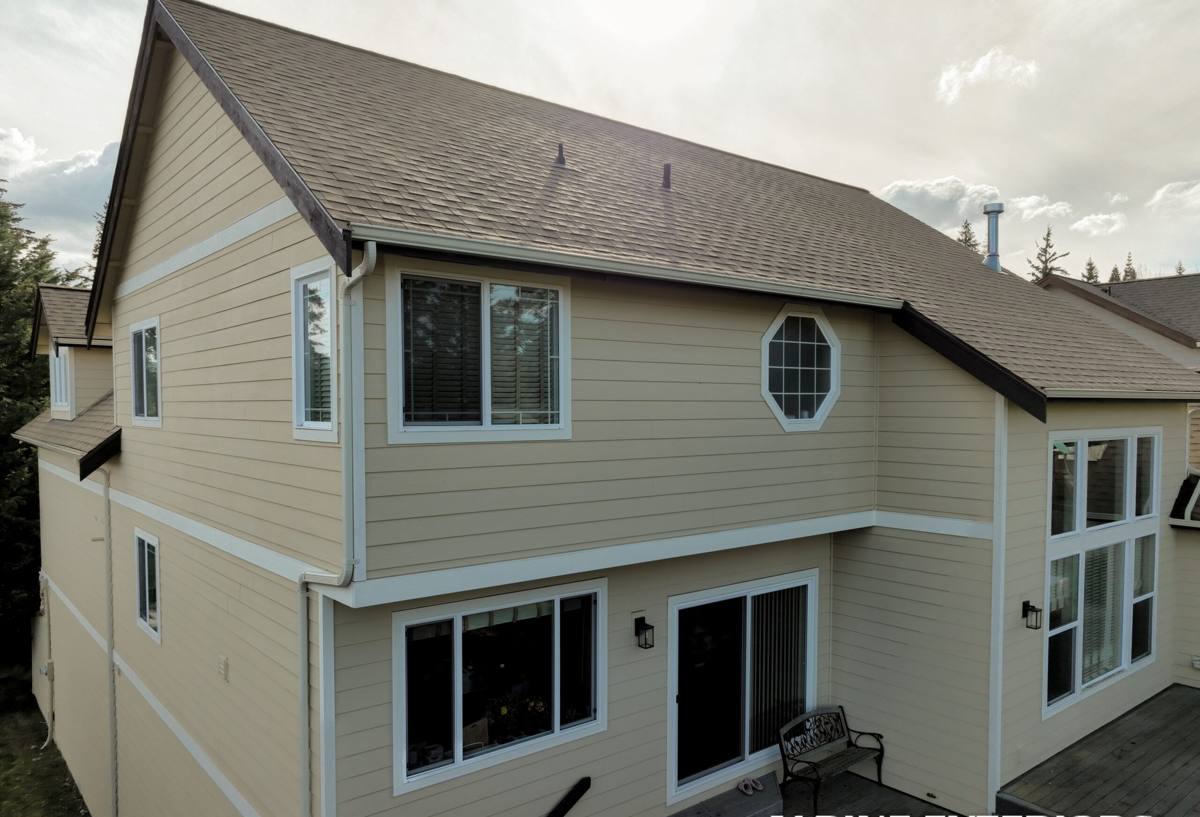
What Bellingham's Climate Does to Siding on a Shaded, Lakeside Lot
Whatcom County sits in a marine climate — damp air moves in off the Pacific and Puget Sound and settles into the valleys and tree cover inland, Sudden Valley included. Add Lake Whatcom's own humidity and the dense tree canopy that shades much of the neighborhood, and you get siding that dries out slower than siding on an open lot even a few miles away. That combination shows up in a few predictable ways:
- Extended moss and algae season. Shade plus moisture means siding surfaces can stay damp for days after a storm, which is exactly what moss and algae need to take hold — especially in north-facing corners and under eaves.
- Driving rain against vertical joints. Board and batten's vertical seams are more exposed to wind-driven rain than horizontal lap siding, so joint design and flashing detail matter more here than on a typical lap job.
- Marine air moisture cycling. Salt-laden, moisture-heavy air off the Sound reaches inland through the county and puts wood, fasteners, and paint film through more expansion-contraction cycling over a year than a drier inland climate would.
- Slower drying after debris buildup. Needle drop and organic debris from surrounding trees collect at trim and butt joints, holding moisture against the siding face longer than a bare wall would experience.
None of this means board and batten is a bad fit for Sudden Valley — it means the product and the install both need to be chosen with this microclimate in mind, not treated the same as a job in a drier, more open part of Bellingham.
Why Board & Batten Is a Strong Match for the Neighborhood — When Done Right
The vertical board-and-batten profile actually has a practical advantage in a wet, shaded setting: the strong vertical lines shed water down and off the wall rather than pooling along a horizontal lap edge. It also tends to show moss growth less obviously than smooth lap siding, since the reveal lines break up the wall visually. Aesthetically, it pairs well with the wooded, cabin-adjacent character a lot of Sudden Valley homes already have, and it works cleanly as an accent on gables and entry features for homeowners who don't want a full board-and-batten exterior.
The catch is that board and batten is less forgiving of installation shortcuts than standard lap siding. Every batten strip creates another seam, another fastening line, and another place where water can find its way behind the cladding if flashing and gapping aren't handled correctly. In a climate that already keeps walls damp longer than average, a marginal installation shows its problems faster here than it would in a drier region.
Board & Batten Material Options and Why We Standardized on One
| Material | How it handles this climate | Long-term consideration |
|---|---|---|
| Solid cedar boards | Attractive natural grain, but absorbs moisture readily; shaded, damp walls accelerate cupping, splitting, and moss growth | Repainting and moisture maintenance on a shorter cycle than most owners expect |
| Vinyl board & batten panels | Sheds water on the face, but seams and end caps can trap moisture behind the panel in shaded, humid conditions; can warp with sun-shade cycling on partially exposed walls | Limited repair options — damaged sections are often replaced, not patched, and color fades with UV exposure |
| Primed engineered wood | Performs reasonably where kept dry, but the wood core is vulnerable if the factory edge seal or field-cut edges aren't fully protected — a real risk with the extra battens and joints this profile requires | Manufacturer moisture warranties are typically conditioned on strict installation and maintenance requirements |
| James Hardie fiber cement | Non-combustible, dimensionally stable core that doesn't swell or rot the way wood-based products can; factory ColorPlus finish is baked on rather than field-applied | Correct installation with a rainscreen gap and proper flashing is still required — the product's durability doesn't replace good technique |
We install James Hardie fiber cement exclusively — we don't offer vinyl, engineered wood, cedar, or other fiber cement brands for board and batten work. That's a deliberate standard, not a sales pitch: in a climate that keeps siding damp longer than most, we'd rather build every Sudden Valley project on a material engineered for moisture exposure and back it with the same product family across every job, so we know exactly how it behaves over 10, 20, and 30 years in this setting.
What Correct James Hardie Board & Batten Installation Actually Involves
Board and batten with Hardie products is typically built one of two ways: vertical HardiePanel with HardieTrim battens fastened over the panel seams, or a reveal-style panel system with battens set to a consistent spacing. Either way, the details that make or break the job in a climate like this are mostly invisible once the siding is up:
- A rainscreen gap behind the panel. A furring strip or drainage mat creates space between the panel and the weather-resistive barrier, so any moisture that gets past the face has somewhere to drain and air movement to dry it out — critical on shaded walls that don't get much direct sun.
- Correct fastener placement and spacing. Hardie specifies fastener location, type, and spacing precisely; getting this wrong at batten lines is one of the most common causes of premature panel movement and cracking.
- Flashing at every horizontal transition. Window heads, trim boards, and any horizontal break in the wall plane need proper flashing so water is directed out and away rather than behind the panel.
- Factory-cut edges kept sealed. Field cuts need to be sealed per Hardie's specification, since an unsealed cut edge is a moisture entry point regardless of how good the rest of the install is.
- Batten spacing that respects expansion. Panels and battens need consistent gapping so the assembly can move slightly with temperature and moisture changes without stressing joints or caulking.
Skipping or rushing any one of these doesn't usually show up as a problem in year one. It shows up in year five or six, as staining, soft spots at the base, or paint failure at the seams — and by then it's a repair job, not a maintenance item.
Our Process for Sudden Valley Projects
1. On-Site Assessment
We walk the property, check existing siding and sheathing condition, note shade patterns and drainage around the foundation, and flag any moisture damage that needs to be addressed before new siding goes on — not covered up by it.
2. Product and Layout Plan
We spec out the Hardie board and batten system, panel and batten spacing, trim details, and ColorPlus color selection based on the home's exposure and how it sits relative to tree cover and prevailing weather.
3. Tear-Off and Substrate Check
Old siding comes off, and we inspect the sheathing underneath for rot or water damage — common on shaded walls that have been trapping moisture for years — and repair before anything new goes up.
4. Rainscreen, Flashing, and Panel Installation
Drainage gap, flashing, panels, and battens go in to Hardie's fastening and clearance specifications, with particular attention to horizontal transitions and any spot where the wall meets trim, trees, or grade.
5. Final Walkthrough
We review the finished work with the homeowner, confirm seams and caulking are clean, and go over basic care specific to a shaded, wooded lot.
Cost Factors for Sudden Valley Board & Batten Projects
| Factor | Why it affects cost here |
|---|---|
| Existing siding removal | Tear-off and disposal of old cedar, vinyl, or engineered wood adds labor before new siding can start |
| Sheathing repair | Shaded, damp walls more often need rot repair discovered during tear-off than dry, sun-exposed walls |
| Trim and batten complexity | More battens and trim transitions mean more flashing details and labor hours per square foot |
| Site access | Wooded, sloped Sudden Valley lots can require more staging and hand-carrying of material than an open, flat lot |
| Color and finish | Standard ColorPlus color families are typically more economical than premium or custom-matched finishes |
We give exact numbers only after seeing the specific home and wall conditions — broad ranges without an on-site look tend to be more misleading than useful.
Signs Your Sudden Valley Siding Needs Attention Now
- Moss or algae established on more than just the north-facing wall
- Soft or spongy spots when pressed near the base of the wall or below windows
- Paint or finish peeling or bubbling at seams and butt joints
- Visible gaps opening up at batten joints or trim boards
- Staining running down from a specific joint or flashing point after rain
- Siding that stays visibly damp long after the rest of the house has dried
Any one of these on its own isn't necessarily an emergency, but on a shaded Sudden Valley wall they tend to compound faster than homeowners expect, since the drying window between storms is shorter here than in more open parts of Bellingham.
Why Hiring a Crew That Already Works in Sudden Valley Matters
Sudden Valley isn't a neighborhood you can treat like any other Whatcom County address. Lot access, tree cover, and the community's private road network all affect how a siding job gets staged and sequenced, and a crew that's already familiar with the neighborhood plans around that instead of losing time to it. More importantly, a crew that has actually installed and later serviced board and batten siding on shaded, lakeside lots here has seen firsthand which details hold up under this specific moisture pattern and which don't — that's not something a manufacturer's install manual alone teaches you.
If you're weighing board and batten siding for a Sudden Valley home, we're glad to take a look, walk the property, and give you a straightforward, no-pressure estimate based on what your home actually needs.